
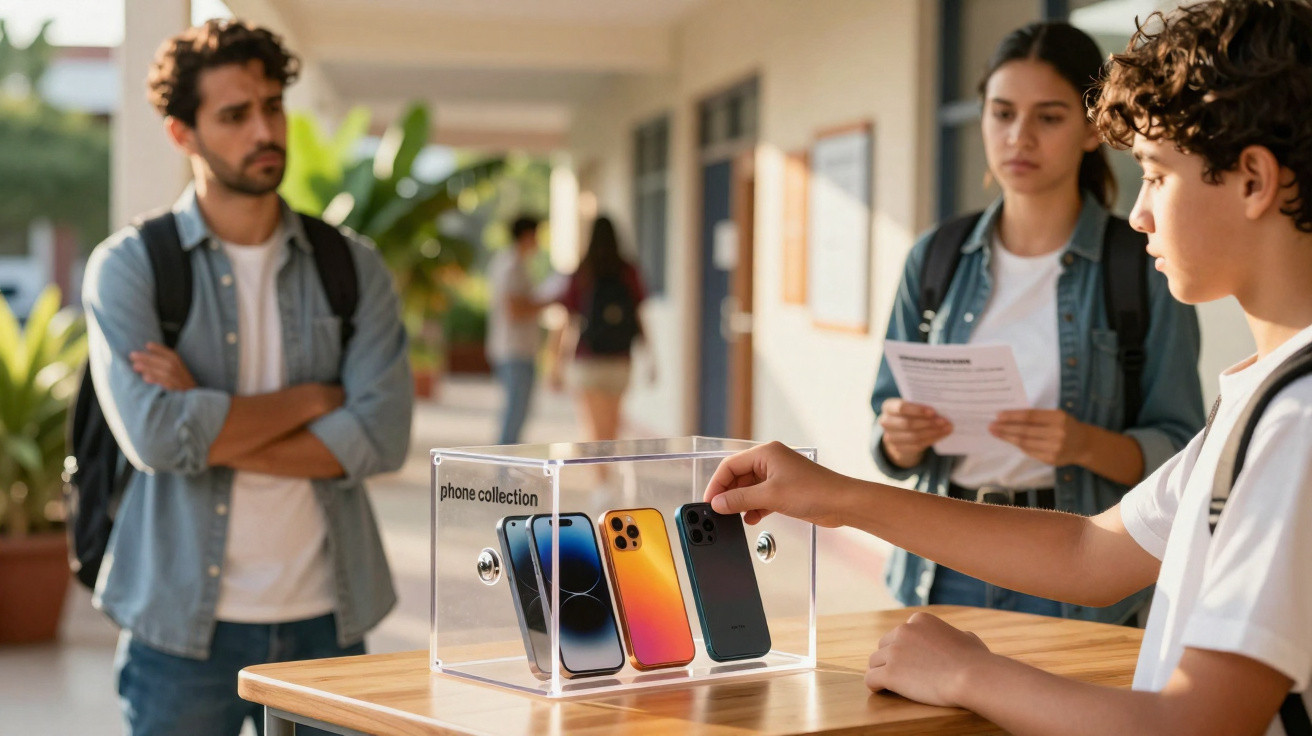
Backpacks remain closed. Nobody is furtively browsing TikTok beneath a desk. At this suburban secondary school, the new policy is straightforward: smartphones are prohibited from the moment pupils enter through the gates until they leave again. Teachers describe it as “liberating”. Some parents describe it as “authoritarian”.
Near the car park, two mothers quietly disagree, their arms folded as they watch the school entrance. One fears for her son’s safety if he cannot message her. The other says her daughter has finally started doing homework again. The headteacher passes by with a slight smile, acting as though nothing has been heard. A policy that can be written in one sentence is dividing families.
The deeper conflict, however, is not simply about phones.
Why a simple rule is ripping parents apart
In an English town, the school newsletter appeared in parents’ inboxes on a wet Tuesday: “From next term, smartphones will be banned on school grounds.” Within hours, that one line had prompted a week of furious WhatsApp exchanges and late-night debates around kitchen tables.
For some parents, the announcement brought immediate relief. Their children had been tired, overstimulated and repeatedly distracted during lessons. Others reacted to precisely the same wording with growing anger. For them, a phone was not merely a device; it was a lifeline - for safety, anxiety and children who find face-to-face communication difficult.
Beneath the policy lay two competing ideas of childhood.
Accounts quickly followed. One mother said her 13-year-old had a meltdown at the prospect of surrendering his phone from 8 a.m. until 3 p.m. “What if something happens?” he repeatedly asked, treating permanent contact like a seatbelt.
Another parent recounted a very different experience. Her daughter, who had previously spent break times in a corner scrolling through Instagram, returned home after one week of the ban and quietly said, “We actually talked today. It was less scary than I thought.”
Teachers said the sound of the corridors had shifted as well. There was less frantic pinging and more real conversation. During the first day or two, some pupils seemed unsure what to do, with their hands lingering near the places where their pockets once buzzed. After that, they began playing football again.
Behind these stories is a harsh attention economy. Schools can see the evidence in classroom-app data and examination results: children lose focus more rapidly and switch their attention dozens of times each hour. Teachers refer to “TikTok brain” - the relentless demand for something different every three seconds.
Parents, meanwhile, see another reality. They see a world that appears less safe than the one in which they were raised: news alerts about incidents at schools, GPS tracking applications and group chats that become active when a child is two minutes late leaving school. For years, they have been told that being “contactable” means being “responsible”.
The smartphone ban runs into both of these realities. It offers the prospect of restored attention spans, quieter classrooms and fewer cyberbullying incidents erupting during lessons. But it also requires parents to accept a new kind of silence during the school day and to trust adults they scarcely know with the people they love most.
How schools make a smartphone ban work without starting a war
At this school, the policy is more than simply “no phones”. It is “no phones that anyone can see, hear, or feel” during the school day. Pupils place their devices in locked pouches or leave them switched off and buried at the bottom of their bags. The focus is not on punishment, but on taking temptation away.
One practical measure helped reassure parents: a clear and obvious procedure for emergencies. The school office number is displayed on every fridge. Parents ring the school, reception contacts the classroom and the teacher brings the child out when necessary. It may be old-fashioned, but it provides everyone with a reassuring contingency plan.
Teachers have also committed to not using their own phones in front of pupils. There is no quick browse beneath the desk while children complete group work. That modest action conveys a powerful point: this is not “do as I say, not as I do”. It is a collective experiment in attention.
The schools that withstand the backlash tend to communicate rather than impose. They hold parent evenings and share straightforward figures: how often a typical teenager checks their phone each day, how sleep deteriorates when phones remain in bedrooms and how concentration changes in classrooms once devices are removed.
They also include pupils in the discussion. Some students agree small compromises, such as being allowed access to their phones only after the final bell, while still on school premises. Others request quiet phone areas near the gate so they can message parents before walking home.
On a personal level, validation can be the most effective response. Staff meet parents’ eyes and say, “We get why you’re scared.” The policy remains unchanged, but the atmosphere in the room changes.
“We’re not banning smartphones because we hate technology,” one headteacher told me. “We’re banning them during school so kids can remember what it feels like to pay attention to one thing at a time.”
Parents who gradually accept the policy often put a modest safety net in place at home:
- A written card in the backpack containing emergency contact details and medical information.
- A clear arrangement for cancelled buses or clubs finishing early.
- Brief, reliable check-in times after school rather than continual messages.
- A shared household rule: no phones during homework time, for children or adults.
Let us be honest: nobody truly manages this every day. Even so, families who achieve it a few times each week often notice a subtle change. Children start coping with minor delays and uncertainty independently, rather than immediately reaching for the glowing rectangle in their pocket.
The bigger question behind the smartphone ban
At first glance, this is a story about school policies, uniforms and confiscated phones. Look more closely and it becomes a story about how much control we are prepared to give algorithms over our children’s minds.
Many parents feel caught between guilt and exhaustion. They understand that their child’s attention is being sold to the highest bidder in Silicon Valley. They also know the feeling of arriving home drained after work and offering a screen simply to secure twenty quiet minutes to prepare dinner.
On a difficult day, that does not feel like poor parenting. It feels like survival.
When a school suddenly announces, “We’re cutting phones out of the school day,” it therefore touches a raw nerve. One set of parents hears a judgement: “You should have done this yourselves.” Another hears support: “You don’t have to fight this alone anymore.” The same policy can have an entirely different emotional effect.
Most of us have experienced looking up from our own phone only to realise that our child has been trying to speak to us for a full minute. The school ban holds that mirror up to adults as well. It quietly asks whether we are prepared to follow the same standards we expect of 13-year-olds.
The most candid parents do not pretend to hold perfect solutions. Instead, they describe small changes: switching off notifications after 8 p.m., leaving phones in the kitchen overnight and allowing children to be bored in the car. It is neither heroic nor tidy; it is inconsistent and deeply human.
Still, it all suggests a broader truth: protecting children’s attention may first require us to protect a little of our own.
| Key point | Detail | Why it matters to the reader |
|---|---|---|
| Why schools ban phones | To reduce distraction, bullying flare-ups and “TikTok brain” in lessons | Helps you understand the reasoning behind a policy that may feel severe |
| Why parents push back | Safety concerns, anxiety and dependence on instant contact throughout the day | Acknowledges your concerns rather than dismissing them as “overprotective” |
| What actually helps children | Clear boundaries, honest communication and parents demonstrating healthier phone habits | Provides realistic actions without suggesting you must be a perfect parent |
FAQ:
- Can schools legally ban smartphones during the day? In many countries, yes. Schools can establish rules governing devices on their premises, provided they communicate the policy clearly and enforce it consistently.
- What if my child has anxiety and needs their phone? Speak to the school about individual arrangements. Some schools permit phones to remain switched off but available from the office for particular medical or mental-health needs.
- Isn’t this avoiding the real problem of teaching self-control? Self-control develops gradually. Removing persistent triggers at school does not replace that work, but it gives children a fair opportunity to practise concentration without a thousand pings.
- How can I support my child if I disagree with the rule? Be honest that you do not support the policy, while making clear that you will help them manage it. Concentrate on practical support: planning their journey home, knowing whom to approach for help at school and creating after-school check-in routines.
- Won’t kids just binge their phones even more after school? Some do initially. In time, many families find that when the after-school period has structure - homework, dinner, then screen time - use becomes less frantic and more intentional.





Comments
No comments yet. Be the first to comment!
Leave a Comment