
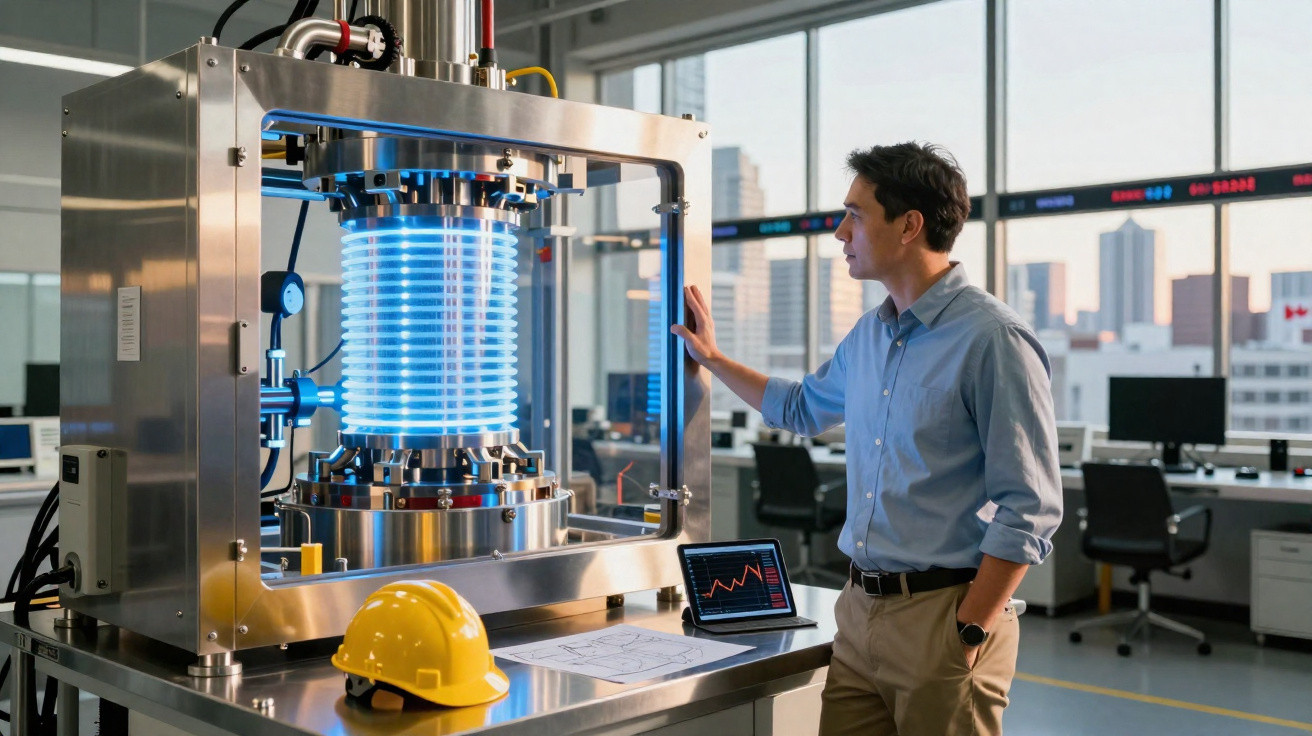
Canada has helped move nuclear fusion beyond laboratory fascination and towards a commercial narrative, supporting a domestic start-up that intends to build power stations using pistons and liquid metal rather than enormous magnets or lasers.
Canada takes fusion to the stock market
General Fusion, a Canadian fusion start-up based in British Columbia, is preparing to become the first publicly listed business devoted exclusively to commercial fusion energy.
The company intends to float through a merger with Spring Valley Acquisition Corp., a US special purpose acquisition company (SPAC). This structure allows General Fusion to enter the stock market by combining with an already listed shell company, instead of following a standard initial public offering.
General Fusion’s deal values the company at around $1 billion and signals that fusion is shifting from long-shot experiment to investable industry.
The deal assigns General Fusion a pro forma value of approximately $1 billion (roughly €850 million). Its funding package includes:
- around €100 million from an oversubscribed private financing round
- close to €220 million in cash already held by the SPAC, provided investors do not withdraw substantial amounts before completion
For Canada, this is not simply a financial novelty. It puts the country near the forefront of a contest increasingly led by US and UK fusion companies, while giving Ottawa a flagship technology story in a sector that could transform the world’s electricity system if it can be scaled.
A fusion machine designed like an engine rather than a science experiment
Moving beyond tokamaks and lasers with pistons and liquid metal
Most fusion programmes use either intense magnetic fields, such as those used by the ITER tokamak in southern France, or vast laser installations, including the US National Ignition Facility. General Fusion has instead chosen a substantially more mechanical route.
Its method, known as magnetized target fusion (MTF), avoids enclosing plasma with multi-storey magnets or striking it with arrays of lasers. Dozens of pistons instead compress a chamber containing circulating liquid metal, usually lithium, around a small volume of magnetized gas heated to extremely high temperatures.
In General Fusion’s concept, pistons slam into a metal sphere of liquid lithium, squeezing a magnetized plasma at the centre to fusion conditions for a fraction of a second.
The liquid-lithium layer performs several functions simultaneously. It protects the reactor’s solid structure against severe neutron bombardment, one of the principal challenges faced by most fusion designs. It also absorbs the heat produced by fusion reactions, which could subsequently power turbines in much the same way as a conventional generating station.
As the wall is liquid and continually renewed, it may avoid some of the degradation problems affecting solid reactor parts. If the design scales as intended, this could make maintenance easier and lower costs.
Lawson Machine 26: General Fusion’s first full-scale demonstrator
The new capital raised through the stock market is intended for one central project: the Lawson Machine 26, or LM26, General Fusion’s first large demonstration system.
General Fusion states that LM26 is already operating and is intended to demonstrate, in stages, that its MTF design can achieve the demanding conditions required for fusion reactions that produce energy. The programme has three principal targets:
- Achieving 1 keV (around 10 million °C) to maintain a basic plasma stably
- Achieving 10 keV (about 100 million °C), at which fusion reactions start happening at useful rates
- Moving towards the Lawson criterion, which brings together temperature, density and confinement time and indicates the threshold at which a reactor could generate more energy than it uses
LM26 has already been constructed at about half the diameter of the commercial reactor envisaged by the company. That scale is significant: engineers are not merely refining small laboratory equipment, but confronting the plumbing, timing, heat management and materials challenges that a future power station would genuinely encounter.
By going big early, General Fusion wants to test both the physics and the day-to-day engineering of a viable fusion power station.
How magnetized target fusion compares
General Fusion’s approach is one of a growing range of fusion concepts, each balancing compromises between complexity, cost and performance.
| Confinement method | Core idea | Typical examples | Main strengths |
|---|
Share this article
Previous article: Why brown rice takes longer to cook and still feels firm
Next article: Experts warn that solar energy must become the only power source on earth and fossil fuel workers are just collateral damage in a necessary energy war
Ryan Holloway
Related posts
Farewell to induction hobs from 2026 as the gas flame makes a fie ...
16 February 2026
Psychology says people who still write to-do lists by hand rather ...
16 February 2026
Say goodbye to the sofa bed as Ikea unveils a smart new solution ...
16 February 2026
Leave a reply
Cancel reply
Your email address will not be published. Required fields are marked *
Comment
Name *
Email *
Website
Save my name, email and website in this browser for the next time I comment.
Copyright © 2026 Vetromebel.com






Comments
No comments yet. Be the first to comment!
Leave a Comment