
Far out in the Atlantic, a specialist vessel is working to bring a largely forgotten backbone of the early internet up from several thousand metres below the surface. The transatlantic fibre-optic cable TAT‑8, installed in the late 1980s and decommissioned long ago, is being lifted from the seabed to make way for the next generation of global data highways.
How a fibre-optic cable transformed the Atlantic
When TAT‑8 entered service on 14 December 1988, it represented a decisive break with previous technology. For the first time, a transatlantic submarine cable linked North America and Europe using fibre optics rather than copper conductors, with pulses of light carrying the data.
The cable was built and laid by a consortium centred on AT&T, British Telecom and France Telecom. The concept was to replace electrical signals with optical pulses, which could transmit far more information simultaneously. At the time, this seemed almost futuristic.
To highlight the symbolic importance of the launch, a special event was arranged: science-fiction author Isaac Asimov spoke from New York to audiences in Paris and London via video conference. He described it as a “journey across the sea on a beam of light” – an image that captured the new era remarkably well.
The first fibre-optic cable across the Atlantic demonstrated just how much more data could be carried by light than by copper – and it reached capacity faster than anyone had expected.
Just a year and a half after going live, TAT‑8 had already reached capacity. At the time, that congestion was seen as proof of the immense demand for fast international data transmission. The cable became a model for the hundreds of further fibre-optic cables that followed and now form the backbone of the global network.
From technology pioneer to decommissioned relic
Technology ages, and TAT‑8 was no exception despite its pioneering role. Faults became more frequent after several years, while maintenance and repairs grew more expensive as far more powerful newer cables entered service alongside it.
TAT‑8 was taken out of service in 2002. Data traffic had long since moved to newer connections, while the former prestige project was simply left on the seabed. A symbol of future technology had become a piece of submerged industrial history.
That history is now receiving a final chapter: specialists are recovering the cable from the depths section by section. They are not doing so for nostalgic reasons, but for very specific commercial and strategic purposes.
Heavy work at sea: recovering a deep-sea cable
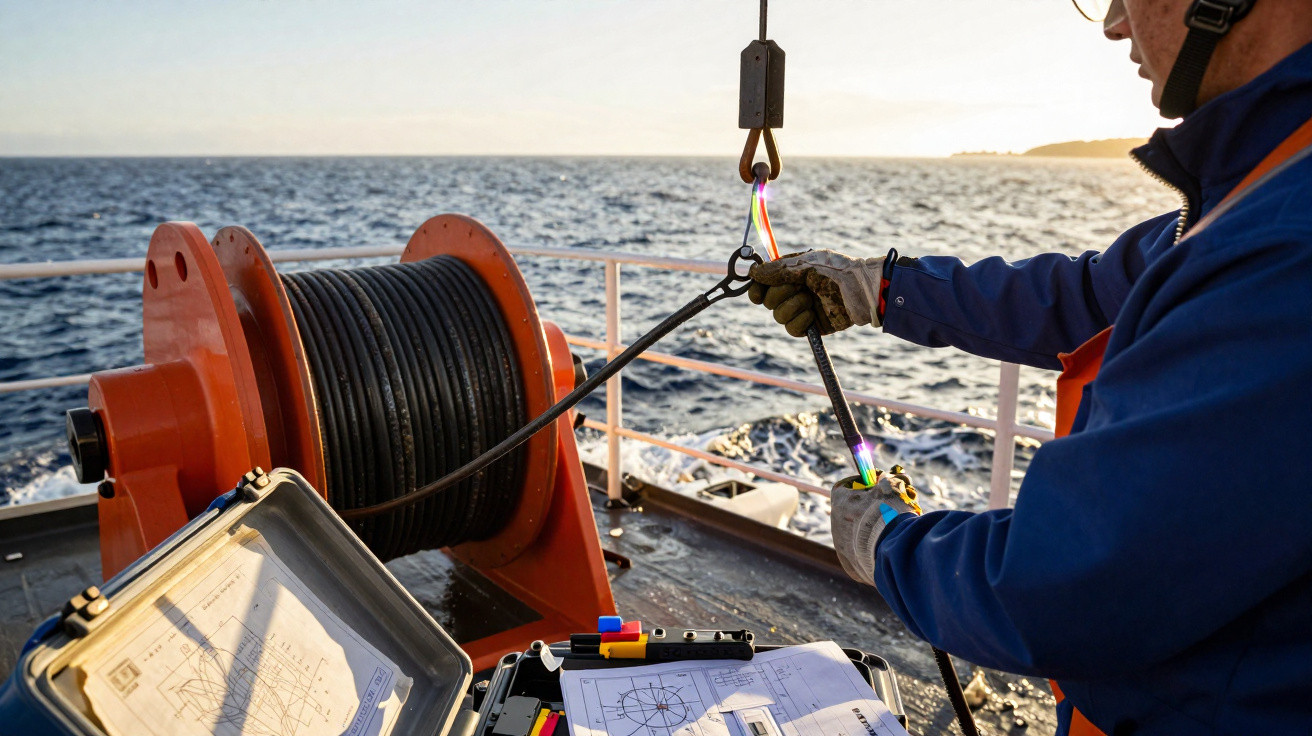
Retrieving a cable from several thousand metres down cannot be done with an ordinary crane. The working vessel – in this case the cargo ship “MV Maasvliet” – must first establish the route’s precise position. Modern nautical charts and survey data assist, but experience and accuracy are ultimately crucial.
The process may look unremarkable, but it is exceptionally demanding:
- Locating the cable route using old plans and current sonar data
- Deploying specialist grapnels designed to catch the cable on the seabed
- Hauling up the line slowly while the vessel continually corrects its position
- Bringing it aboard and winding it manually to avoid damaging the optical fibres
The operation is governed by the weather. Heavy seas or storms can make the forces acting on the cable so unpredictable that the line could snap or equipment could be damaged. Meteorologists reported an unusually early cyclone season for the current mission, and the vessel has already had to alter its route.
Every metre of cable that emerges from the depths has “seen” decades of digital history – and is now secured by hand onto the reel on deck.
The old material presents another difficulty: it is no longer in perfect condition. Corrosion, material fatigue and past damage from anchors or fishing activity all complicate recovery. Technicians therefore allow substantial margins in the pulling force and deliberately work slowly rather than too quickly.
A resource trove from the depths: why the recovery is worthwhile
This effort is not solely about maritime history; its main purpose is materials recovery. Fibre-optic cables also contain considerable quantities of high-value metals. Copper is particularly sought after, as it is found in numerous layers and components of the construction.
The International Energy Agency has for some time warned of a potential copper shortage in the coming decades. Global expansion of electricity grids, electric cars and renewable energy is increasing demand. Recoverable submarine cables therefore suddenly look less like waste and more like an attractive source of raw materials.
Three main groups of materials from recycled TAT‑8 are intended for reuse:
| Material | Use after recycling |
|---|---|
| Copper | Conductors in cables, electronics, energy infrastructure |
| Steel | Reinforcement elements in new lines, construction industry |
| Polyethylene sheath | Recycled plastic for industrial products and packaging |
In particular, the steel armour and plastic outer covering can be recycled much more efficiently using today’s processes than they could in the early 2000s. The optical fibres themselves play a more limited role in recovery, as they are less economically significant than the metals.
The invisible backbone: why submarine cables remain essential despite satellites
When people hear the word “internet”, they often think of Wi-Fi routers and 5G masts. Yet almost all data travelling between continents moves through cables beneath the sea. Experts estimate that more than 95 per cent of intercontinental data traffic passes through such connections.
Satellites have made progress in recent years. Projects involving thousands of small satellites provide internet access even in remote areas. However, submarine cables remain the first choice for enormous volumes of data travelling between North America, Europe and Asia. They offer:
- substantially greater capacity per connection
- more consistent latency for real-time applications
- lower costs for each gigabyte transmitted
The network on the seabed is correspondingly dense: hundreds of thousands of kilometres of active fibre-optic cables currently run through the world’s oceans. At the same time, an estimated 2 million kilometres of decommissioned lines lie in the deep, most of them still untouched.
The recovery of TAT‑8 therefore represents a broader trend. Old connections are not simply left behind; they give way to newer cables offering more bandwidth while using more economical materials. At the same time, a new business sector is emerging around recovering valuable raw materials from deep-sea “scrap”.
What TAT‑8 reveals about our digital future
The cable’s story illustrates how rapidly communications networks evolve. What was viewed as a technical marvel in the late 1980s would no longer be enough even for a small town today. Yet this first fibre-optic cable also paved the way for streaming, video conferencing and cloud services.
For network operators, every additional percentage point of capacity now matters. Modern transatlantic connections combine hundreds of fibre pairs, transmit data using new modulation techniques and can be continuously upgraded while in operation. Such systems do not emerge in isolation; they often follow the corridors already established by older cables such as TAT‑8.
For anyone who regularly encounters the phrase “data highways”, this project offers a tangible picture: the seabed does not contain an abstract network, but a very real tangle of metre-thick, steel-armoured conduits that support the digital economies of entire continents.
Experts expect even more activity at sea in future. New cables designed specifically for cloud providers and streaming companies are replacing older lines with limited capacity. At the same time, pressure is increasing to avoid simply leaving obsolete routes to decay, instead removing and processing them in a structured way.
What non-specialists often underestimate about fibre-optic cables
When a fibre connection is installed at home, it is usually visible only as a slim cable in the wall. A transatlantic cable, by contrast, resembles a steel rope as thick as an arm. It contains:
- several optical fibres at its centre, each as thin as a hair
- copper around them to power amplifiers along the cable
- multiple protective layers against pressure, corrosion and animal damage
- heavy steel armouring near the coast, where anchors and fishing nets pose a risk
The actual data technology is housed in stations on land. There, systems amplify and combine the optical signals before they begin their journey across the ocean. Within the cable, devices known as repeaters at regular intervals ensure that the light signal does not weaken too greatly.
This combination of high technology and heavy industry makes submarine cables an exciting but often overlooked part of our infrastructure. The recovery of TAT‑8 vividly demonstrates how much steel, copper and engineering expertise are involved in every international video connection.





Comments
No comments yet. Be the first to comment!
Leave a Comment