
Once the last flowers have fallen, an orchid can sometimes look worn out. A few carefully chosen adjustments may nevertheless restart its natural cycle.
An orchid with no blooms is not necessarily unhealthy. For the indoor varieties most commonly sold, the resting period can last several months. The leaves remain green and the roots stay alive, yet the flower spike stops producing anything. This is often when care mistakes start to build up: too much water, excessive fertiliser, an overly sunny window or a pot that holds on to moisture.
A plant that needs time between flowering periods
The orchid given as a gift is usually a variety suited to life in a flat or house. It enjoys bright conditions but dislikes direct sunlight. It also requires alternating growing and resting phases in order to prepare fresh buds.
Flowering may return every year when conditions remain consistent. Some plants even bloom twice within twelve months. Conversely, an orchid kept too close to a radiator or watered before its roots have dried can go a long time without producing flowers.
“An orchid with firm leaves and healthy roots is not beyond saving simply because it no longer blooms: it is often waiting for better conditions before starting again.”
Six steps that encourage orchids to flower again
1. Check the roots before watering
A timetable is less dependable than the condition of the roots. In a transparent pot, they offer a particularly clear indication: green roots still hold moisture. When they turn grey or silvery, watering may be needed.
Soaking is still a straightforward method. Put the pot into a container of low-limescale water for around ten minutes, then allow it to drain completely. Water must never be left standing in the bottom of the decorative pot or saucer.
- Ideally, use clean rainwater, filtered water or water with a low limescale content.
- Water the growing medium and roots rather than the flowers.
- Do not leave water in the centre of the leaves, where it can trigger the onset of rot.
- Adjust how often you water according to the season and the temperature indoors.
2. Place the orchid in gentle light
An orchid needs brightness to develop a new flower spike, but a sun-facing glazed door or window can scorch its leaves within hours. A spot close to a bright window, screened by a sheer curtain, is often ideal.
The leaves provide another useful sign. Very dark green foliage may point to insufficient light. Yellow, brown or bleached patches can instead signal excessive exposure. Turning the pot slightly from time to time helps the plant grow more evenly.
3. Create a small drop in temperature at night
The constant warmth of homes does not always prompt a new flowering stem to form. Keeping the plant for a few weeks in a slightly cooler room can help restart its cycle. Night-time temperatures of around 15 to 18°C are often welcomed, provided cold draughts are avoided.
In late summer or early autumn, a bright windowsill in a lightly heated room may be enough. The aim is not to expose the orchid to cold, but to give it a moderate difference between daytime and night-time temperatures.
“A slight fall in temperature for a few weeks can signal to the orchid that a new season is beginning.”
4. Prune the stem according to its condition
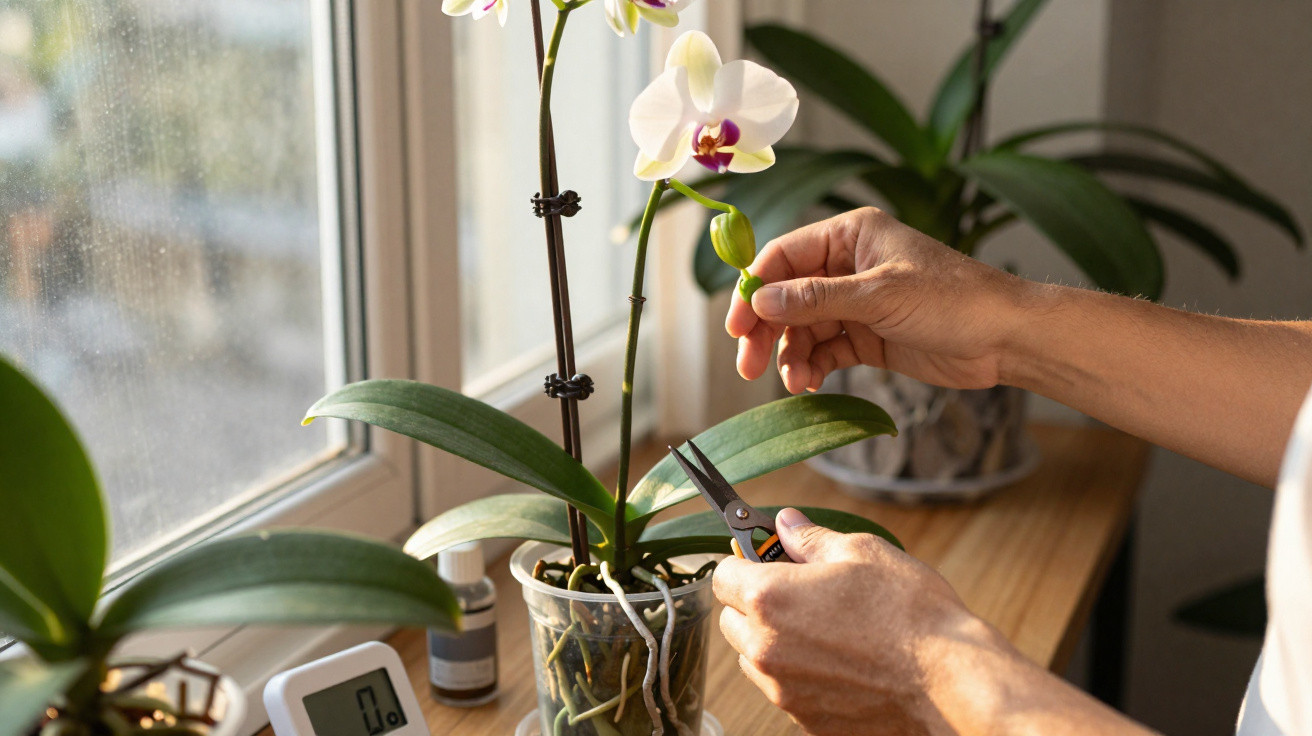
Once flowering has ended, inspect the flower spike closely. If it is still green, it can be cut just above a node, the small swollen area found along the stem. A new shoot may then emerge from that point.
If the spike has become dry, brown or hollow, it is better to cut it close to the base using a clean tool. This prevents the plant from using energy to maintain a stem that will not grow again. Also remove dried flowers that have fallen into the pot and any completely damaged leaves.
5. Repot when the growing medium breaks down
Ordinary compost is unsuitable for an orchid. Its roots need air and grow in a highly free-draining mix made mainly of bark. Over time, this growing medium compacts, decomposes and retains moisture for too long.
Repotting every two or three years is generally enough. Do this after flowering, never while the plant is still carrying buds. Select a pot only slightly larger than the previous one: an oversized container retains too much water and slows drying.
- Gently lift the plant from its pot.
- Remove old pieces of bark stuck to the roots.
- Cut away black, soft or dried-out roots using disinfected scissors.
- Put the orchid back into a specialist bark-based mix.
- Wait a few days before giving it its first thorough watering.
6. Feed without overdoing it
A potted orchid has limited reserves. During its growing period, a suitable fertiliser feed can support the production of new leaves and strong roots. Caution is still essential: too much fertiliser burns roots and can prevent flowering.
A heavily diluted specialist orchid fertiliser is generally used after watering or added to the soaking water. It is preferable to give a small amount regularly during growth rather than one large dose at once. Homemade mixtures made from food leftovers are sometimes promoted, but they ferment quickly and may attract insects into the pot.
Mistakes that often explain why flowers are absent
The first trap is treating an orchid like an ordinary leafy houseplant. It cannot tolerate roots that remain wet all the time. An opaque pot inside a closed decorative pot often conceals the issue until the roots start turning black.
Another common mistake involves misting. Lightly increasing humidity around the plant can help in a very dry home, but heavily spraying the leaves or flowers every day encourages disease. Standing water between the leaves is especially hazardous.
| Observed sign | Possible cause | Helpful response |
|---|---|---|
| Brown, soft roots | Too much water | Let the plant dry and remove damaged parts |
| Leaves yellowing in patches | Direct sunlight | Move the plant slightly away from the glass |
| Very dark leaves | Lack of light | Choose a brighter position |
| No new flower spike | Constant warmth or insufficient rest | Create a slight temperature difference |
A flower spike does not appear overnight
After being moved, repotted or pruned, an orchid may take several weeks to show signs of recovery. A green tip emerging between the leaves often indicates a new root. A flower spike is usually thinner and more rigid, with small bumps along its length.
Patience is part of orchid care. Keeping the leaves in good condition, monitoring the roots and avoiding sudden changes give the plant its best chance of flowering again. A well-cared-for orchid can remain in a home for several years, with successive flowering periods sometimes far removed from the date it was given as a gift.




Comments
No comments yet. Be the first to comment!
Leave a Comment