
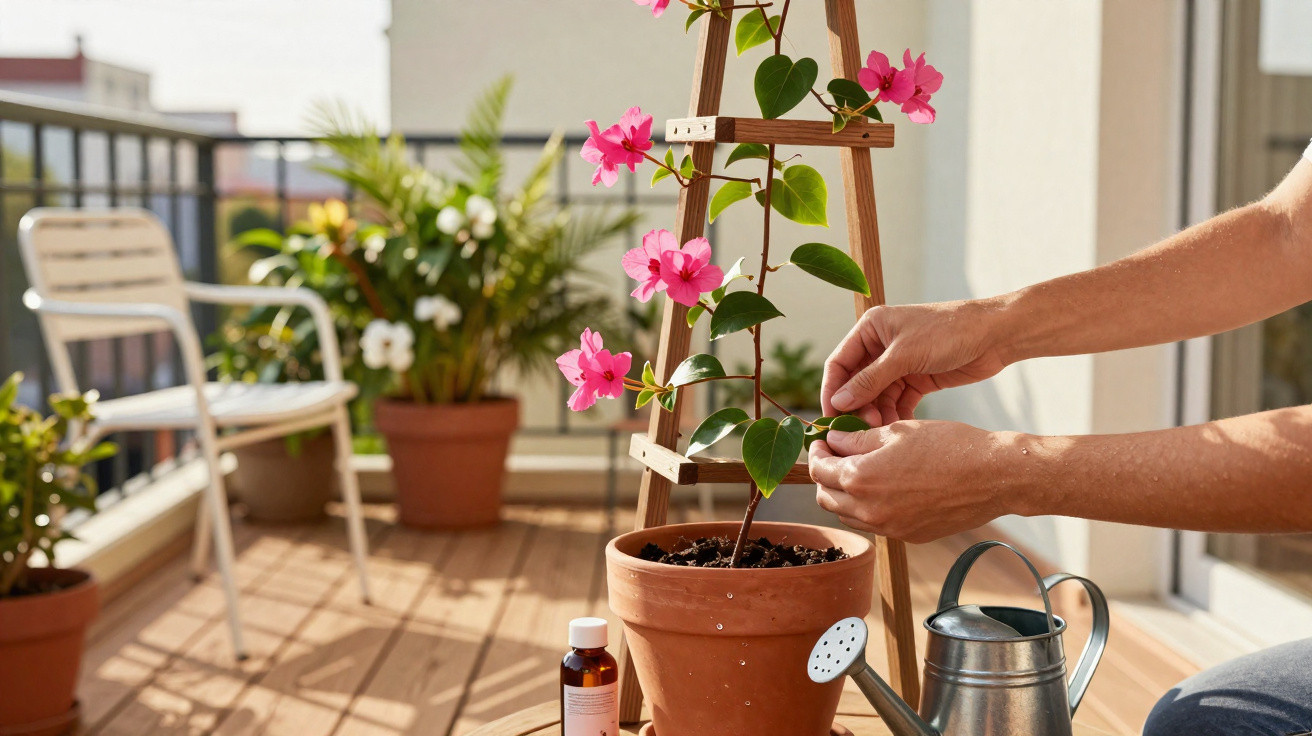
When planters are filled with the same flowers every spring, mandevilla offers a more vertical and more abundant alternative. Native to warm climates, this plant enjoys sunshine, copes reasonably well with dry spells and can bloom for much of the warmer season. Provided a few straightforward rules are followed, it quickly dresses a railing, trellis or a slightly bare corner of the patio.
A climbing plant with real presence
Also sometimes sold as dipladenia, mandevilla is recognisable by its dark green, thick, slightly glossy foliage. Depending on the variety, its trumpet-shaped blooms come in red, pink, white, fuchsia or bicoloured shades. They stand out especially well against a pale wall, wooden fence or lighter foliage.
Its greatest strength is its flowering pace. Placed in the right spot, it can begin blooming in spring and continue until the first cold spells of autumn. It will not climb a wall unaided: initially, its stems need to be trained. Once tied to a support, they quickly gain size.
Mandevilla combines long-lasting flowering, dense foliage and good heat tolerance: three qualities sought after for planting up a sunny space.
Choosing the right spot as warmer weather returns
This plant thrives in bright light. A south-, south-east- or west-facing position suits it very well, particularly in areas with moderate summers. In northern France, a wall that releases warmth late in the day can make all the difference. Conversely, a permanently shaded location significantly reduces the number of flowers.
Spring is the right time to plant it, once the risk of frost has passed. In a pot, this can still be done from April in many areas, provided the plant is protected if a cold night is forecast. In the ground, it is better to wait until the soil has warmed up.
A support makes all the difference
Mandevilla works well in several settings:
- at the base of a trellis fixed to a sunny wall;
- in a large planter with a small metal frame;
- along a balcony balustrade, using soft ties;
- close to a pergola, to create a light flowering screen;
- in the centre of a border, alongside plants with silvery foliage.
On a balcony, choose a container that is both sufficiently deep and stable. Wind can dry out the root ball and weaken the stems. A pot with drainage holes, measuring at least 30 to 40 centimetres across for a young plant, will give the roots more room.
Watering mandevilla without drowning the roots
Mandevilla likes growing medium that remains fresh, but it cannot tolerate standing water. This is the most common point requiring attention. A saucer left full after watering, or a pot without drainage holes, can suffocate the roots and then cause the leaves to turn yellow.
Compost for flowering plants, made lighter with a little drainage material, is generally enough. Clay pebbles at the bottom of the pot may help, but they are no substitute for a drainage hole. In hot weather, check the compost with a finger: if the top two centimetres are dry, it is time to water.
The plant copes better with a brief, slight lack of water than with lasting excess moisture around its roots.
In summer, regular watering is still needed to maintain plentiful flowering, especially for plants in pots. It is best to water early in the morning or in the evening, directly at the base. Wetting the flowers serves little purpose and may damage them in very strong sunshine.
A little fertiliser to extend flowering
Mandevilla is hungry when it flowers for a long period. From May to September, applying liquid fertiliser for flowering plants roughly every two to three weeks can encourage new buds to form. Follow the dosage stated on the product: too much fertiliser can sometimes promote leaves at the expense of flowers.
Removing spent blooms improves the plant’s overall appearance, although this is not as essential as it is for some annual species. Lightly pruning stems that have grown too long also helps maintain a balanced shape. Secateurs should be clean to avoid spreading disease.
Which form to choose for your space
| Type of mandevilla | Recommended use | Desired effect |
|---|---|---|
| Vigorous climbing variety | Pergola, trellis, fence | Flowering screen and height |
| Compact variety | Balcony, small patio, planter | Dense, space-saving habit |
| White-flowered variety | Dark wall or colourful furniture | Bright contrast |
| Pink or red variety | Full-sun border | Warm, colourful atmosphere |
A perennial that needs a proper winter strategy
Mandevilla is a perennial, but it does not withstand severe frost. In the mildest Mediterranean areas, some plants can remain outside with good protection. In most French regions, the pot should be moved to a bright, frost-free space as soon as night-time temperatures consistently approach 8 to 10 °C.
A lightly heated conservatory, bright greenhouse or light room at around 10 to 15 °C is suitable. During this resting period, watering should become very infrequent. The root ball should not be allowed to dry out completely for weeks, but water applications must be greatly reduced.
The plant may lose some of its leaves over winter. This does not necessarily mean it is dying. As brighter light and milder temperatures return, moderate pruning of the stems and a gradual return to watering will encourage fresh growth.
Simple pairings to enhance the exotic effect
To prevent the display from becoming overly busy, mandevilla can be combined with plants of contrasting forms. Ornamental grasses in pots add movement. Purple-leaved morning glories highlight pale flowers. Lantanas, verbenas or trailing petunias complete a composition designed for very sunny conditions.
Aphids, whiteflies and scale insects should also be watched for, particularly when the plant is overwintered indoors. Regular checks beneath the leaves make it possible to act early. At the start of an infestation, a gentle spray of water or cleaning with very diluted black soap is often sufficient.
With a sturdy support, sunshine and measured watering, this climber turns an ordinary outdoor corner into a flowering display for many months. Above all, it offers a lasting solution for those who want to retain colour without replacing all their planting every season.



Comments
No comments yet. Be the first to comment!
Leave a Comment