
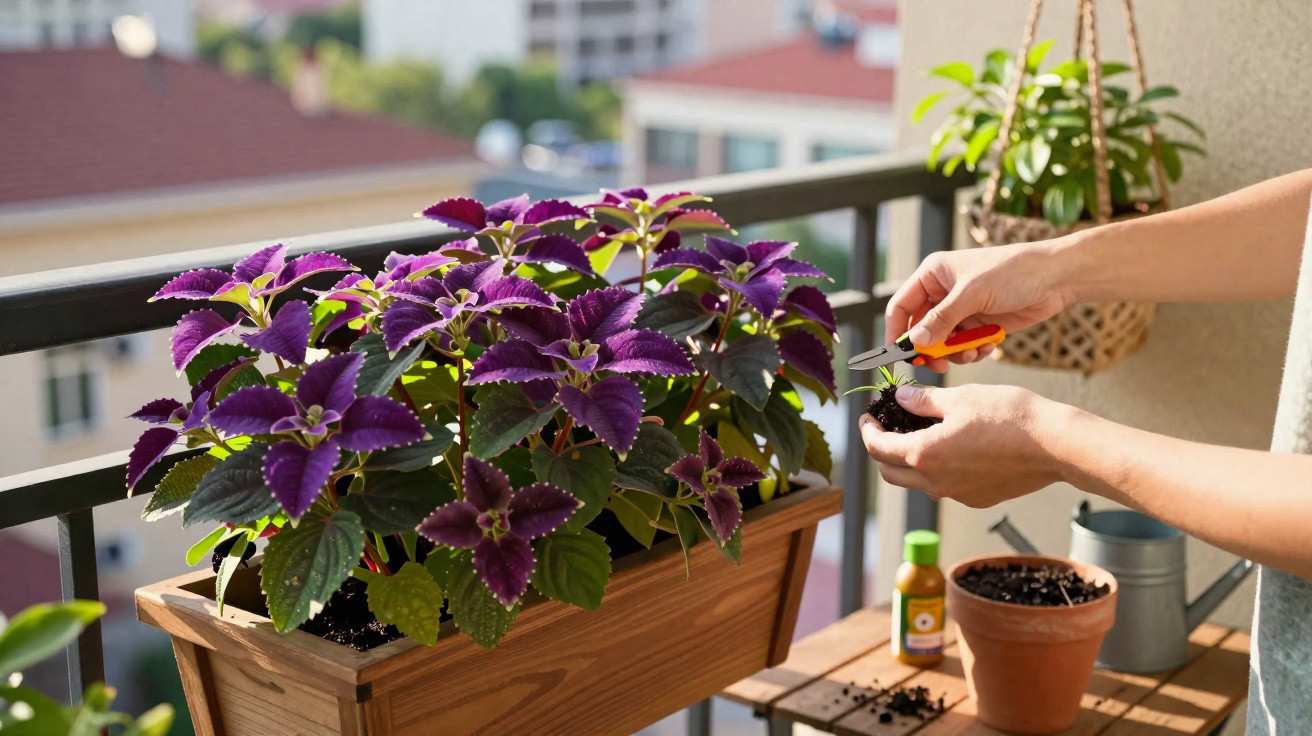
While geraniums, petunias and fuchsias start to fade in August, one relatively little-known plant is only just getting going: Plectranthus ‘Magic Mona Purple’, often sold as ‘Mona Lavender’. Native to South Africa, it grows in a compact habit, thrives on partially shaded balconies and turns plain hanging baskets into dense spheres of purple flowers when most summer bedding plants have long since given up.
Why this purple perennial transforms balcony planters
Most traditional balcony plants are seasonal performers: lush in May, tired by August and finished in September. This is particularly true in planters and hanging baskets, where compost dries out and overheats quickly. That is exactly where Plectranthus ‘Magic Mona Purple’ comes in.
“This perennial densely fills planters and hanging baskets, beginning its main floral display only when many other plants are already fading.”
The plant develops an upright, bushy shape. Depending on its care and pot size, it reaches around 60 to 70 centimetres in height and about the same in width. Rather than producing long trailing shoots, it forms a dense, rounded cushion-like bush that fills the entire container. This makes it ideal for taller hanging baskets, railing-height balcony planters and larger pots.
Its foliage is especially striking: dark green on the upper surface and distinctly purple underneath. This two-tone look remains eye-catching even before flowers appear. For this reason, many gardeners deliberately use it as a foliage plant in shaded corners too.
Autumn flower display instead of late-summer disappointment
Its real advantage is that its main flowering season falls in autumn. When geraniums and petunias have already been deadheaded and are half dried out, Plectranthus ‘Magic Mona Purple’ produces long, slender flower spikes in vivid purple. Rising clearly above the foliage, they create a bold contrast against the dark green leaves.
The flowers are rich in nectar and attract bees and other pollinators, provided temperatures still allow it. Anyone looking to make their balcony more wildlife-friendly will therefore find a plant that is not only attractive but also provides food.
- Flowering period: mainly late summer to autumn
- Flower colour: purple in long, airy spikes
- Foliage: dark green, purple underneath, slightly glossy
- Height: around 60–70 cm, compact and bushy
The right position: partial shade rather than blazing sun
Plectranthus ‘Magic Mona Purple’ originates from frost-free parts of South Africa. There, it grows in relatively sheltered, partially shaded positions. It is therefore particularly well suited to balconies that are challenging for classic sun-lovers such as geraniums.
“A bright position without full sun is ideal – for example, an east- or north-facing balcony, or an area beneath a roof overhang.”
It does not cope well with direct midday sun in high summer. The leaves may scorch, while the compost dries out too rapidly. If you only have a south-facing balcony, it is essential to provide shade, perhaps with taller plants positioned in front or with a sunshade.
Temperatures and winter suitability
In mild, almost frost-free regions of the world, Plectranthus grows as a true perennial that can remain outdoors permanently. In central Europe, however, it is sensitive to frost and should be treated as a container-grown, non-hardy perennial.
- Outdoor growing period: roughly May to October, once night frosts are no longer expected
- Frost limit: around 0 °C; ideally, bring it indoors before this point
- Overwintering: bright, frost-free, relatively cool, with reduced watering
Many amateur gardeners give the plant a “double life”: a lush balcony or patio plant in summer, followed by a decorative houseplant on a bright windowsill in winter.
Planting Plectranthus ‘Magic Mona Purple’ in hanging baskets and pots
For a successful start, the main requirement is a suitable container with good drainage. This perennial dislikes waterlogging intensely, as waterlogged roots can quickly rot.
- Choose a container: Use a hanging basket, hanging planter or pot with several drainage holes.
- Add a drainage layer: Place expanded clay pellets or coarse gravel in the base, for example.
- Mix the growing medium: Combine quality multi-purpose compost with a little compost and a loose, free-draining addition such as expanded clay or perlite.
- Set in the plant: Water the root ball thoroughly, then plant it at the same depth as it was in its nursery pot.
- Water in: Moisten the compost without soaking it completely.
One plant per hanging basket is generally sufficient, since it branches quickly and gradually fills all available space. In larger containers, two or three plants can be used, possibly combined with understated companions such as white-flowering bacopa or delicate ornamental grasses.
Everyday care: less demanding than petunias and similar plants
Anyone who has grown petunias or fuchsias will know the routine: frequent watering, plenty of feed and continual deadheading. By comparison, Plectranthus ‘Magic Mona Purple’ is pleasantly undemanding.
Watering and feeding
The root ball should remain evenly, lightly moist, but never saturated. Compost in hanging baskets dries out faster, so daily watering is often necessary during hot spells; on cooler days, less is usually enough.
“It is better to water small amounts more often than to completely flood the pot at irregular intervals.”
Applying a liquid fertiliser for flowering plants every fortnight during the growing season encourages vigour and abundant flowering. If controlled-release fertiliser is mixed into the compost, the intervals can be extended.
Pruning and shape
The perennial branches well naturally, but benefits from occasional pinching out: lightly cutting back shoot tips in spring and after the main flowering period keeps its growth compact and encourages even more side shoots. This produces a consistently dense, rounded bush in a hanging basket, without bare patches.
How to keep the plant for years and propagate it easily
Although it is not hardy, there is no need to buy a new plant every year. By thinking ahead about overwintering and perhaps taking cuttings, you can build up your own small Plectranthus collection.
Overwintering indoors
Before the first frost is expected, move the pot indoors or into an unheated, bright stairwell. A temperature range of 5 to 15 degrees is ideal. In warm living rooms, the plant will continue growing, but may become slightly leggy, producing longer and softer shoots. This can be corrected with a firm cutback in spring.
Water sparingly through winter, giving only enough to prevent the root ball from drying out completely. Feeding is unnecessary at this time.
Taking cuttings: new plants for free
Plectranthus ‘Magic Mona Purple’ is very easy to propagate from tip cuttings. A well-grown parent plant can quickly provide several young plants.
- Cut shoot tips around 8–10 centimetres long
- Remove the lower leaves, leaving only 2–3 leaves at the top
- Insert the cuttings into seed compost or loose multi-purpose compost
- Keep the growing medium lightly moist, but do not make it waterlogged
- Place somewhere warm and bright, away from direct midday sun
After a few weeks, roots will have formed and the young plants can be moved into individual pots. This provides an inexpensive, long-lasting way to green up shaded balcony areas.
Who will benefit most from Plectranthus ‘Magic Mona Purple’
This purple perennial is especially worthwhile for amateur gardeners who have had little success with traditional sunny-balcony plants or who want to brighten shadier spaces. It is also usually a good choice for people with busy working lives who cannot manage an evening watering round every day, provided the position is not too hot.
It is equally appealing to anyone wishing to plant their balcony in a more wildlife-focused way. Its late flowering period fills a gap in the food supply for pollinators, which is particularly valuable in urban areas.
Those who enjoy combining plants can mix Plectranthus with other late-summer performers, such as white autumn asters in pots, ornamental grasses or colour-coordinated coral bells. This creates container displays that remain attractive well into October, without requiring a daily care schedule.





Comments
No comments yet. Be the first to comment!
Leave a Comment