
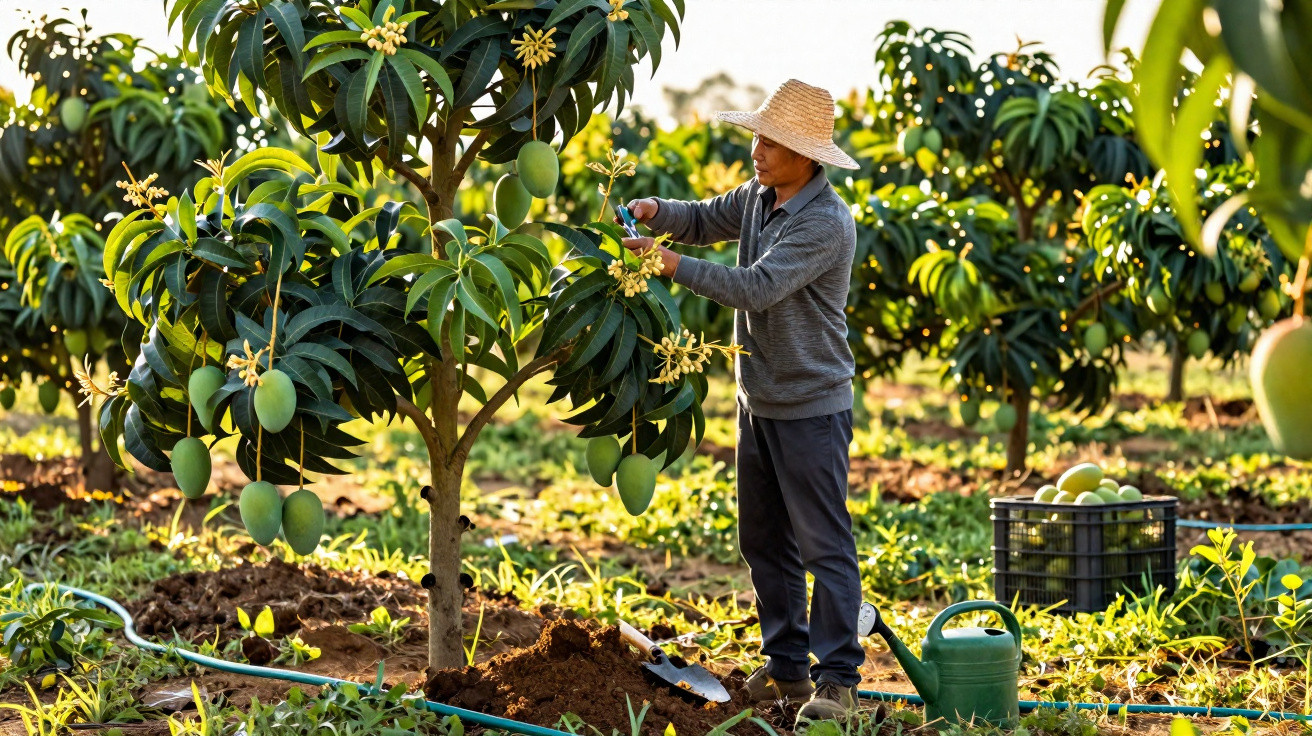
August is a crucial time for many mango trees, although the right care depends on the region and the tree’s growth stage. Across much of Brazil, trees may be undergoing floral induction, flowering or beginning to set fruit. At this point, heavy pruning and an excessive nitrogen feed can harm production. The priority is to inspect the canopy, protect the flowers, provide balanced nutrition and postpone renewal pruning until after harvesting.
Why is August important for mango production?
Cooler weather and drier spells can slow vegetative growth and encourage the mango tree’s natural flowering. In Brazil’s north-eastern semi-arid region, for instance, natural flowering can be particularly strong from June to August. Elsewhere, the timing changes according to temperatures, rainfall, cultivar and growing conditions.
Therefore, a tree carrying plenty of flower panicles in August is already determining part of its next crop. The aim at this stage is not to trigger a flush of new leaves, but to retain the productive framework and limit anything that could hinder fruit set.
- Check whether the canopy has flowers or emerging panicles;
- Avoid severe pruning while the tree is in flower;
- Do not overuse nitrogen-rich fertilisers;
- Keep the soil mulched, without allowing organic matter to touch the trunk;
- Monitor flowers for pests and diseases.
Should a mango tree be pruned in August?
If it is flowering or setting fruit, August is generally not the right time for intensive production pruning. This work is usually carried out after harvest, removing dead, diseased and poorly positioned branches, as well as growth that makes the canopy too tall or dense. Post-harvest pruning also encourages shoots that will develop into the branches needed for the following production cycle.
How should fertiliser be applied before the next crop?
The appropriate amount depends on the soil, the size of the tree and the nutrients already available to it. A mature mango tree should not simply be given large quantities of fertiliser because flowering is approaching. Too much nitrogen can promote leafy vegetative growth precisely when mature, productive branches are needed.
More accurate management relies on soil testing and, in technically managed orchards, leaf analysis. Potassium, nitrogen, phosphorus, calcium, magnesium and micronutrients all contribute to plant development, but they must be supplied in balance.
- Avoid applying excessive fertiliser without knowing what the soil requires;
- Where appropriate, spread fertiliser beneath the canopy’s drip line;
- Do not pile fertiliser close to the trunk;
- Use well-rotted organic matter where it forms part of the management plan;
- Favour balanced nutrition rather than recipes aimed solely at flowering.
Should watering increase when flowers and small fruit appear?
Water requirements change throughout the cycle. A drier period can contribute to floral induction, but after flowering, and during fruit set and fruit growth, a severe lack of water can reduce production. In home gardens, the most reliable approach is to assess the soil, rainfall and the tree’s condition, maintaining sufficient moisture without leaving the roots permanently waterlogged.
Preparing the next mango crop starts immediately after harvest
The most common mistake is to assume that the number of mangoes is determined only once flowers emerge. After harvest, the mango tree needs to produce new branches, rebuild its reserves and create the structure that will later mature and undergo floral induction. This is when production pruning, suitable fertilisation and canopy maintenance become most important for the next cycle.
In August, then, there is no single action that suits every mango tree in Brazil. If the tree is already flowering, preserving panicles, avoiding heavy pruning and keeping water and nutrients balanced matter more than attempting to stimulate new growth. Once harvesting has finished, the real structural preparation for the following crop begins, through controlled canopy renewal and the development of branches capable of flowering in the next cycle.


Comments
No comments yet. Be the first to comment!
Leave a Comment