
People walk past lines of bare-root fruit trees and say, “I’ll come back in spring. Trees like warmth, right?” Their trolleys remain empty, the chance passes unnoticed, and they never see how much valuable growing time they have surrendered.
Come April, the scene is busy and upbeat. Trolleys are packed with flowering apple, peach and cherry trees: perfect for Instagram. Beneath that appealing surface, however, many of those trees have already fallen behind. Their roots are under pressure, moisture is limited and temperatures are climbing too quickly. It is the sort of gradual disadvantage that stays hidden… until the first dry spell arrives.
Delaying until spring seems sensible and safe. In reality, it is one of the most subtle errors made by first-time fruit growers.
Why waiting until spring quietly sabotages your future harvest
Last March, I watched a couple plant three container-grown apple trees in a small suburban garden. The weather was warm, children were racing about with spades, and everyone had the excitement of starting a fresh project. Meanwhile, the soil surface was already beginning to dry and form clumps.
The trees appeared healthy as they went into the ground, yet their roots were circling inside the pots and finding it difficult to spread outwards. By early summer, the foliage looked lacklustre and thirsty. They used the same fertiliser as their neighbours, the same hose and the same level of enthusiasm. The meaningful difference was timing: their neighbour had planted in late autumn, unnoticed by anyone… and his trees surged into growth.
It seemed unfair, but it was not. It came down to when they were planted.
Planting in autumn and early winter gives fruit trees several months of unobtrusive development. Although the branches appear dormant, the roots are spreading through cool, damp soil. There are no leaves to maintain, no heat to withstand and no desperate cycle of watering. Instead, the tree can establish itself slowly and deeply.
A spring planting reverses those conditions. Newly planted trees must develop roots, produce leaves, cope with increasing temperatures and endure unpredictable spring winds all at once. That is considerable pressure in only a few weeks, often leading to shallow roots and poorer growth in the first year.
In theory, “spring tree planting” sounds like the obvious choice. In practice, postponing the job can give your future harvest a delayed beginning from which it may never completely recover.
Fruit trees that hate waiting – and why cold months suit them
Visit a serious orchard in late autumn and the activity may surprise you: tractors, workers and bundles of bare-root trees. Just as many home gardeners are putting their tools away, professional growers are beginning their tree planting.
They are not doing it for enjoyment. They understand which trees benefit from being planted well before spring: apples, pears, plums, cherries, many apricots and even certain hardy peaches in milder climates. These trees are designed to rest during winter, then emerge from dormancy with an established root system already beneath them.
Commercial growers are not emotionally attached to particular seasons. They are focused on results.
Consider young apple trees. A UK nursery compared first-year growth in trees planted in November with those planted in March. The autumn-planted trees often produced up to 30–50% more shoot growth in their first year. The variety, soil and care were the same; only the planting period changed.
A backyard grower I spoke to in Pennsylvania kept straightforward notes. He planted one row of bare-root apples in November and another in late April. By the end of the second summer, the autumn-planted trees were noticeably thicker, with sturdier scaffold branches and more flower buds beginning to develop. The spring-planted trees “looked like they’d lost a year”, as he put it.
Those first months count for more than many people realise. A fruit tree isn’t just a stick in the ground; it’s a long-term investment whose clock quietly starts ticking the day it meets your soil.
There is a sensible reason that planting late feels secure, yet it can quietly work against you. People respond to visible signs: green leaves, blossom and sunshine. Trees operate differently, following soil temperature, moisture and their internal dormancy rhythms.
When planting takes place in autumn or very early winter, in areas where the ground does not remain frozen solid for months, roots continue growing whenever the soil is above freezing. In three peaceful winter months, they may grow more than they would through an entire stressful spring.
A spring-planted tree must balance too many needs. Leaves emerge, transpiration rises sharply, watering becomes essential, and a minor problem – a hot weekend, one missed thorough watering or a spell of wind – can affect a tree whose roots have scarcely extended beyond its planting hole. That is not a robust beginning; it is survival mode.
We often focus on “full sun” and compost. The planting date can have a greater effect than either.
How to use the “cold-season advantage” without killing your trees
For many fruit trees, the ideal time is remarkably straightforward: plant while the tree is dormant, the soil can be worked and a severe, prolonged freeze has not made planting impossible. Across many temperate areas, that means from late autumn until late winter.
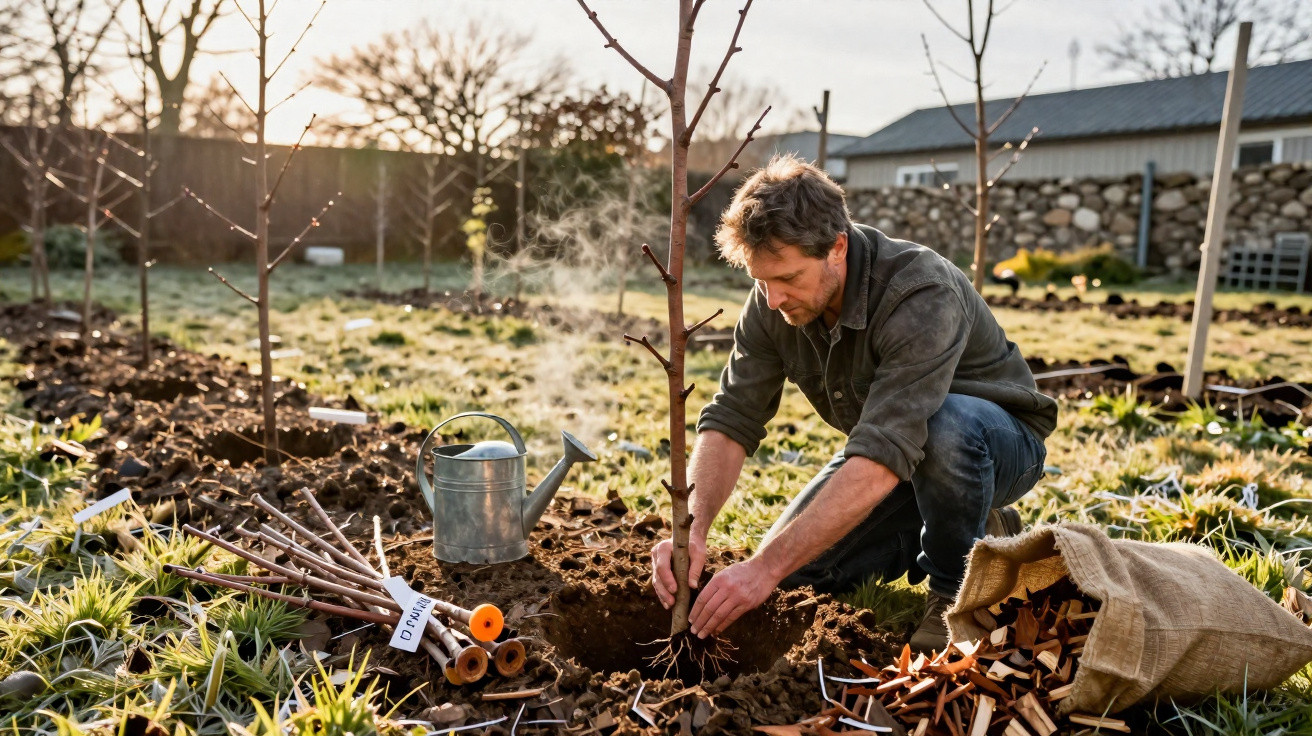
The process does not resemble bright spring planting. You are wearing a warm jumper, your breath is visible, and the ground is cool rather than waterlogged. Dig a broad hole, loosen its sides and arrange the roots like the spokes of a wheel rather than forcing them into a narrow cylinder. Water deeply once, allow the soil to settle, then apply a light mulch around, but not against, the trunk.
The tree is planted looking “ugly”: without leaves, flowers or anything worthy of Instagram. Yet that quiet point is precisely when the real work starts.
Many gardeners hesitate to plant during the cold season because they fear doing it “wrong”. Their concerns are understandable: frost damage, waterlogging and frozen roots. Most hardy fruit trees, though, are adapted to this seasonal pattern.
The major avoidable errors are usually made by people. Digging into saturated, sticky soil creates a bath that can drown roots. Planting too deeply leaves the graft union beneath the soil. Failing to mulch in exposed, windy places allows soil to heave and split around newly developing roots.
There is also a very human pitfall: waiting for a “perfect” free weekend. It never arrives. The trees then remain in their pots, or worse still in a dark garage, gradually declining as the calendar advances. Let’s be honest: nobody really does this every day.
One grower expressed it perfectly:
“Trees don’t need you to be perfect. They just need you to be on time.”
If you keep only a few simple points in mind, you are already ahead of most casual gardeners:
- Plant dormant, not leafy: bare-root or leafless container-grown trees cope best with the cold season.
- Think wide, not deep: a wide hole with loosened sides is always better than a narrow, deep shaft.
- Mulch like a blanket: leave it a few inches clear of the trunk, while protecting the root zone.
We have all experienced a summer heatwave, looking at drooping young trees with a hose in hand and wishing we had given them an easier start. Cold-season planting lets you quietly change that outcome before it begins.
The quiet power of planting fruit trees “off-season”
Once you have witnessed the difference, it is difficult to overlook it. Trees that receive those additional cold months behave as though they are older than they really are. Their trunks gain thickness sooner, their canopies develop more quickly and, when the first substantial crop finally comes, their branches are better equipped to bear its weight.
This is not solely about larger harvests. It also means fewer losses, less anxiety over watering and a garden that feels established rather than perpetually starting again. The irony is striking: by bypassing the glossy spring sales rush and choosing the colder, quieter period, you often achieve exactly what you wanted from spring in the first place – visible growth, vigour and momentum.
No single planting date works for every climate. In places with severe winters, very late winter or the earliest spring, while trees are still completely dormant, may be the safer option. In warmer areas, the planting window can extend far into winter. The crucial change is in your thinking: plant according to the tree’s rhythm, not your calendar’s convenience.
That modest decision – buying a bare-root apple in November rather than April, or planting a cherry while neighbours are putting their chairs away – compounds quietly over the years. Fruit trees are, after all, about the long game.
| Key point | Detail | Benefit for the reader |
|---|---|---|
| Plant during dormancy | Put trees into the ground in late autumn or winter, when they have neither leaves nor flowers | Provides months of unseen root growth before spring warmth arrives |
| Prioritise the roots | Use a wide hole, spread the roots, water deeply once and apply a light mulch | Builds a deep root system that withstands drought and wind more effectively |
| Choose suitable species | Apples, pears, plums, cherries and other hardy varieties | Lowers the likelihood of failure and speeds up the arrival of the first harvests |
FAQ:
- Is it really safe to plant fruit trees in late fall or winter?
Yes, provided the soil is not frozen solid and the tree is dormant. Hardy fruit trees are made to tolerate cold; what they cope with poorly is drying out in a pot while waiting for “nicer” weather.- What if my ground freezes hard in winter?
In very cold climates, aim for the period between soil thaw and bud break. Plant as soon as the ground is workable, while the tree remains leafless and dormant.- Are container-grown trees different from bare-root?
Bare-root trees respond particularly well to cold-season planting and often establish more rapidly. Container-grown trees can also be planted while dormant, but carefully loosen any circling roots first.- Will I get fruit faster if I plant in fall instead of spring?
Often, yes. Many growers find that autumn-planted trees behave as though they are a year ahead by their second or third season, developing stronger structure and flowering earlier.- Do I need to water winter-planted trees a lot?
Usually, no. One deep watering at planting followed by occasional checks during dry spells is often sufficient. The cool, damp season reduces stress and water loss compared with spring heat.






Comments
No comments yet. Be the first to comment!
Leave a Comment