
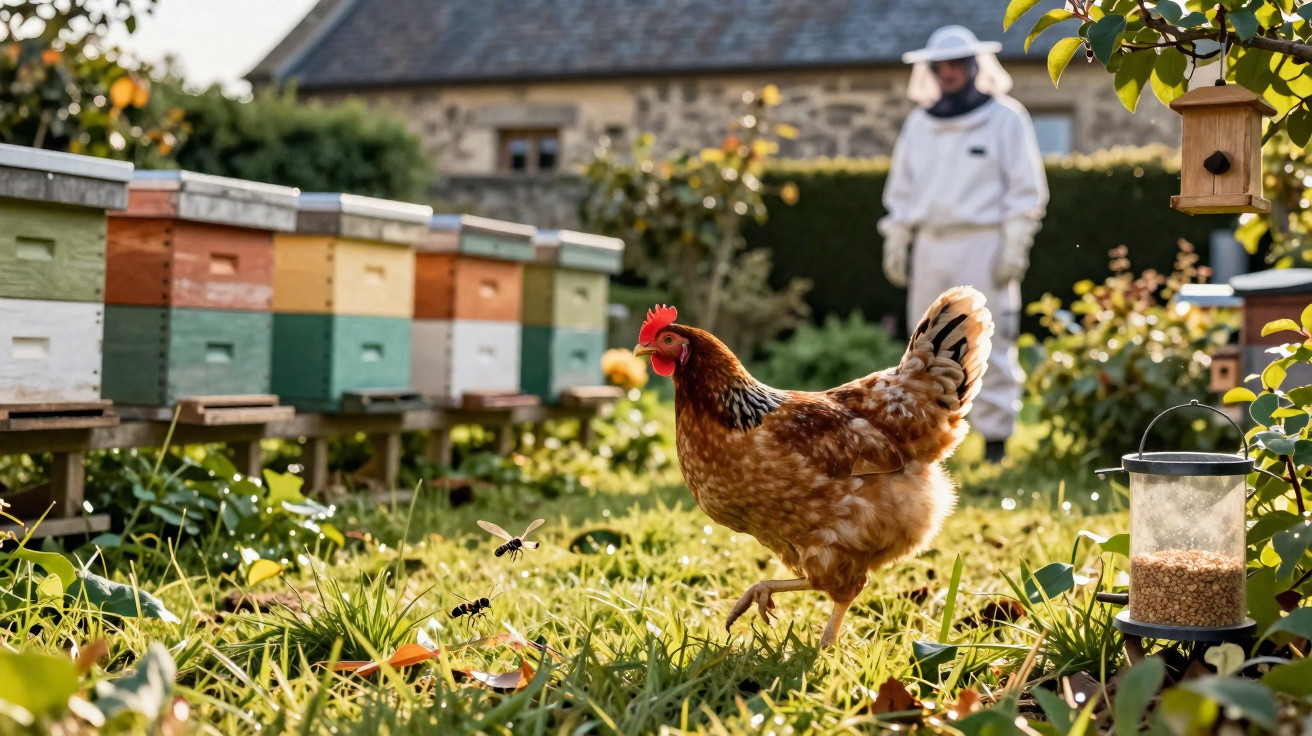
In western France, a heritage chicken that was close to being forgotten has discreetly emerged as a frontline ally against a rapidly spreading predator.
As Asian hornets advance further across Europe and prey on honeybee colonies, a hardy Breton hen is attracting the attention of concerned gardeners and beekeepers.
A winged crisis: why Asian hornets alarm beekeepers
The Asian hornet, Vespa velutina, first appeared in France in the early 2000s, most likely concealed in a pottery shipment. It has since spread through much of western Europe, hunting bees and other pollinators already under pressure from pesticides, habitat loss and disease.
At a hive entrance, the pattern is familiar. A hornet hangs in the air, waits for a foraging bee returning with nectar or pollen, and then attacks. One hornet may kill dozens of bees each day. Repeated assaults and stress from an entire hornet colony can ultimately cause a hive to fail.
Many hobby beekeepers feel unable to respond effectively. They turn to plastic-bottle traps, sweet baits or aggressive insecticides. Yet these approaches also kill butterflies, wild bees and non-harmful wasps. They address the symptom rather than the wider problem.
Uncontrolled hornet pressure near hives can cut honey production, weaken colonies before winter and push small apiaries to give up.
The Janzé chicken: a restless Breton treasure rescued from the brink
At the centre of this story is a bird with glossy black plumage tinged with green: the Janzé chicken. Named for a small town in Ille-et-Vilaine, Brittany, this local breed nearly disappeared during the 1980s. Conservation work led by Rennes’ Écomusée and the Bintinais agricultural park returned it to the region.
Fully grown hens weigh from 1.5 to 2.5 kg. They produce roughly 150 white eggs each year, weighing 55 to 60 g apiece. On paper, they may resemble any ordinary farmyard hen. Their temperament, however, makes them distinctive.
Breeders portray the Janzé as hyperactive, inquisitive and constantly on the move. Locals call it “the great wanderer”. The nickname reflects its habits: it dislikes being confined and spends the day roaming, scratching and hunting. It checks every part of orchards, vegetable plots and hedgerows for anything moving in the grass.
The Janzé chicken works like a small, feathered patrol unit: it walks, scans, pecks, then moves on, hour after hour.
Its keen vision and unexpected agility allow it to jump, negotiate low obstacles and react rapidly when a flying insect comes within reach. Earthworms, beetle larvae, caterpillars, grasshoppers and wasps are all part of its diet.
How a farmyard hen takes on the Asian hornet
For beekeepers, the most compelling sight occurs around hives and fruit trees. Asian hornets hover by hive entrances or circle apples and plums. Janzé hens spot their characteristic zigzag flight and switch into hunting mode.
Observers recount a straightforward routine. The hen moves closer with her neck extended and waits for the hornet to descend. She then delivers a quick peck, often catching the insect in flight or immediately after it lands. A second peck crushes or decapitates it before she eats the protein-rich body.
That protein is significant. Energetic hens require animal protein for their feathers, muscles and egg production, while hornets offer a concentrated source. The habit therefore becomes self-reinforcing: a hornet is treated as a useful snack rather than a danger.
One fertilised Asian hornet queen eaten in spring can mean 1,500 to 2,000 fewer hornets in the landscape later that year.
A reported trial in an organic Breton orchard indicates what this might achieve on a larger scale. Around 90 Janzé hens were released across three hectares of fruit trees. During the season, growers recorded a major decline in insect pests, approaching 90 per cent, alongside far less hornet activity around the trees.
Nobody suggests that hens can eliminate hornets throughout an entire region. Hornets build nests high in trees, on pylons and in buildings, and many will never come within a chicken’s reach. Around apiaries and orchards, however, the birds create an ongoing mobile barrier that hornets must pass through to feed.
Creating a feathered anti-hornet patrol
Space, movement and a genuine hunting ground
The Janzé becomes far less effective in a very small pen. To hunt hornets and garden pests, it needs space to explore. Keepers in Brittany describe an active “range”, rather than a fixed run. The birds work through hedges, compost heaps, areas of fallen fruit and sunny margins where hornets and wasps frequently gather.
A modest garden does not rule out the breed, but the hens should be able to reach as many microhabitats as possible: short turf, rougher patches, low shrubs and several shaded spots. Tight, barren runs leave them bored and more likely to peck feathers instead of pursuing insects.
Feeding strategy: do not overfill the feeder
Fabrice Jan, manager of the agropastoral park at the Bintinais eco-museum, offers a clear warning: too much food suppresses the urge to hunt. When hens can take all the calories they need from a feeder, they remain close to it instead of searching beneath the trees.
The aim is not to deprive them of food, but to ensure that part of their diet still comes from foraging. A sensible method combines a measured grain ration with daily access to varied ground. Their hungriest periods then encourage them to seek out larvae, beetles and hornets.
- Morning: measured grain ration to meet basic requirements
- Daytime: free-ranging around hives, orchards and vegetable plots
- Evening: brief visual inspection and a coop secured against predators
Costs and practical considerations
Specialist breeders in western France offer black Janzé hens at approximately €30 to €50 per bird, according to age and lineage. Young, active hens usually deliver the strongest results near hives. Cockerels can help preserve the breed, although they also create noise that neighbours may not welcome.
| Aspect | Janzé chicken |
|---|---|
| Main role | Predator of insects and hornets, egg layer |
| Annual eggs | About 150 white eggs |
| Ideal setting | Free range, orchards, apiaries, large gardens |
| Purchase cost | €30–€50 per hen |
| Extra benefits | Soil aeration, fertiliser, garden “animation” |
Year-round work: more than hornet control
The Asian hornet may be the main attraction, but the Janzé has an effect throughout the year. In spring, hens target soil larvae and young caterpillars that would later feed on leaves and developing fruit. Their light scratching around young plants may disturb some seedlings, but it also breaks up compacted soil and improves aeration.
In summer, they patrol shaded areas beneath trees and shrubs where hornets, wasps and flies rest. They consume fallen fruit before it rots and draws in more insects. During autumn, they continue working under trees, breaking up leaf litter and seeking overwintering larvae.
This constant activity has another benefit: natural fertiliser. Their droppings return nitrogen and phosphorus to the ground. Together with their scratching, this organic matter is quickly worked into the soil. Some gardeners use movable fencing to rotate hens through separate areas and distribute the benefit.
For small farms and serious gardeners, a Janzé flock acts as pest control, soil worker and egg producer wrapped in one lively package.
Limits, risks and potential use elsewhere
No biological-control method is without compromises. Hens may harm delicate beds, pull mulch away from young plants and consume beneficial insects as well as pests. They are also vulnerable to foxes, dogs and birds of prey. Coops must be shut at night, while fencing needs to be suited to local predators.
Asian hornets can adapt as well. Where chickens are common, they may move their hunting activity higher into tree canopies or closer to water. Hens therefore belong in a broader toolkit rather than offering a miracle solution. Selective trapping, nest detection and community reporting remain important, particularly in urban areas where keeping poultry is not practical.
The Janzé example prompts a broader question for regions dealing with invasive insects, from spotted lanternflies in the United States to stink bugs in southern Europe. Local and heritage breeds of chickens and ducks often retain powerful foraging instincts lost by industrial hybrids. Farmers could identify birds that readily eat troublesome species and deliberately include them in pest-management plans.
For beekeepers interested in trying the method, a small pilot is the best starting point: keep a few agile hens, watch how they behave around hives from a safe distance, and adapt feeding and fencing as needed. Repeating that simple field observation in many gardens could help shape the next generation of low-tech, living defences against the hornet’s spread.






Comments
No comments yet. Be the first to comment!
Leave a Comment