
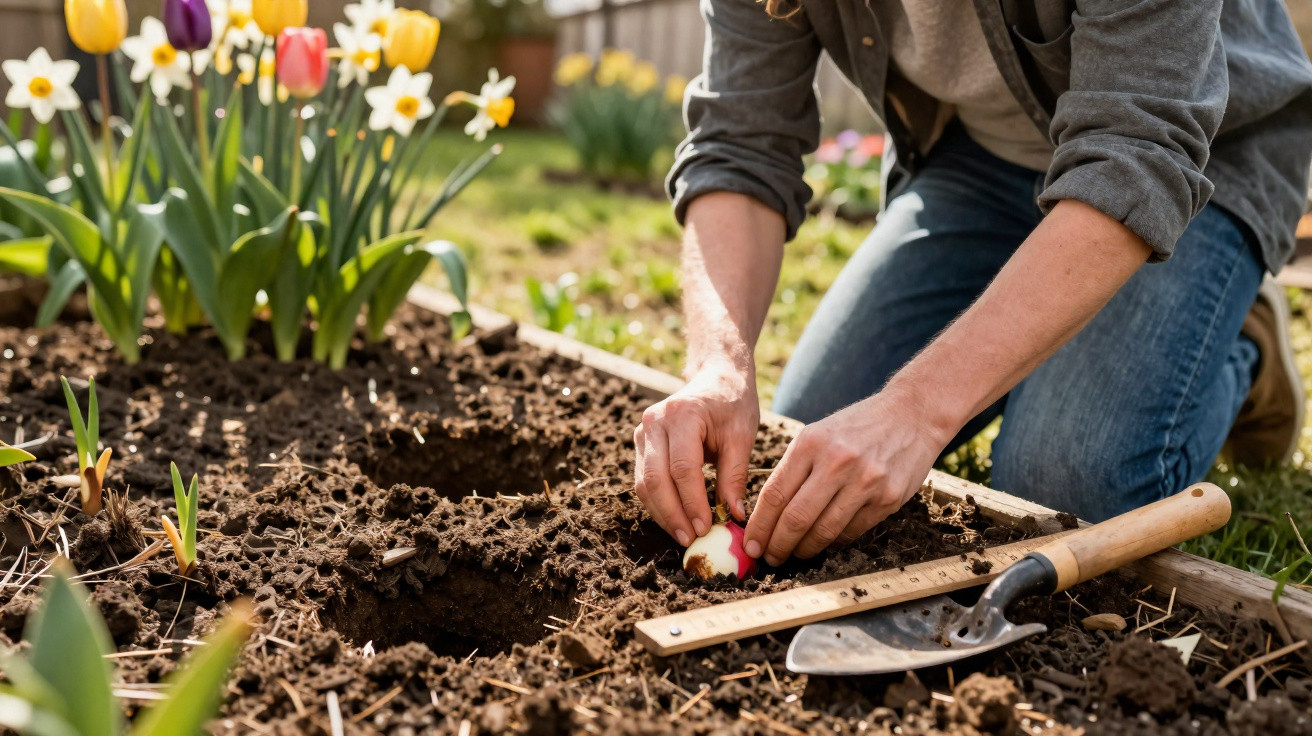
On a chilly October afternoon, I saw my neighbour crouched beside her flowerbed with a bucket of tulip bulbs next to her. She pushed each bulb just beneath the soil, gave the surface two pats, and carried on with the quick efficiency of someone finishing a job on a list. It took no more than ten minutes. That spring, her tulips emerged spindly and unsteady, as though they had raced towards the light before losing momentum halfway through. By the next year, nearly all of them had disappeared, seemingly swallowed by the garden.
She assumed she had simply been unlucky.
She had not.
Why shallow bulbs look great once… and then disappear
Planting bulbs too shallow is one of those understated gardening errors rarely mentioned at the garden centre. You push the bulbs in, cover them with soil, and from above everything appears as it should. They will often flower in the first spring too, which feels reassuring but gives a false impression.
The trouble begins the following year.
I once helped a reader investigate her “ghost daffodils.” In their first year, her borders looked like a postcard: neat lines of yellow trumpets, exactly like those shown on the packet. The next spring, leaves appeared but there were no flowers. By the third year, the bed contained little more than bare earth and a few forlorn green shoots doing their best.
When we dug into the bed, the reason became clear. The bulbs were scarcely 5 cm below ground, stuck in the dry, hot upper layer of soil and divided into small, depleted fragments.
Bulbs set too close to the surface are constantly under pressure. Their roots occupy the part of the ground that dries out first, freezes most severely and becomes hottest in summer. Rather than steadily restoring their energy below ground, they use it up coping with the weather. Eventually, they become smaller rather than larger, their flowers diminish, then cease, and finally vanish.
Bulbs planted deeply, on the other hand, sit in a cooler and steadier layer of soil. There is less upheaval, greater stored energy and better flowering. That is the whole point.
The simple depth rule that changes everything
Gardening books can make bulb-planting depth seem complicated, but the most useful guidance is straightforward. Set bulbs at a depth of around three times their own height, measuring from the base of the bulb to the soil surface. A 5 cm tulip bulb should therefore be planted at approximately 15 cm; narcissus need slightly more depth, while small crocus can sit a little higher, though still properly covered.
Once you understand this, it is difficult to overlook.
Many gardeners scrape out a small, shallow hole, drop in the bulb, brush soil over it and consider the task complete. There is not much time, your knees ache and daylight is disappearing. We have all had that moment when we know we are taking a shortcut, but carry on because dinner is waiting. The bulbs offer no protest. They flower a little, and we assume the approach has worked.
The real cost becomes apparent in the second or third spring, when the display gradually falls apart.
For bulbs, planting depth is not a minor consideration; it is their insurance policy. Deep planting shields them from frost that can destroy new roots, summer heat that can dry them out, and the repeated disruption caused by weeding and mulching. A well-planted bulb is basically living in its own underground climate zone.
In truth, nobody measures every bulb hole with a ruler day after day. The most sensible method is to recognise the appearance and feel of “deep enough”, then make it your instinctive standard.
How to plant bulbs so they come back stronger every year
The simplest way to achieve the right depth without making a fuss is one easy movement. Rather than scraping out a shallow scoop, push your trowel vertically into the ground to its full depth, then lever it backwards to create a narrow slit. Place the bulb at the very base of the slit with its pointed end facing upwards, then firm the soil back together with your hand or boot.
That extra push of the trowel can be what separates “one-and-done” from “back every spring.”
Much shallow planting is driven by anxiety. Gardeners fear that a bulb will be “too deep” and fail to reach the surface. However, bulbs are made to force their way through soil and debris; that is what they do. The greater danger is placing them in the exposed zone where frost, sun and animals can reach them with ease.
If your garden has heavy clay soil, make every hole a little wider and work a handful of compost or leaf mould around the bulb. It need not be an elaborate process: simply create a small buffer that prevents water collecting and causing the base to rot.
Some experienced gardeners have a quiet saying: “If a bulb fails, it was either too wet… or too shallow.” It’s not always true, but it’s true often enough to change how you dig.
Rough depth guide by bulb size
Small bulbs (crocus, snowdrops, muscari): 7–10 cm deep.
Medium bulbs (tulips, narcissus, hyacinths): 12–18 cm deep.
Large bulbs (alliums, big daffodils, crown imperials): 18–25 cm deep.3 practical planting tricks
Plant 5–12 bulbs together in one broad hole instead of scattering them individually.
Loosen the earth beneath each bulb with a hand fork so that roots can grow farther down.
Add a light mulch over freshly planted bulbs to maintain even moisture.Common shallow-planting traps
Planting in raised beds, where soil warms up and dries quickly.
Setting bulbs on old roots or stones and then only just covering them.
Allowing children to “help” without checking the depth, then wondering why the bulbs disappeared.
When you plant deeper, the whole garden changes rhythm
When you begin setting bulbs at a suitable depth, there is a subtle change in how the garden behaves. Rather than seeing tulips and daffodils as throwaway plants, you start to regard them as a long-term investment, almost like miniature trees. They settle deep in the ground and adapt to your soil. The first spring is attractive, the second is often better, and the third can be spectacular.
You no longer find yourself replanting the same areas every year out of disappointment.
It is striking how different a border feels when bulbs return dependably. Spring stops feeling like a gamble and takes on a pattern. Narcissus emerge along the same sweeping lines, tulips rise among newly emerging perennials, and alliums stand above fresh foliage. Even weeding becomes different, because you know where the concealed clumps are and trust that they are resting underneath.
With shallow bulbs, the entire display seems short-lived. With deep bulbs, the garden begins to remember.
Some gardeners will always grow tulips as annuals before moving on. Others will quietly spend that extra minute with a trowel, creating a layered, recurring display that becomes more generous each year. Neither choice is wrong. But if disappearing flowers have let you down, the answer is often directly beneath your feet: just 5–10 cm deeper than you normally dig.
Next time you plant, stop briefly before firming the soil. Ask yourself one small question: is this bulb living in the weather, or just below it?
| Key point | Detail | Value for the reader |
|---|---|---|
| Correct depth | Plant at roughly three times the bulb’s height | Improves bloom quality and long-term return |
| Soil “climate zone” | Deeper soil stays cooler, moister, and more stable | Protects bulbs from stress, rot, and temperature swings |
| Simple planting method | Use a deep trowel slit or wide group holes | Saves time while avoiding shallow, “one-season” planting |
FAQ:
- How deep should I plant tulip bulbs exactly? As a general guide, plant them at around three times the bulb’s height. Most standard tulip bulbs perform well at 12–18 cm deep, measured from the base of the bulb to the soil surface.
- What happens if bulbs are planted too shallow? They have greater exposure to frost, heat and drying conditions. They may produce good flowers in the first year, but often weaken, divide into tiny pieces and stop flowering after one or two seasons.
- Can bulbs be too deep to flower? Yes, they may struggle if they are buried exceptionally deep in heavy ground. In ordinary garden soil, however, the three-times-height rule places them in a safe range where they can still reach the surface.
- Do I need special tools to plant at the right depth? No. A standard hand trowel, a solid bulb planter or even a narrow spade will do. The important thing is to push deeper than initially feels “natural”, then allow that to become your usual practice.
- Can I fix bulbs that are already too shallow? Yes, but wait until the foliage has died back. Carefully lift the bulbs, assess their condition, then replant them deeper in fresher soil to give them a better opportunity to recharge for the following season.





Comments
No comments yet. Be the first to comment!
Leave a Comment