
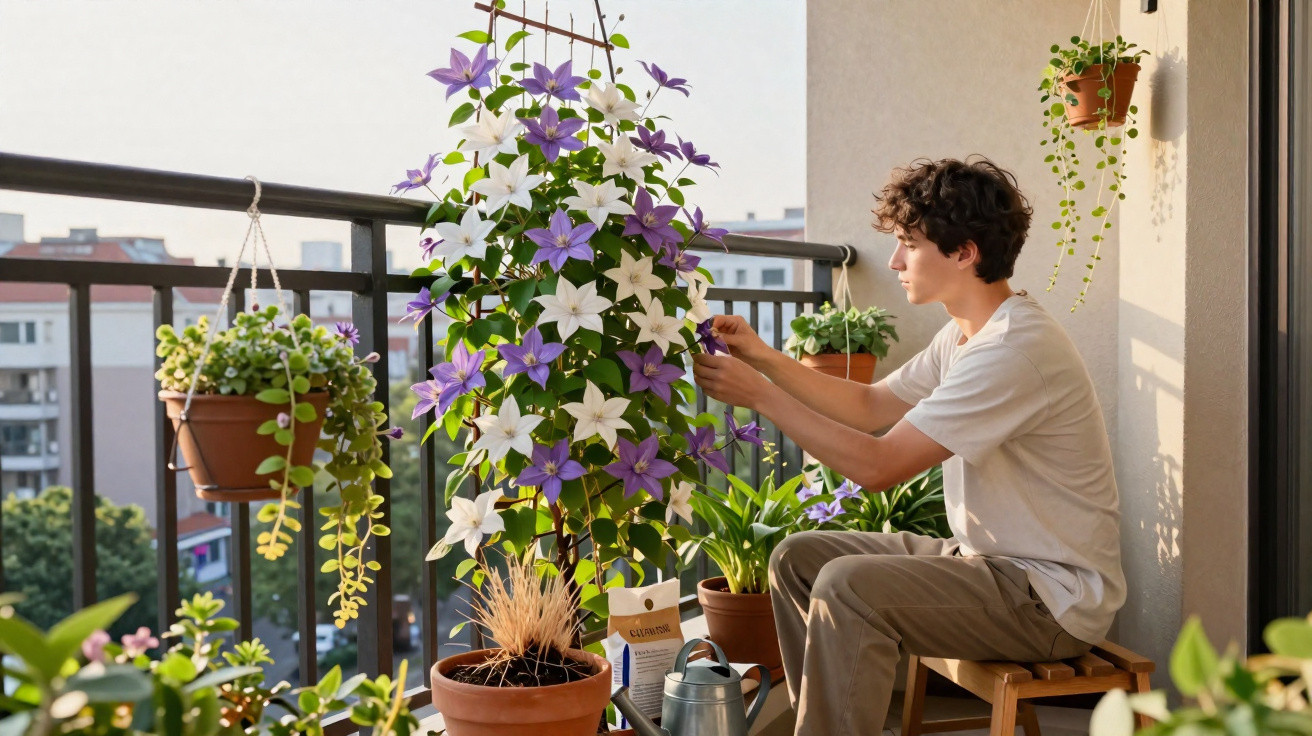
A single, well-chosen climber is enough to create a genuine wow moment.
Narrow courtyards, tiny urban gardens, balconies where there’s only room for a small table: that’s the reality in many German cities. Ground space is limited, and pots and beds end up competing with the barbecue, chairs and the bike. The answer isn’t more floor area but more height - and that’s exactly where compact clematis varieties come in, turning underused corners into true walls of bloom.
Why compact clematis shine in tight urban gardens
Traditional climbers often shoot up several metres, spread out sideways and demand plenty of ground space. Modern dwarf and compact clematis behave differently: they typically top out at about 1–2 metres, grow as slim, upright plants, and make use of space almost entirely in the vertical.
"A narrow column of flowers instead of a sprawling bush - that’s exactly what makes these clematis types so appealing for small spaces."
Gardeners who have to make do with limited room tend to value three things in particular:
- They take up virtually no footprint - a single pot in a corner can be enough.
- They flower from the base to the top - no bare, empty stems down low.
- They add colour to dull walls - perfect for grey brickwork or concrete balustrades.
These plants have been bred specifically for cramped city settings, and they now appear at respected garden shows as ready-made solutions for mini gardens. Cultivars such as ‘Ithemba’, ‘Eliza’ and ‘Queens Nurse’ can wrap a complete support cane or small trellis from bottom to top - without sending rampaging shoots into the neighbour’s space.
Flowers like full-size clematis - just in a compact form
A stubborn misconception says that smaller clematis also produce smaller, less striking flowers. These compact cultivars prove the opposite. Their blooms can reach similar sizes to classic varieties, but they’re packed in more densely, often from the root zone right up to the tips.
Typical colours and effects include:
- ‘Ithemba’: white flowers with a bold pink central stripe - particularly elegant against pale walls.
- ‘Eliza’: opens in a soft blue and fades to a clean white - ideal if you enjoy a changing look.
- ‘Queens Nurse’: a strong pink that visibly lifts darker corners and north-facing spots.
Many compact varieties keep pushing out fresh flowers for weeks, sometimes for months. In closely built-up areas - where your view from the window might be the next building’s wall - a continuous ribbon of bloom can make the space feel noticeably more pleasant.
Pot, planter, hanging basket: where to put mini clematis
The big plus point is flexibility: these plants are just as happy in containers as they are in the ground. So if you don’t have garden soil to work with, you can still grow them successfully on a balcony or terrace.
Choosing the right pot size and compost
Even though the plants stay small above ground, compact clematis still need enough compost volume to develop strong roots. For a single plant, it’s worth using a pot of at least about 10–12 litres. Shape matters less than having adequate depth and proper drainage.
"Without drainage holes in the base, it won’t work - waterlogging is the most common reason clematis fail in containers."
A high-quality, structure-stable compost for container plants is a good choice. If you like, add a little sand or expanded clay to improve drainage. A thin drainage layer of expanded clay or gravel at the bottom also helps.
Handy ideas for hanging baskets and windowsills
For very narrow balconies, extra-small selections such as Clematis tangutica ‘Little Lemons’ are especially interesting. It grows to only about 40–50 centimetres, yet forms a dense, bushy habit covered in yellow, bell-shaped flowers. Later on, it produces decorative, feathery seed heads that create a completely different look.
These varieties can be placed in hanging baskets over the railing, on wall hooks, or directly on the balcony frame. Other low-growing cultivars such as ‘Bijou’ start off upright and then trail attractively as the shoots lengthen, which makes them well suited to long balcony planters.
Support and position: how to grow a truly dense wall of flowers
Compact clematis are considered semi self-clinging: they’ll reliably twine around thin canes or strings, but they can’t manage thick posts on their own.
Useful supports include:
- a narrow wooden or metal trellis placed in the container,
- a few bamboo canes arranged like a fan,
- a slim metal frame pushed into the pot,
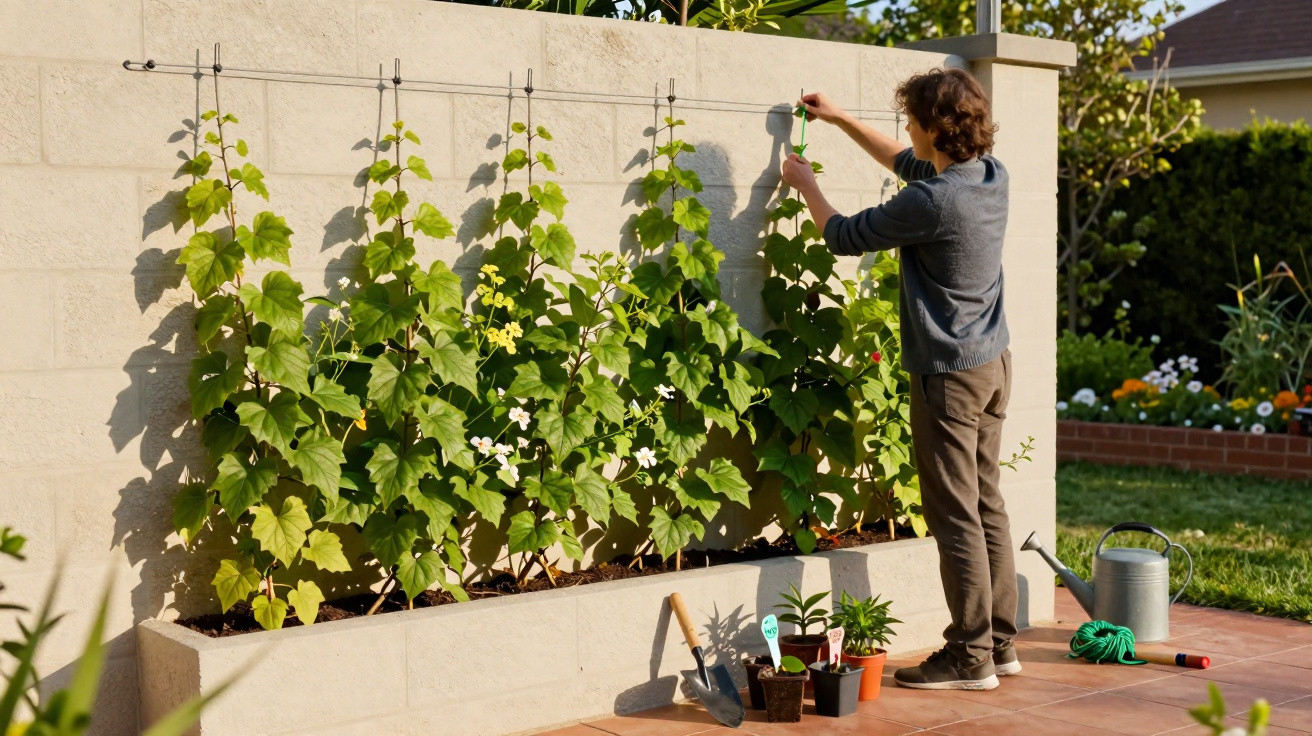
- tension wires run along a balcony railing.
At the start, loosely tie young shoots in with soft ties or gentle clips. After that, the plant will do the rest and wrap itself around the support.
As for position, most clematis prefer a bright spot to partial shade. Full midday sun on a south-facing balcony can work - provided the root area stays shaded. You can achieve this by adding low companion plants such as lobelia, million bells (calibrachoa) or trailing ivy to the pot; they also help disguise the rim.
Watering, feeding, pruning: low-effort care
Despite their refined look, these clematis are surprisingly straightforward as long as a few basics are right.
Water properly - but don’t drown it
Container compost dries out faster than soil in a bed. In warm weather, the plant will need regular watering - but only once the top layer has dried. Constantly wet roots quickly lead to rot.
A practical rule of thumb:
| Condition of the compost | Action |
|---|---|
| Surface dry, slightly moist beneath | Water lightly |
| Completely dry several centimetres down | Water thoroughly until it runs from the holes |
| Permanently wet, pot feels heavy | Stop watering immediately and improve drainage |
If temperatures climb well above 27°C, the leaves may turn yellow. The plant often slips into a kind of resting phase at that point. Extra water won’t help then - in fact, the roots can be particularly sensitive to wetness when growth has slowed.
More flowers with targeted feeding
For generous flowering, use a fertiliser with a high potassium content, similar to what you’d choose for tomato plants. Begin once the first buds appear. Then feed every one to two weeks until the flowers are just about to open. If you pause after that, you encourage the plant to produce another flush of buds.
Pruning without complicated rules
Many home gardeners avoid clematis because they worry about pruning mistakes. Compact cultivars are noticeably more forgiving. A light tidy in late winter or very early spring is usually enough to keep the plant in shape and refresh it.
What you can do without concern:
- remove dry or damaged shoots right at the base,
- shorten overly long, straggly stems,
- shape the plant into an even column or flat, covered panel.
Practical tips: turning a balcony into a green room
If you want your balcony to be not only attractive but also more functional, you can use clematis deliberately as a screen against views and wind. Place a tall pot right by the railing, add a narrow trellis behind it, and you’ve got a movable green divider that can be repositioned whenever needed.
It also becomes interesting when paired with other climbers. Combined with twining star jasmine or an annual sweet pea, you get a layered wall of flowers that looks good and draws in bees and bumblebees. That can turn a bare balcony into a small, living ecosystem.
If you’re moving in somewhere new or renovating a neglected courtyard, it pays to plan vertical planting early. One or two well-placed clematis in containers are often enough to pull attention away from bins, plain walls or facing windows. This approach is particularly useful in rented homes: everything stays mobile, nothing is permanently fixed in place, and when you move out, the flowering wall moves with you.

Comments
No comments yet. Be the first to comment!
Leave a Comment