
Many garden owners are surprised each year by how quickly a delicate Japanese maple can scorch in summer or start to look weak and listless. While some specimens glow as if they belong in a Japanese garden, others already seem tired by June. A small, unshowy job in March often makes all the difference - and it costs next to nothing.
Why the Japanese maple suffers so quickly
The Japanese maple (Acer palmatum) has a reputation for being a diva in the garden. In reality, it is not that fragile once you understand its weak point: the roots. They sit very close to the surface, just beneath the top layer of soil - exactly where the toughest contrasts hit over the year.
- In March: cold ground, sometimes still frosty, but the sun is already getting stronger
- In summer: soil that heats up and dries out, with very little moisture
- In wind: rapid moisture loss around the root zone
If the tree is planted in bare soil or surrounded by gravel, those fine surface roots take the full impact of these extremes. That leaves the maple more prone to:
- scorched leaf edges during hot spells
- early leaf drop in late summer
- dull, washed-out autumn colour
- growth checks and poor, stunted development
Protecting the root area of your Japanese maple gives the tree strength, water reserves and noticeably more beautiful leaves.
The crucial natural trick: a protective mulch layer
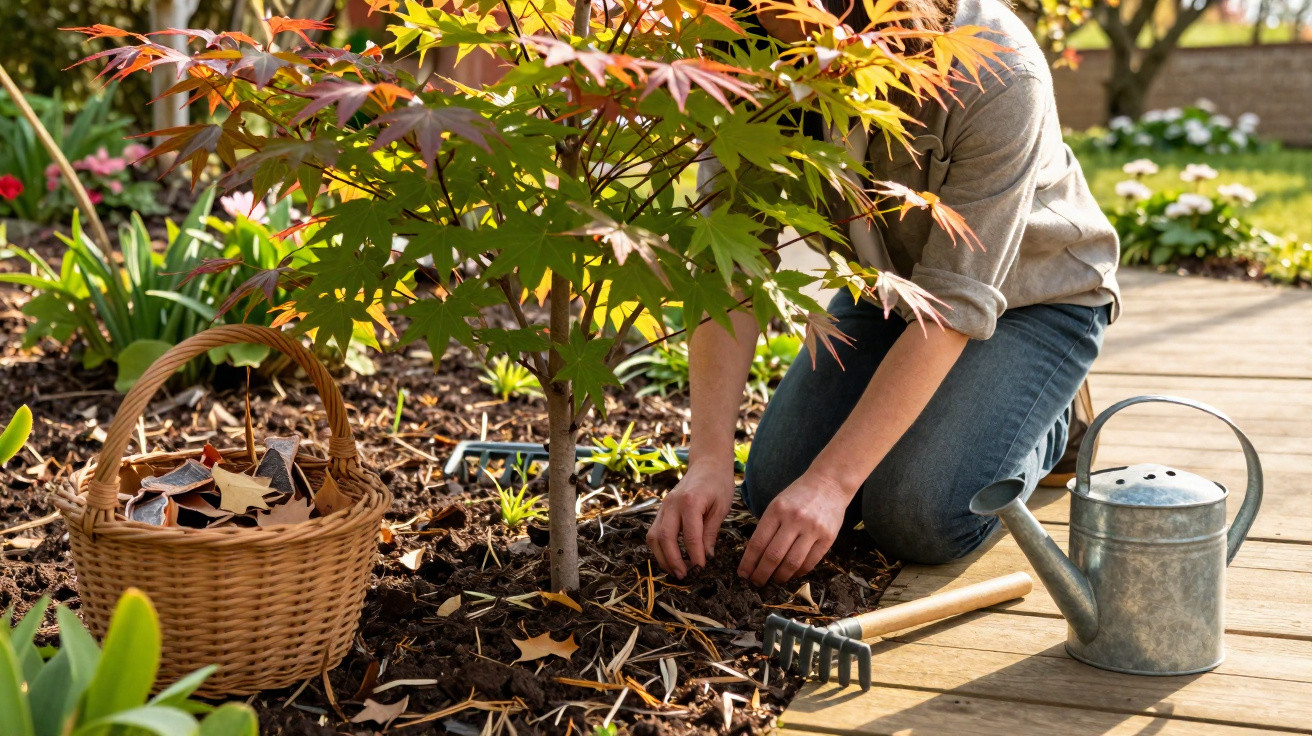
The professionals’ “March trick” is extremely straightforward: lay an organic mulch layer around the trunk. A covering of natural material works like a blanket and a buffer at the same time.
It delivers several benefits at once:
- cushions temperature swings in the soil
- keeps moisture in the root area for longer
- shields surface roots from frost and heat
- suppresses weeds around the tree
- releases nutrients gradually over time
Garden experts suggest a layer about 5 to 8 centimetres thick. The key point: keep the root flare - the transition from trunk to roots - visible. That area needs air; if it stays covered, rot can develop.
Which natural material suits the Japanese maple?
Not every mulch is a good match for a Japanese maple. The plant originates from woodland, humus-rich habitats and prefers slightly acidic, loose soil. For that reason, the best options are materials that mimic a forest floor.
Particularly recommended mulch materials
- Fine pine or conifer bark: slightly acidic, long-lasting, and visually in keeping
- Well-rotted leaf mould (leaf compost): nutrient-rich, open in texture, excellent at holding water
- Wood chips from thin branches (including bark-rich pieces): breaks down slowly and improves soil structure
Over time, these choices build a humus-rich layer, much like woodland soil. Many gardeners report they can cut watering by 30 to 50 percent because the ground dries out far more slowly.
Using mulch from your own garden, sensibly
In many gardens, suitable material is already to hand:
- shredded, dry fallen leaves saved from autumn
- dried hedge trimmings (finely chipped)
- well-dried grass clippings in a very thin layer, so nothing rots
What matters is applying the material dry and loose. Grass clippings that are too wet quickly mat together and go mouldy - something the maple really does not like.
Materials you are better off avoiding
Some mulches may look tidy, but in the long run they are harmful to Japanese maples:
- dark chippings or gravel: heats up strongly and effectively cooks the fine roots
- pouzzolanic rock or stones that warm up heavily: intensify heat and dryness
- coloured decorative wood chips: often too coarse and frequently treated with dyes
A handy extra tip: leave a ring of bare soil around the trunk, about 10 centimetres wide. That way, no permanently damp material sits against the bark, and the trunk can dry more easily.
How to mulch your Japanese maple step by step
Whether it is in a border or in a container, the method is much the same. The ideal window is between March and early April, when the sap is starting to rise but the soil is still cool.
- Clear the area: remove weeds, old leaves and stones from around the trunk.
- Lightly loosen the surface: gently scratch the top layer with a small rake or your hand, taking care not to damage roots.
- Spread the mulch: apply your chosen material in a circle, slightly wider than the canopy.
- Keep the trunk area clear: leave a small ring around the trunk uncovered.
- Do not compact it: the mulch should sit loosely so air can still reach the soil.
- Water thoroughly: after mulching, give the area a deep watering so soil and material are properly moistened.
Mulching in March and watering consistently lays the groundwork for a richly coloured, stress-resistant Japanese maple right through to autumn.
Japanese maple in a pot: special rules for balcony and patio
Many enthusiasts grow their Japanese maple in a container. Here, mulching can be even more effective, because pots dry out far faster and can heat up dramatically in summer.
In a pot, pay attention to the following:
- use a thinner mulch layer of only 3 to 5 centimetres
- ensure there are adequate drainage holes so the compost does not become waterlogged
- do not place the pot in intense midday sun
- during hot weather, check moisture levels regularly
For containers, fine bark or leaf mould works particularly well. A topping of coarse gravel may look “clean”, but it increases heat stress in summer.
How mulch affects the tree’s appearance
Many gardeners think of mulch mainly as a labour-saver. With Japanese maples, however, what covers the soil has a direct effect on leaf colour.
If the roots are not shocked by late frosts in spring, the tree leafs out more evenly. When the soil stays consistently cool and moist through summer, the leaves can move more water. The result is:
- fewer dry, brown leaf edges
- longer-lasting, more intense red or orange colour in autumn
- a denser, more uniform crown overall
The tree simply looks more “relaxed”. If you know your maples well, you will usually spot the difference in the very first year of disciplined mulching.
Water, feed and mulch - how they work together
Mulch is not a substitute for fertiliser, but it does support soil life. Microorganisms break down the organic material gradually, producing humus and nutrients that the maple can use effectively.
A sensible routine for healthy trees:
- in early spring, apply a small amount of organic slow-release fertiliser
- then spread the mulch layer over the top
- in dry periods, water regularly, but avoid overwatering
Feeding too often can lead to soft, vulnerable shoots. With mulch, the tree can balance much of this itself because nutrients are released more steadily.
Mistakes Japanese maples handle particularly badly
For the March trick to pay off, it helps to avoid a few common errors:
- pressing mulch right up against the trunk: encourages fungal problems and rot
- heavy compaction: if everything is trodden down firm, hardly any air reaches the soil
- constant waterlogging: in containers without drainage or in low-lying spots
- a “concrete layer” of wet grass clippings: stops gas exchange in the soil
Light, loose and airy - that is what a well-made mulch ring should look like. Keeping that picture in mind prevents most mistakes when caring for a Japanese maple.
Why March matters so much
Late winter timing is not random. This is when sap flow begins, buds swell, and the tree prepares to leaf out. At the same time, nights can still be frosty while the daytime sun already has real strength.
This is exactly where mulch makes the difference: it stops the roots freezing in the morning and overheating by afternoon. The tree responds to that steadier “soil mood” - often for the entire season.
So if you reach for a rake and a shovel of mulch at the start of March each year, you give your Japanese maple an advantage that no emergency rescue in midsummer can make up.
Comments
No comments yet. Be the first to comment!
Leave a Comment