
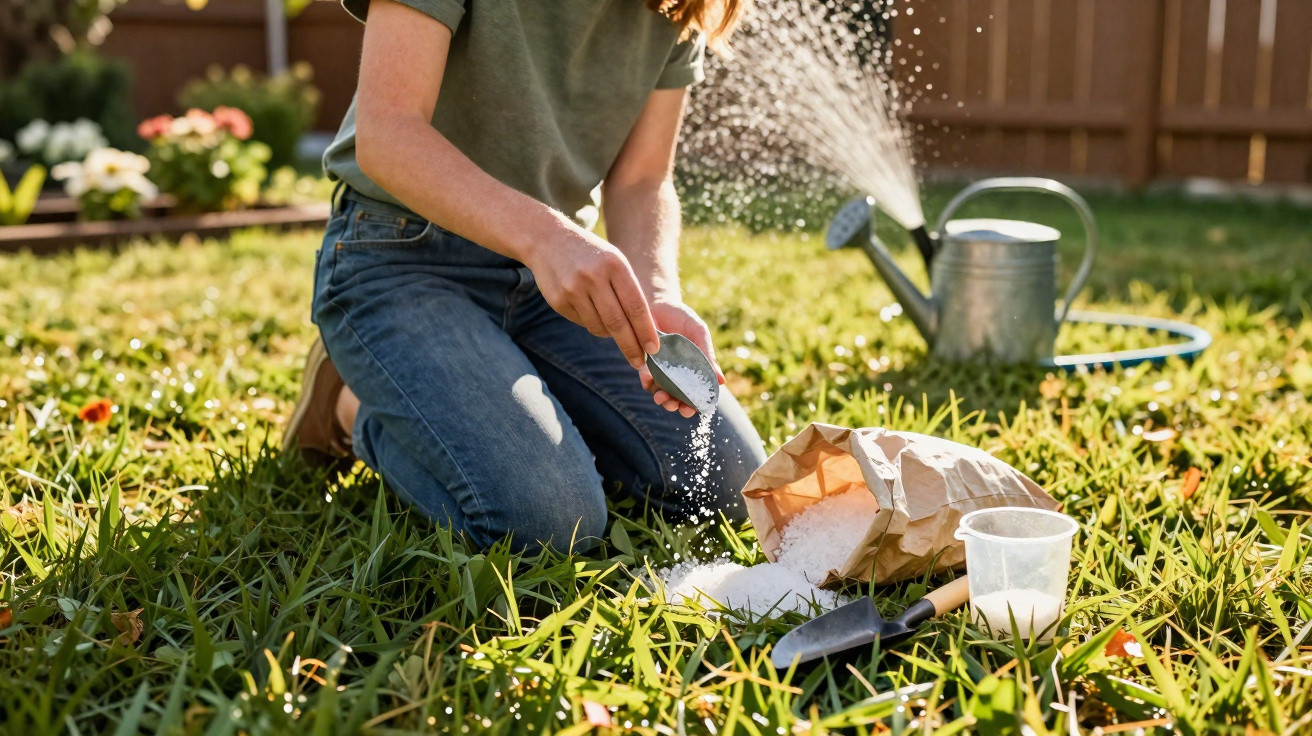
A tip is currently doing the rounds in gardening forums and Facebook groups that sounds almost too good to be true: instead of buying pricey specialist fertiliser, amateur gardeners are reaching for a cheap bath salt from the supermarket, costing around one euro. It is not a miracle product from professional agriculture, but a classic bath additive that most people associate with relaxing in the tub - and it is now supposed to bring a tired lawn back to life.
Why a bath salt has suddenly become a gardening craze
The star of this approach is Epsom salt, chemically magnesium sulphate. Depending on the retailer, you may find it in the bath aisle or sold directly as a garden feed. Dissolved in water, it supplies magnesium - a mineral that plays a central role in lawn health.
Magnesium sits at the core of chlorophyll molecules. No chlorophyll means no photosynthesis; no photosynthesis means no energy - and without that, you will not get a rich green carpet in the garden. If the soil lacks magnesium, lawns often show it quickly: the grass looks dull, growth slows, and yellowing patches begin to appear.
"Magnesium sulphate supports the lawn in two ways: it strengthens the leaf green and helps the roots make better use of nutrients already present."
Professional gardeners have used Epsom salt for years, and not only on lawns. Vegetable beds, roses and ornamental shrubs can also benefit - but only when the soil genuinely contains too little magnesium. In that situation, plants tend to use nitrogen and phosphorus more effectively, build sturdier roots, and put on noticeably more vigorous new growth.
When the 1‑euro trick actually helps your lawn
Despite the enthusiasm online, this bath salt is not a magic powder for every struggling patch of grass. It is most worthwhile on areas with a proven magnesium deficiency. Typical cases include:
- very sandy soils where nutrients are easily washed out
- older lawns that have been heavily irrigated or watered for years
- spots where the grass turns yellow between the leaf veins while the veins themselves stay green
Another red flag is a lawn that remains pale despite regular watering and normal fertiliser applications, and looks more limp than a neighbour’s lawn under similar conditions. If you want to be sure, a soil test is the safest route. Many garden centres and laboratories offer these checks, and magnesium levels are usually included.
On many ordinary domestic lawns, standard lawn fertiliser already provides enough magnesium. In those cases, applying extra Epsom salt brings little benefit. In the worst case, it simply increases nutrient leaching, because excess magnesium can be carried down into deeper layers by rain or watering.
"If you spread it ‘just in case’ without a real deficiency, you usually lose out - the lawn does not automatically become better as a result."
How gardeners apply bath salt to a lawn
If the soil really is short on magnesium, a targeted application in spring can help the lawn get going for the season. Depending on your region, the best window is typically between March and April, once the ground is frost-free and the grass has started to grow again.
The right dosage
Many manufacturers of garden-grade Epsom salt recommend around 600 grams per 10 square metres - and no more than once per year. The key is to follow the instructions on the pack and measure the area roughly beforehand. Applying too much is more likely to harm the soil than help it.
Spreading or watering - two methods at a glance
| Method | How to do it | Advantage | Disadvantage |
|---|---|---|---|
| Spread dry | Apply the granules evenly to a slightly damp lawn, then water thoroughly or wait for rain. | Quick on larger areas; easy to use with a spreader. | Uneven coverage is possible when spreading by hand. |
| Water in as a solution | Dissolve about a cup of Epsom salt in a large watering-can reservoir and distribute evenly. | Easier to control, especially on smaller problem patches. | More labour-intensive; impractical for very large lawns. |
One important point: only use a product without fragrances, colourants or conditioning oils. Many wellness bath salts contain additives that do not belong in the garden. For lawns, only pure magnesium sulphate is suitable.
What else the lawn needs alongside it
Epsom salt only addresses one very specific deficiency. On its own, it is not enough for a long-lasting, dense, hard-wearing lawn. Anyone who wants their lawn to look good quickly should work on the basics at the same time.
- Mowing height: Avoid cutting too short. About 4–5 centimetres is usually ideal. Scalping stresses the grass and encourages moss.
- Watering: Water less often, but deeply. Light daily watering promotes shallow roots.
- Fertiliser: A slow-release feed in spring supplies the lawn evenly with nitrogen, phosphorus and potassium.
- Soil care: Scarify compacted areas; on heavy soils, work in sand so water can soak in more easily.
If you keep on top of these points, you will usually only need a magnesium boost in exceptional cases. Well-managed soil with plenty of organic matter can buffer many nutrient swings on its own.
Risks and limits of the Epsom salt trend
The current hype tempts some people to spread the cheap bath salt over large areas. That can have consequences. High salt levels put pressure on soil life, and some micro-organisms are sensitive. If the lawn is already fertilised regularly, the nutrient balance can be pushed further out of line.
There is also an environmental angle: surplus magnesium and sulphate can move with percolating water into streams and groundwater. In wetter regions, the risk rises if applications are well above what the lawn actually needs.
"Online garden trends only work when they suit your own plot - blind action helps neither lawn nor environment."
Practical examples from everyday gardens
A common scenario in a terraced-house garden: after a harsh winter, pale patches appear and the blades look sluggish. If you reach straight for Epsom salt without checking more closely, you often miss the real causes - waterlogging, cutting too low in autumn, heavy foot traffic on wet ground, or a lack of overseeding.
It can be different in rural areas with very sandy soils. There, gardeners report that after a moderate spring application of magnesium sulphate, the lawn quickly improves in colour and looks denser. The effect is particularly noticeable when a slow-release fertiliser is applied at the same time and the area is watered regularly - but not excessively.
When it is worth the money - and when it is not
One euro per pack feels insignificant, and the bags can end up in the trolley quickly at the DIY store. Buying it makes sense mainly when several points line up: sandy soil, yellowing blades with veins staying green, little or no magnesium in your current fertiliser, and ideally a soil test confirming it.
If that foundation is missing, the money is usually better spent on high-quality grass seed, a well-planned slow-release fertiliser, or a soil analysis. A thick lawn rarely comes from a single product. It is built through many small steps working together: the right cutting height, the right nutrients, free-draining soil and a bit of patience.
Magnesium sulphate can be one element in that mix when the timing is right and the conditions fit. If you watch your lawn carefully and do not follow every trend blindly, you will soon see whether this budget bath salt is a genuine hidden gem in your garden - or whether traditional care measures deliver far more.

Comments
No comments yet. Be the first to comment!
Leave a Comment