
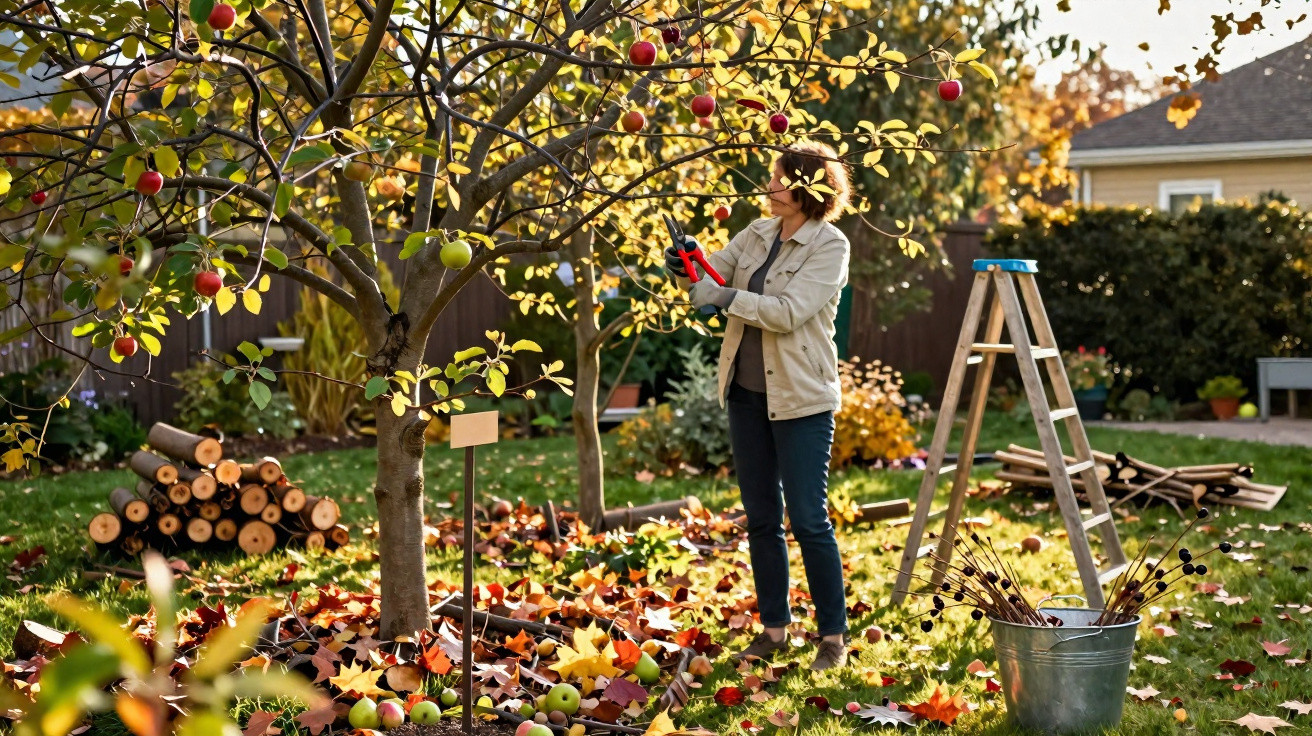
By late October, the afternoon light fades earlier each day and the garden can suddenly appear a little… worn out. Leaves are curling, the lawn is wet, and the apple tree that looked so lovely all summer now appears strangely congested, as if it is choking itself. You pull your jacket closer, pruning shears in hand, and pause. Should you cut now or leave nature to manage alone?
A blackbird bounces among the fallen leaves in search of worms, apparently unworried by the approaching winter. Your trees are not so fortunate. If they enter the cold months with weak, overcrowded or damaged branches, the consequences will show in spring: fewer flowers in some cases, and entire dead limbs in others.
Oddly, the trees you feel most nervous about pruning are often those that need attention most.
The understated benefits of autumn pruning
Around the first proper cold spell, a tree’s framework often comes sharply into view. As foliage thins, its outline becomes clearer and you can finally see how every branch has developed through the year. This is an ideal opportunity to act. Sap flow is slowing, the tree is moving into dormancy, and every tidy cut can support the following spring.
Autumn pruning is not a harsh trim. It is closer to clearing a crowded room gently before a long night’s rest: less weight, better airflow and lower risk.
Imagine a modest back garden containing a young apple tree, a maple beside the fence, a hazel close to the shed, a cherry at the far end and a persistent rose tree near the patio. They are five very different trees with one equally anxious owner. He left them untouched last year because he feared “doing it wrong”. Then winter brought deep snow followed by a storm.
By March, the weight had broken an apple branch, canker covered the cherry, and the hazel had become so dense that hardly any light could pass through. The spring flowers were attractive, but sparse. This year, he took a different route: targeted late-autumn pruning after leaf fall, making fewer but more considered cuts.
The reasoning is straightforward. During autumn, a tree is no longer directing its energy towards leaves and fruit; it is already drawing resources back into its roots. A precise cut in the right place heals more calmly, with less sap loss and reduced stress. Branches that cross, chafe or grow towards the centre are potential injuries waiting to occur. Dead or infected timber can act as an open invitation to fungi throughout a wet winter.
Thinning these parts of a few priority species - fruit trees, maple, hazel, cherry and rose trees - is not simply “tidying the garden”. It directly cuts the likelihood of breakage, decay and disease when snow, wind and prolonged damp nights arrive.
Five trees to prune before frost arrives
Begin with fruit trees, including apple and pear. When most of the foliage has fallen and the branch arrangement is easy to see, move slowly around the tree. First identify dead, damaged or clearly diseased wood. Use clean, sharp secateurs to cut these branches back to sound tissue. After that, remove shoots growing vertically from the main branches, known as water sprouts, along with branches that cross and rub against one another.
The aim is to create an open centre so that spring light can reach inside the tree. This is where flowers develop and where next year’s fruit will grow. You are not shaping a bonsai; you are allowing the tree to breathe.
Then focus on maples and hazels. Both can produce thick, tangled crowns or clumps that hold snow and moisture. With maple, prioritise thinning instead of reducing length: take out whole small branches at their point of origin rather than merely shortening their ends. For hazel, remove the oldest and darkest stems at ground level, retaining the younger, stronger growth.
Cherry and rose trees need their own approach. Cherry does not respond well to heavy, careless cutting, so work carefully and sparingly, removing dead twigs and crossing branches. Rose trees, particularly standard forms and taller shrub varieties, benefit when weak canes and those facing inwards are removed. Think of it as a pre-winter detox rather than a drastic diet.
The most frequent error is pruning too aggressively and too quickly. This is especially tempting when pruning has been “neglected” for several years. Gardeners may remove the top of a cherry, turn a maple into a rounded ball, or leave lengthy stubs that fail to heal well. Another major mistake is choosing the wrong time: pruning during an early-winter mild spell or halfway through a rainy week, when cuts remain wet for days.
Realistically, nobody checks the exact moon phase or textbook humidity before going into the garden. You can, however, choose a dry day, avoid severe frost, disinfect your tools and ensure that every cut has a purpose. Less panic, more care.
“Autumn pruning isn’t about control, it’s about partnership,” says Claire Morel, a landscape gardener who’s been tending small urban gardens for 20 years. “You’re not forcing the tree into shape. You’re removing what it can’t carry safely into winter.”
Use this straightforward checklist to stay focused while holding the shears:
- Begin by removing dead, diseased and broken wood from apple, pear, cherry, hazel and rose trees.
- Thin congested sections by taking out complete branches rather than snipping at every tip.
- Prune on a dry day above freezing, using sharp, disinfected tools.
- Do not top trees harshly, particularly cherry and maple. Make fewer cuts, positioned more carefully.
- After each set of cuts, step back and assess the whole outline.
Listening to what your trees reveal
After pruning these five key trees, the garden can feel unexpectedly lighter. Their shapes are more distinct, and it becomes easier to picture April sunshine filtering through them. That is the subtle reward of autumn work: nothing dramatic at present, but a promise quietly made to the season ahead. It is also an opportunity to notice what the garden has been showing you all year.
Perhaps the overcrowded apple only produced fruit at its outer tips. Maybe the maple lost large limbs during summer storms. Or the rose only flowered on one side. Every pruning cut can also say: I noticed what happened, and I am adapting with you.
| Key point | Detail | Value for the reader |
|---|---|---|
| Target five key trees | Concentrate on apple/pear, maple, hazel, cherry and rose trees in late autumn | Gives clear priorities rather than the vague guilt of “I should prune everything” |
| Prioritise health cuts | Remove dead, diseased, crossing and inward-growing branches first | Lowers winter damage and disease while supporting spring growth and flowering |
| Work with timing and weather | Prune on dry, frost-free days after most leaves have fallen | Promotes cleaner healing, less stress for the tree and safer working for you |
FAQ:
- When exactly should I do autumn pruning? Usually from late October to early December, after most leaves have fallen, on a dry day before hard, lasting frosts set in.
- Can I prune these trees in spring instead? Yes, for many species, but autumn pruning helps prevent winter breakage and makes the branch structure easier to see, especially for fruit trees and hazel.
- Do I need special tools for these five trees? For most home gardens, sharp bypass secateurs, a small pruning saw for thicker branches and gloves will be sufficient; disinfect blades with alcohol between trees.
- What if I’m afraid of cutting too much? Begin with anything obviously dead, diseased or broken, then stop. You can always make finer adjustments next year. Trees cope better with too little pruning than with severe over-pruning.
- Should I seal the cuts with wound paint? For clean, moderate cuts in the correct position, most modern arborists do not use wound paint; a tree’s natural defences usually manage healing more effectively alone.



Comments
No comments yet. Be the first to comment!
Leave a Comment