
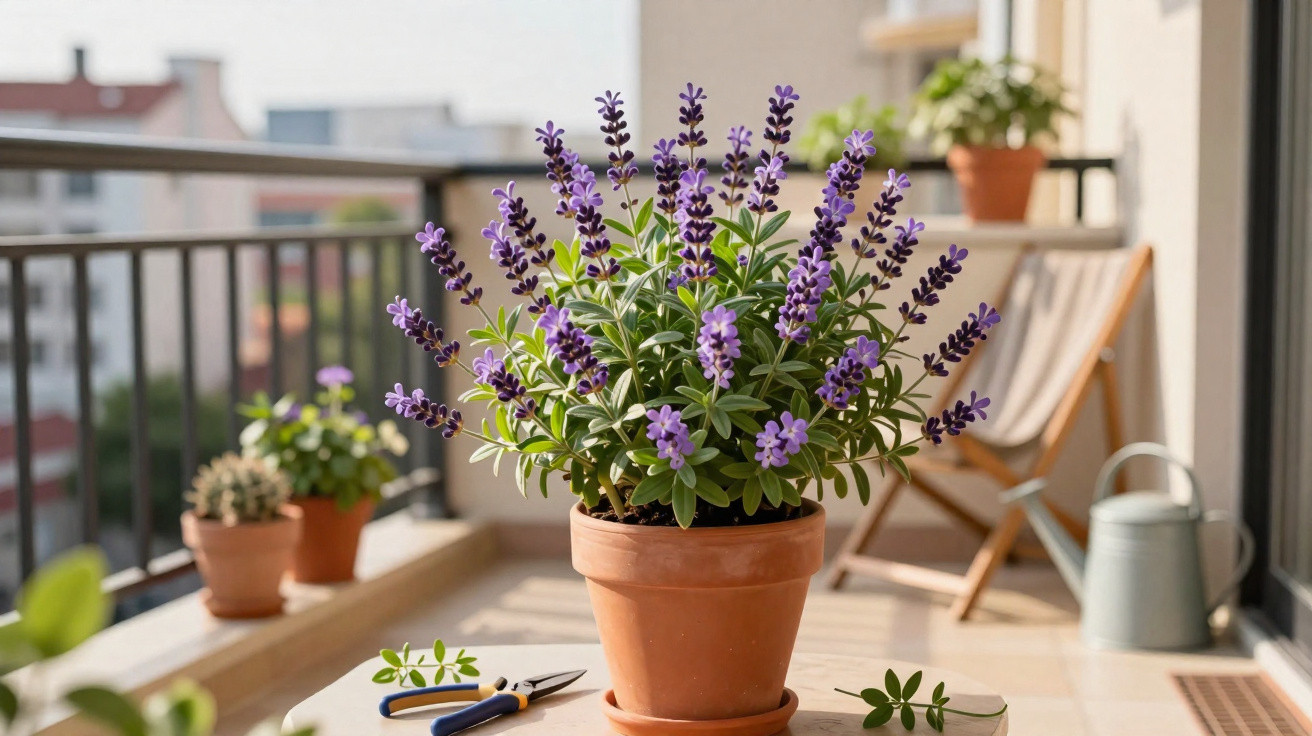
I first noticed this plant squeezed into a chipped terracotta pot on a slim urban balcony: the sort of spot where chairs need to be folded away and every item must justify the room it takes up. Even so, it poured small lavender-coloured clouds over the balustrade. Its delicate flower spikes moved softly in the warm breeze, while bees hovered around them like miniature helicopters with somewhere important to be.
I immediately thought: that is the dream. Here was a plant that stays well behaved and compact, has a romantic appearance, and flowers for months without behaving like a diva.
When I asked the owner what it was, she laughed. “Oh, that? Nepeta.”
Catmint: the understated star of compact spaces.
This compact lavender lookalike that will not take over your life
You may have passed Nepeta countless times without ever learning its name. It makes low, bushy cushions of grey-green leaves, crowned by loose spires of pale lavender-blue flowers. From late spring until October, it hums with pollinators. It carries the easy appeal of an English cottage garden, yet has a growth habit that genuinely suits flat living.
That is important on a narrow balcony or small front garden, where each square metre needs to earn its keep. Nepeta handles the job with understated assurance, bringing colour to tight corners and inconvenient edges without being loud or ever quite fading from view.
Picture a traditional suburban front border planted with large roses, hefty hydrangeas and clipped box balls. It may look lovely, but reduce it to a 2-metre terrace or a postage-stamp patio and those familiar favourites can become bullies. A friend in Lyon discovered this for herself. She packed lavender, roses and a dwarf conifer into one long planter. A year later, the lavender had become woody, the rose was sulking, and the conifer appeared ready to lodge a complaint.
She removed the lot and started afresh with three Nepeta ‘Walker’s Low’ plants in a line. By June, the planter along her railing had become an unbroken wash of lilac-blue. Bees darted in, neighbours remarked on it, and the area finally felt spacious rather than overcrowded.
Nepeta is so effective in limited areas because it respects boundaries. It forms neat cushions or relaxed mounds, generally reaching 30–60 cm in height and seldom exceeding that in containers. Its stems arch gracefully without collapsing into complete disorder. The roots are shallow enough for pots but resilient enough to cope with warmth and occasional neglect.
It is also accommodating of normal human routines. Skip a watering and it may droop a little before recovering. Forget the feed and it will still bloom, although slightly less lavishly. Its lengthy flowering window, from May to October, is not a miracle: it is simply the plant’s usual pattern when it receives sufficient sunshine and fairly free-draining soil. Rather than working against its instincts, you are making use of them.
How to help Nepeta thrive on a balcony, terrace or tiny garden
The essentials are straightforward: sunshine, drainage and a container that is not absurdly small. Choose a pot at least 25–30 cm deep, with proper drainage holes rather than decorative “maybe the water will find a way” marks. Use a light, free-draining compost mix, adding a little sand or fine grit to ordinary potting compost if your summers bring persistent heavy rain.
Position Nepeta where it will receive at least 5–6 hours of direct sunlight each day. In hotter climates, morning sunshine and afternoon shade is ideal, while full sun is excellent in milder conditions. Water thoroughly, then allow the top few centimetres of compost to dry before watering again. Nepeta appreciates a drink, but it cannot stand having wet feet.
Most of us know the routine: buy an attractive plant, drop it into whichever pot is available, water it daily and hope everything works out. In confined outdoor spaces, excessive kindness is Nepeta’s chief problem. Gardeners often drown it, or put it into rich, waterlogged compost and then question why it flops in midsummer.
Realistically, nobody checks the compost moisture with a finger every day. Use easier signs instead. If lifting the pot reveals that it feels light, give it water; if it remains heavy, leave it alone. Apply a modest amount of balanced liquid fertiliser once a month during the growing season, with no need to overdo it. This is a plant that looks its best when treated as an adult, rather than a delicate houseplant on life support.
Every perennial that flowers for a long time has a useful little technique, and Nepeta’s is a haircut. Its first substantial display in early summer is normally spectacular. When the flower spikes have faded and begun to turn brown, use clean shears for a decisive but not ruthless trim, removing roughly one-third of the plant’s height.
Do this on a dry day, then water and walk away. Within two to three weeks, fresh new growth appears, followed by a second (and sometimes third) wave of soft lavender blooms that last well into autumn.
- Best time to plant: Early spring or early autumn, allowing roots to establish before temperature extremes.
- Ideal companions: Low roses, dwarf grasses, small salvias or herbs in neighbouring pots.
- Space between plants: Around 30–40 cm in beds, 20–30 cm in long balcony planters.
- Good varieties for small spaces: ‘Walker’s Low’, ‘Six Hills Giant’ for a slightly larger mound, and compact types such as ‘Junior Walker’.
- Bonus perk: Brushing the foliage lightly releases a gentle herbal fragrance, helping small spaces feel like proper gardens.
Living small, growing wide: what this unassuming Nepeta plant quietly changes
Beyond its soft flowers and restrained shape, Nepeta speaks to a challenge many of us are trying to answer: how to make a limited space beautiful without creating endless work. When something remains alive outside from May to October, a tiny balcony begins to feel like a genuine outdoor room. Open the door and there is movement, colour and a low insect buzz that somehow makes the traffic sound less harsh.
One compact plant will not change a whole city, but it can quietly change how you feel about your own four square metres of sky.
You begin to spot the details: the first flower spike opening in late spring; raindrops resting on the grey leaves; a neighbour upstairs asking what “that soft lavender thing” is, then returning a month later with photographs of their own plant. A small ecosystem develops in a place that previously held only concrete and a plastic chair.
This is not about getting everything perfect. A few stems will turn brown. During a heatwave, a pot may become a little too dry. A cat could roll in the plant, because some cats do love Nepeta almost as much as catnip. Still, it comes back, fills out, forgives and continues flowering. It is quietly dependable.
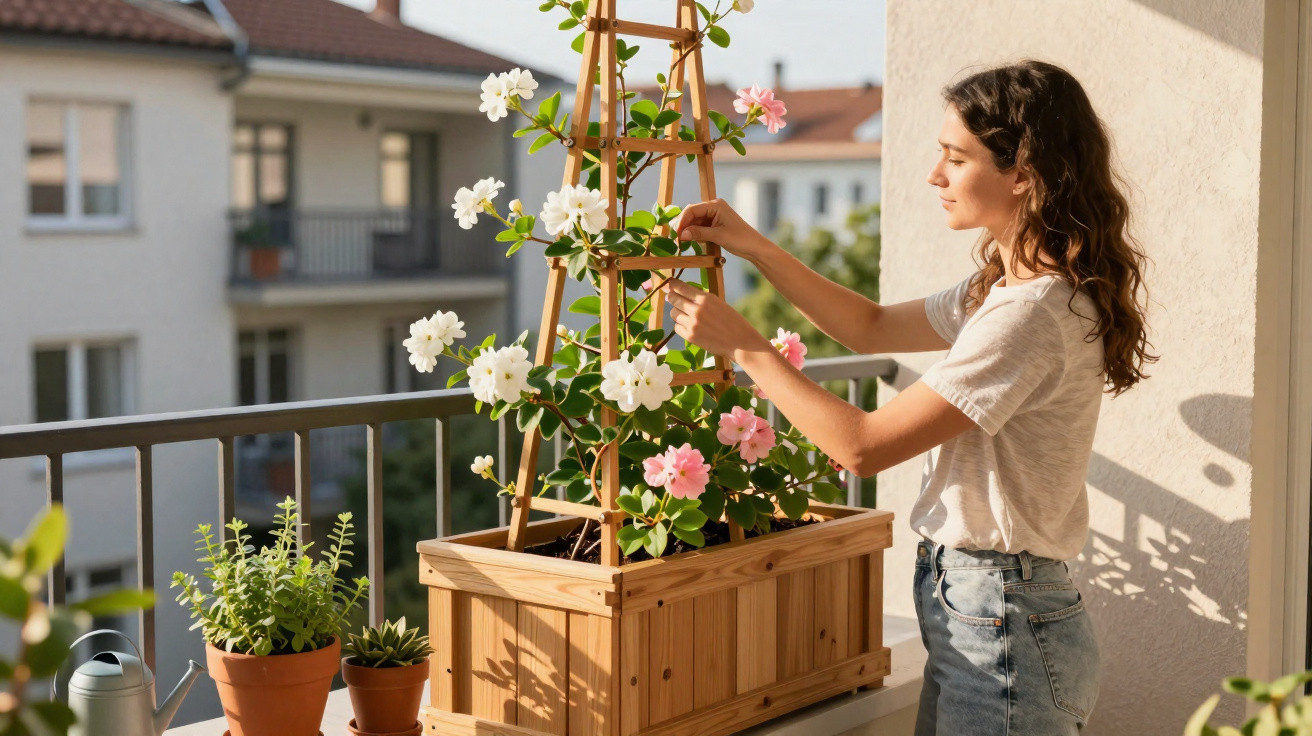
When your space is shared with people, animals or simply the ever-present view from neighbouring windows, this kind of subtle abundance has value. It gives you room to try things out. You might begin with one Nepeta in a terracotta pot, then edge a slim path with three the following year. Or combine it with compact white roses, transforming a cramped strip of soil into something that looks surprisingly like a magazine photograph, albeit one that is lived-in and a little crooked.
The appeal of this perennial is not merely its ability to save space. It uses that space generously, replacing clutter with softness and providing growth that follows its own rhythm while still fitting around yours. That may be the understated luxury so many of us are seeking.
| Key point | Detail | Value for the reader |
|---|---|---|
| Space-saving growth | Produces compact mounds 30–60 cm high, suited to pots and narrow borders | Enables a “real garden” feeling even on small balconies and patios |
| Long flowering season | Pale lavender-blue flowers from May to October with one or two light trims | Delivers months of colour and pollinators without continually buying new plants |
| Low-maintenance care | Grows well in sun and free-draining soil, tolerating some drought and neglect | Offers dependable beauty for busy people who cannot garden every day |
FAQ:
- Question 1 Is Nepeta the same as lavender?
- Answer 1 No, although it creates a similar effect. Nepeta (catmint) has softer, airier flower spikes and grey-green foliage, and it is typically easier and less demanding than true lavender in containers.
- Question 2 Will Nepeta outgrow my small balcony?
- Answer 2 This is unlikely. Most varieties remain compact, particularly in pots. A light haircut once or twice each season will help maintain a neat shape and manageable size.
- Question 3 Does Nepeta attract bees and other insects?
- Answer 3 Yes. This plant attracts bees and other welcome pollinators. On a city balcony, that small hum of life can be unexpectedly calming and beneficial for local biodiversity.
- Question 4 Is Nepeta safe around pets and children?
- Answer 4 Generally, yes. Some cats are drawn to it as they are to catnip and may roll in it, but it is not considered toxic. Always consult current local guidance if your pet tends to chew plants.
- Question 5 Do I need to bring Nepeta indoors in winter?
- Answer 5 No. Nepeta is a hardy perennial in most temperate climates. For potted plants, shield the roots from severe frost with a little insulation or by grouping containers together, and it should return in spring.


Comments
No comments yet. Be the first to comment!
Leave a Comment