
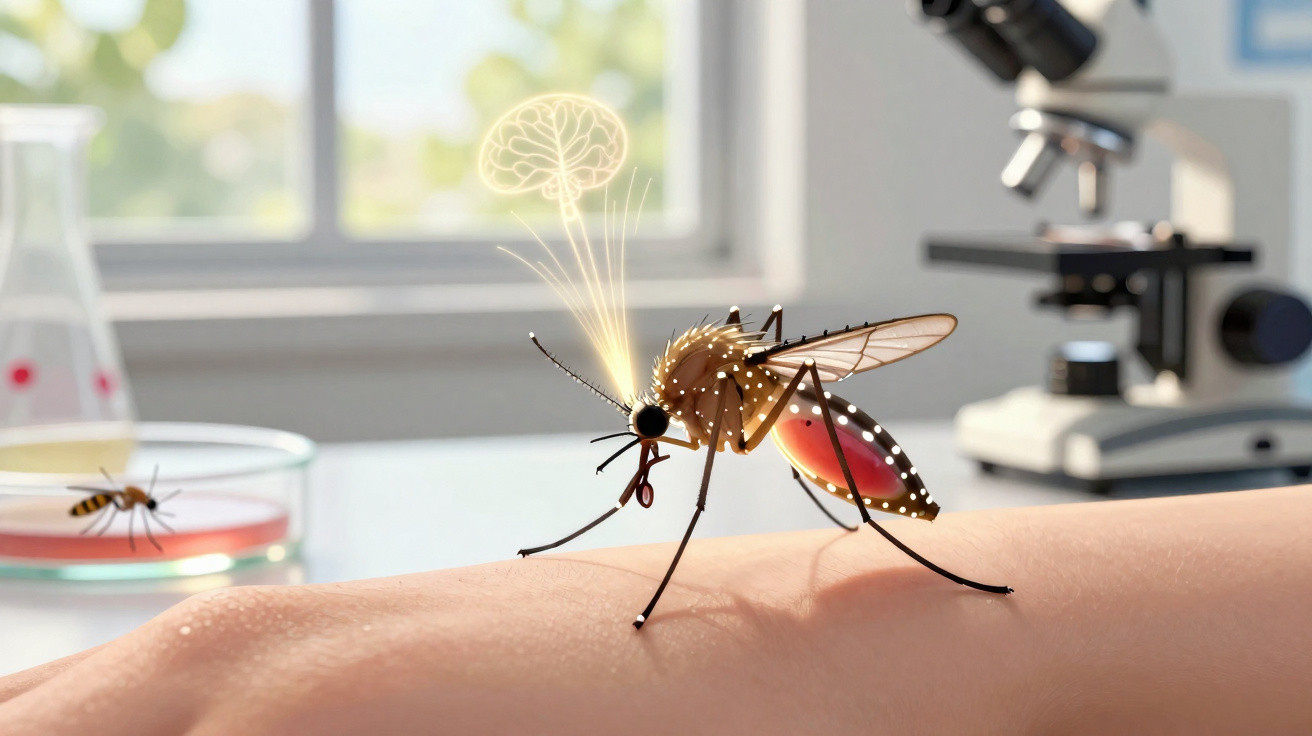
Scientists have found a small group of cells in the mosquito gut that switches off the drive to hunt humans once the insect has fed on blood.
The finding is unexpected because it locates an important appetite-control system in a mosquito’s gut rather than its brain, linking feeding, egg production and biting.
The female mosquito gut is central
The cells are located in six small pads at the end of the female gut, a place where signals of fullness and nutrients meet.
Laura Duvall of Columbia University traced the tissue and identified the receptor in these cells, rather than in the brain.
Scientists have known for decades that female mosquitoes stop wanting to bite for several days after taking a blood meal, but the mechanism responsible had remained unclear.
Locating the switch in the rectum revealed where it operates, although its signals and wider effects still need to be understood.
Why biting stops
In female Aedes aegypti – the yellow fever mosquito – consuming blood suppresses the urge to look for humans for several days.
In 2019, Duvall connected this pause with NPYLR7, a receptor protein that receives appetite-related signals; removing it eliminated the sense of fullness.
The latest research identifies its location and role, indicating that the receptor helps convert nutrients from blood into yolk for growing eggs.
That connection turned the work from a study purely about biting into one concerning reproduction.
Poor egg outcomes
Mosquitoes with NPYLR7 knocked out still consumed normal blood meals and produced clutches of a typical size.
However, their eggs hatched much less consistently, while their mature ovaries contained less protein, indicating that the meal was not being used effectively.
Wild-type females produced around 82 eggs after full blood meals, whereas diluted meals reduced the average to roughly 28.
As the mutants continued to perform poorly after both additional and diluted meals, the issue appeared to be nutrient allocation rather than appetite or digestion.
Not simply waste processing
The most obvious possibility involved plumbing, as the rectum normally enables insects to recover water, salts and small nutrients.
With blood, saline and sugar meals, the mutants generally processed food on time and survived the burden.
There were some delays during the process, but meals still moved through within the anticipated number of hours or days.
The findings instead focused attention on signalling, shifting the explanation away from waste processing and towards decision-making.
Signals after feeding
Nearby nerve endings became the leading possibility because they are close enough to communicate directly with the rectal cells.
Following a meal, these nerves release RYamide, a peptide signal made by nerve cells, and calcium levels rose in the target cells in response.
Amino acids also activated the cells, supporting the idea that they assess both fullness and nutrient quality.
Together, these reactions make the rectum appear less like a drain and more like a checkpoint.
The mosquito gut sends messages
The unusual aspect was what these rectal cells appeared prepared to communicate back to the neighbouring nerves.
Genes active in this gut tissue indicated the presence of vesicles, small packets that cells use to release signals, alongside machinery for common nerve chemicals.
Electron microscope images showed stores of these packets accumulating after blood feeding in normal females, but not in mutants.
The absence of the packets suggests that the receptor helps ready a return signal, though the precise chemical signals are still unknown.
A clue across species
In many animal species beyond mosquitoes, the gut helps determine when eating should slow down or end.
In humans, certain weight-loss medicines imitate a gut hormone that helps communicate fullness through nerve and brain pathways.
In other mammals, gut sensory cells can form synapses with nerves connected to the brain, transmitting nutrient information within milliseconds.
Nevertheless, these similarities do not mean mosquito biology matches our own; they do, however, reinforce the argument that gut-to-brain control is ancient.
A target for feeding control
Researchers working on mosquito control are interested because a gut receptor is more accessible than one located deep in the brain.
More recent compounds that activate NPYLR7 reduced blood feeding at doses 100 times lower than earlier molecules.
“It’s a much more accessible target than a receptor in the brain,” said Duvall.
The approach is still at an early stage and has not been tested beyond controlled experiments, but it could point towards bait-based tools that alter biting behaviour.
Controlling mosquitoes through the gut
Major questions remain, particularly about the signal these cells release after detecting nutrients derived from blood.
The team believes that messages may travel back to the nervous system, although other organs might also receive them.
It is not yet known whether this pathway functions in other blood-feeding insects or is largely specific to mosquitoes.
These unanswered questions matter for any control method, as gut-based tools would need to work consistently beyond a single laboratory species.
A mosquito meal now appears to trigger a signalling chain in which gut cells evaluate nutrients and help determine when biting stops.
If scientists can influence that chain externally, they may find a practical means of reducing bites before they occur.






Comments
No comments yet. Be the first to comment!
Leave a Comment