
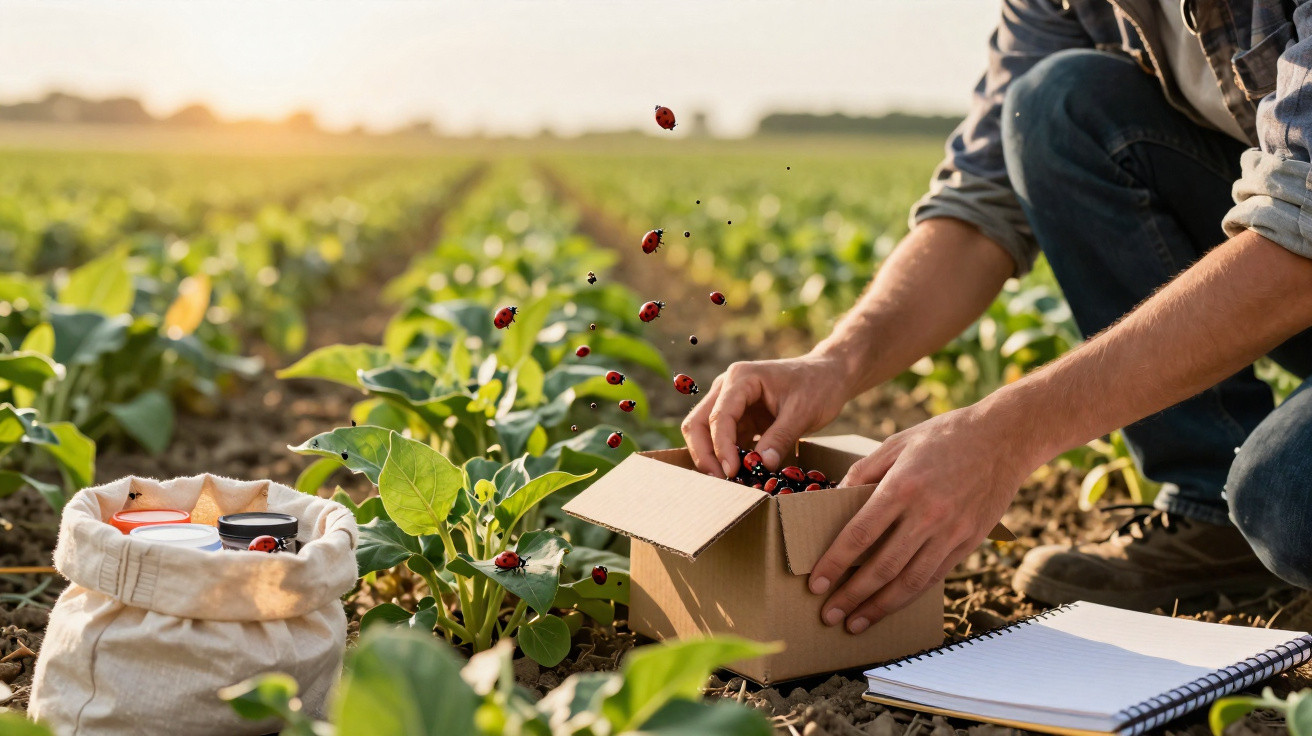
Tiny red specks scramble over one another, tumbling on to the farmer’s hands as he tips a box above a row of lettuce. Beyond him lies a broad valley, normally covered by tractors towing tanks of chemicals. But today it is unnervingly calm. There is no chemical odour and no engine drone, only the faint flutter of wings as thousands of ladybugs start vanishing into the green lines. A neighbouring farmer rests against the fence, doubtful as he watches the insects take to the runway of his livelihood. “So you’re telling me this… replaces pesticides?” he asks. The reply is yes. And, at the same time, not entirely.
Millions of red dots replacing pesticides
At first, the sight can seem like a joke. Rather than applying a thin chemical spray to their crops, certain farmers are releasing literal clouds of ladybugs into them. Packed by the million into cardboard boxes or mesh sacks, they are sent overnight as a delicate, living consignment of hope. Once the containers are opened, the beetles spill out in a slow, glinting flow. They climb, disperse and disappear beneath the foliage. It looks both decidedly low-tech and quietly revolutionary.
For generations, industrial-scale agriculture has depended on synthetic pesticides to deal with aphids, mites and other insects that consume crops. The reasoning was straightforward: eliminate the pests, protect the plants and safeguard the harvest. For a time, it succeeded. Then soils became depleted, useful insects were killed off, and resistant “super pests” emerged. From vineyards in California and orchards in France to Argentine wheat farms, increasing numbers of growers are turning to something that can look almost childlike: letting ladybugs tackle the unpleasant work.
At an organic strawberry farm in central California, the change is already apparent in the figures. The farm once paid tens of thousands of dollars annually for approved organic sprays, using them every week at the height of the pest season. Since adopting a biological approach built around ladybugs and habitat strips, spraying has fallen by almost 70%. Harvests have remained stable. The owners have begun speaking, cautiously, about something absent for years: profit margins that genuinely provide breathing space.
A different grower in southern Spain trialled ladybug releases in only one tomato polytunnel, while maintaining conventional chemical protection in the others. Harvest logs recorded fewer aphid outbreaks in the “insect-managed” tunnel, as well as noticeably fewer follow-on issues such as spider mites. Wildflowers nearby were buzzing once more. In the farmer’s notebook from that year is one brief, unsteady sentence that says a great deal: “No mass die-off of bees this spring.” Statistics can tell a story, but a plain sentence can sometimes land more powerfully.
This is not magic; it is ecology. Ladybugs are extremely hungry predators. An adult can consume dozens of aphids each day, while their larvae can eat even more. Released by the million across a landscape, they become a living, mobile pest-control network, targeting harmful insects without affecting everything else. Instead of coating fields with a broadly lethal substance, farmers introduce a particular participant into a complex process already in motion. Aphid numbers plummet while pollinators continue their work. Spiders, lacewings and other beneficial species return. Across several seasons, the system begins to restore its own balance, much like a woodland gradually recovering after fire.
How farmers work with ladybugs
From a distance, it appears almost absurdly easy. Order ladybugs, open the box, scatter them across the field, and the job is done. In practice, timing and method are crucial. Farmers generally release them at dawn or dusk, when conditions are cooler and the insects are less likely to fly off straight away. They distribute them along crop rows, focus on established pest hotspots, and may lightly spray the plants with water so the ladybugs can drink and settle. It is an unusual blend of scientific practice and care.
Before making the first release, many growers take an even more important step: they cut back or stop using broad-spectrum pesticides that would kill their new arrivals immediately. The changeover can be unsettling. Pest numbers can briefly increase, and some crops may suffer leaf damage. Yet once ladybugs become established, the trend reverses. Growers describe walking through a field to find red beetles feeding calmly throughout it, while the worst aphid colonies have simply… disappeared. It is agriculture, but it can also resemble watching a team turn up just as the match seemed lost.
Not every trial works well. Some farmers introduce ladybugs too late, once pest colonies have already become uncontrollable. Others use them alongside chemical applications that destroy the very insects they bought. Another frequent problem is purchasing an unsuitable species or poor-quality stock from suppliers that regard them as novelty products rather than serious agricultural tools. Let’s be honest: nobody truly gets this right every day on the first attempt, even with technical guidance. The gap between an underwhelming release and an effective biological-control programme often comes down to preparation, patience and recognising that living allies do not follow spreadsheets.
Many growers who make ladybugs work successfully begin to view their land less as a factory and more as an ecosystem. They sow flower strips at field edges, retain small areas of wild vegetation and avoid converting every centimetre into bare earth. These untidy patches give ladybugs and other helpful species places to overwinter and feed when crops are absent. This approach runs counter to the neat, sterile image of industrial farming. Even so, yields can stay high while pesticide costs decline. The view becomes a little wilder, the air smells fresher, and harvest crates remain full.
An agronomist who has helped dozens of farms make the transition puts it plainly:
“We didn’t ‘invent’ ladybugs as a solution. We just stopped fighting against what they were already trying to do.”
That statement is supported by a number of understated but highly practical routines:
- Release ladybugs early, as pest populations begin to emerge, rather than waiting until plants are already covered.
- Shield them from fatal sprays before and after release, particularly on the leaves where they feed and move around.
- Provide a varied landscape, including hedgerows, flowers or cover crops that support alternative prey.
- Keep basic records of release dates, pest levels and weather. After several seasons, those notes become invaluable.
At a human level, these practices require something subtle from farmers: trust. Trust that an unseen army is at work even when they cannot spend all day in a field counting aphids. Trust that using fewer chemicals now can mean fewer emergencies later. That change in mindset is every bit as tangible as a harvest chart.
What ladybugs could change for all of us
It is easy to view millions of ladybugs being tipped into fields as an endearing niche story, a reassuring headline for environmentally aware shoppers. Yet conversations with those doing the work soon reach weightier concerns: farm debt, degraded soil, polluted water and the quiet worries surrounding long-term chemical exposure. Many are not idealists. They are parents calculating costs late at night and wondering how many more seasons their land can absorb what is being poured on to it.
Bringing ladybugs and other beneficial insects back into mainstream agriculture will not fix every problem. It will not remove climate pressures or end drought. It can, however, loosen one persistent belief: that crops can only be protected by sterilising the life around them. More personally, it puts a question to all of us that is rarely asked so directly: how much life do we want in the systems that produce our food? Sterile, predictable and controlled down to the final molecule? Or buzzing, changing and slightly untidy, yet resilient?
In a small balcony garden, releasing a few ladybugs on to aphid-covered roses may feel like a game. On a 500-hectare farm, ordering half a million is a wager involving tens of thousands of euros. It is a quiet bet on cooperation rather than control. We have all stood at a supermarket shelf and chosen the cheapest pack of tomatoes without considering the hidden cost to soil, insects, rivers and human lungs. Once you have seen fields full of living ladybugs rather than chemical haze, that decision feels different.
Perhaps that is the most unusual turn in this story. These red beetles are not merely replacing certain sprays. They are demanding a change in how we imagine farming: from “How do we kill everything that moves except our crop?” to “Who can we bring in so the system supports itself?” When that question becomes ordinary rather than radical, agriculture - and what reaches our plates - will look and taste very different.
| Key point | Detail | Why it matters to readers |
|---|---|---|
| Ladybugs as natural pest control | Every adult and larva can consume dozens of aphids daily, dramatically reducing pesticide use. | Helps explain how food can be produced with fewer chemicals. |
| Timing and technique matter | Releasing ladybugs during cool periods, early in pest outbreaks, and avoiding lethal sprays maximises their effect. | Offers practical pointers for gardeners and for anyone interested in how nearby farms could change. |
| Landscape, not just product | Flower strips, hedgerows and “messy corners” allow ladybugs to survive between crops. | Demonstrates that healthier food systems require redesigned spaces, not simply different inputs. |
FAQ:
- Are released ladybugs harmful to local ecosystems? Most agricultural programmes use species already found in the area, such as Europe’s familiar seven-spotted ladybug, so they strengthen existing populations rather than bringing in outsiders. Issues are more likely when non-native species are imported without adequate research.
- Do ladybugs completely replace pesticides? On some farms, they greatly reduce the need for insecticides, but they seldom work alone. Growers often pair them with other biological allies and use targeted, low-toxicity products where necessary instead of blanket chemical spraying.
- How long do ladybugs stay on crops? Many disperse after a few days or weeks, depending on food availability, shelter and weather. The aim is not to keep every individual in place, but to create conditions in which enough can breed and return season after season.
- Can home gardeners use ladybugs effectively? Yes, particularly in greenhouses, on balconies or in small gardens affected by aphids. Release them at dusk, lightly water plants first, and avoid applying insecticides to the same plants if you want the beetles to remain.
- Are ladybugs a cost-effective solution for large farms? For many farms, the answer is increasingly yes once practices have been adjusted. Upfront investment in insects and habitat can be balanced by lower pesticide costs, fewer resistant pests, and improved soil and pollinator health over time.



Comments
No comments yet. Be the first to comment!
Leave a Comment