
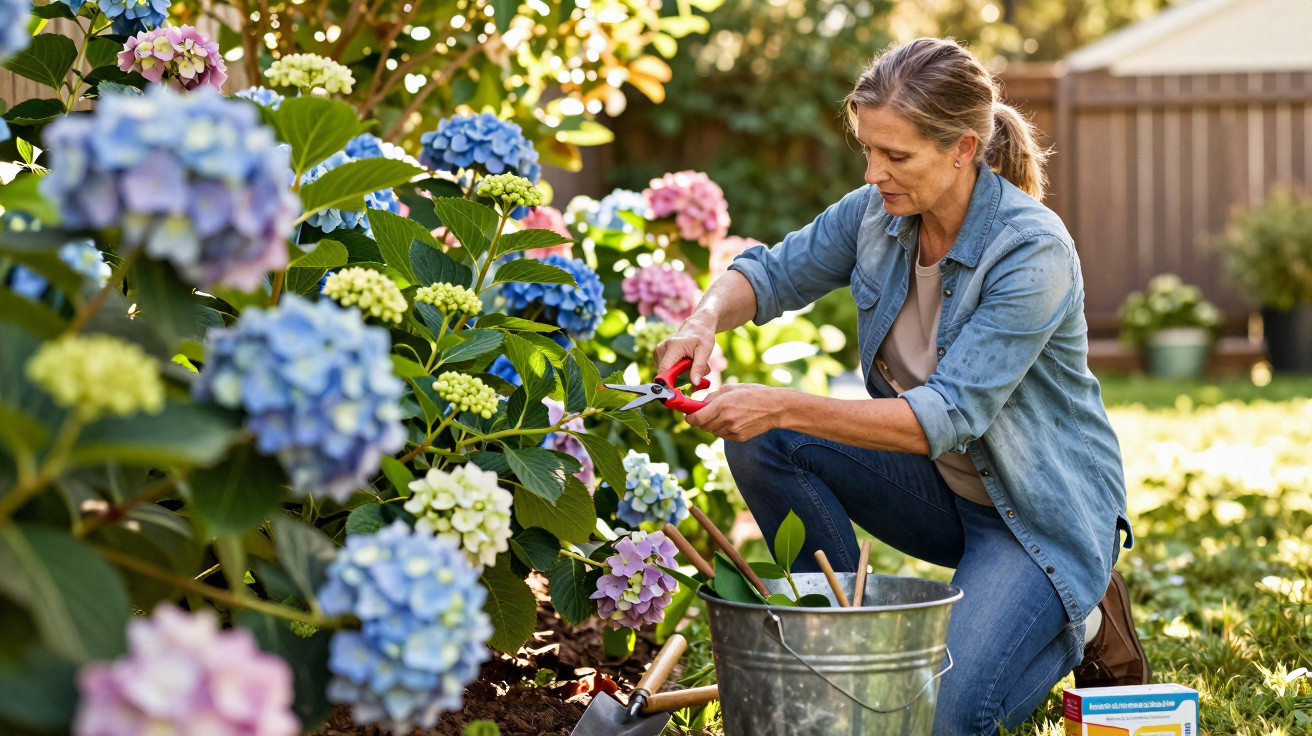
Early in the year, the foundations are laid for a colourful summer.
Anyone who gives their hydrangeas some thought in late winter and takes a few well-chosen steps will reap the rewards. When and how you prune determines whether bold mophead and lacecap blooms appear throughout the summer – not just once, but year after year.
The right time in spring
The ideal pruning window runs from late winter into the very start of spring, usually from late February to early March. The hardest frosts should have passed, while buds are beginning to swell but have not yet opened. At this point, shoots can be assessed safely without damaging developing flower buds. Autumn is not a suitable time, as new growth would be left exposed and could be killed back by frost.
“The decision is made between late February and early March: pruning according to type at this stage ensures abundant flowers for many years in succession.”
What hydrangeas flower on: old or new wood
Not every hydrangea behaves in the same way. Some varieties produce flowers on the previous year's wood, while others form their buds only on newly grown shoots.
- Flowering on old wood: Hydrangea macrophylla (mophead hydrangea), serrata, quercifolia (oakleaf hydrangea), and climbing hydrangeas.
- Flowering on new wood: Hydrangea paniculata (panicle hydrangea) and Hydrangea arborescens, including the well-known garden variety ‘Annabelle’.
This distinction is crucial. Cutting back varieties that flower on old wood too hard removes the entire season’s display. Hydrangeas that bloom on fresh shoots, by contrast, can be pruned much more firmly.
Three straightforward pruning steps for years of hydrangea flowers
Hydrangeas that flower on old wood
The guiding principle for mophead, lacecap and oakleaf hydrangeas is to prune with restraint.
- Remove only the old flower heads, cutting back to just above the first strong pair of buds.
- Cut out weak, dried-up or dead stems completely.
- Each year, remove one to three particularly old basal stems close to ground level to rejuvenate the shrub.
This retains the plant’s natural shape while leaving the buds formed in the previous year intact.
Cutting back paniculata and ‘Annabelle’ correctly
Panicle hydrangeas need a more robust prune: shorten their shoots by one third to one half, always cutting just above an outward-facing pair of buds. This encourages a sturdy, well-aired framework. ‘Annabelle’ will even tolerate being cut back to around 20 cm above the ground. Fewer buds left behind mean fewer flowers, but each individual flower head will be noticeably larger.
| Group | Flowering wood | Pruning intensity | Aim |
|---|---|---|---|
| Mophead, lacecap and oakleaf hydrangeas, climbing hydrangeas | Previous year’s wood | Light, limited to deadheading and thinning | Protect flower buds and retain shape |
| Panicle hydrangeas (H. paniculata) | Current year’s shoots | Moderate, one third to one half | A stable, well-branched framework |
| H. arborescens (‘Annabelle’) | Current year’s shoots | Hard, to about 20 cm | Large, impressive flower heads |
Care after pruning: soil, water and protection
Once the secateurs are put away, turn your attention to the root zone. A few minutes spent here can make a difference for years to come.
- Clear away fallen leaves and diseased plant material thoroughly, so fungal spores do not gain an early advantage.
- Apply a layer of mature compost or a specialist hydrangea fertiliser, working it lightly into the surface.
- Mulch with bark chips or shredded leaves to help the soil hold moisture for longer.
- Water deeply if conditions have been dry, especially for young plants and container-grown specimens.
- Watch for late frosts: when sub-zero temperatures are forecast, cover plants in the evening with horticultural fleece or a light bucket, then uncover them again in the morning.
- Remove blackened, cracked or damaged shoots immediately, cutting back into healthy wood.
“Targeted pruning, a portion of nutrients and protection from late frost – this combination keeps hydrangeas flowering reliably over the long term.”
Position, fertiliser and colour-changing tricks
Hydrangeas thrive in partial shade, with morning or evening sun and a sheltered position out of the wind. Leaves and buds suffer in intense midday sun, while flowering will be sparse in permanently dark sites. The soil should be rich in humus, consistently moist and slightly acidic.
Those wishing to influence the flower colour of mophead hydrangeas should monitor the pH value. Pink varieties can become bluer in more acidic soil where sufficient aluminium is available. This can be achieved with rhododendron compost, a moderate application of acidic mulching material, or alum products from garden centres. Hard water may lead to chlorosis, visible as yellow leaves with green veins. Rainwater and, where necessary, an iron treatment can help.
When it comes to nutrients, feed in a balanced way and never overdo it. Too much nitrogen promotes leafy growth but suppresses flowering. A hydrangea or rhododendron fertiliser with a higher potassium content strengthens tissues and buds. Apply fertiliser in spring, followed by a second, lighter feed no later than June; stop after that so shoots have time to ripen properly.
Common mistakes and emergency tips
The most frequent mistake is cutting back completely a variety that flowers on the previous year’s wood. If flowering fails after such an error, patience is the only remedy. The following year, return to carefully removing only old flower heads and taking out a few old basal stems annually.
Late frost can damage plump buds. Simply trim brown, glassy-looking tips back to green tissue. During severely frosty nights, a quick cover of fleece, cardboard or spruce branches is worthwhile. Container hydrangeas are better placed close to a house wall during cold spells.
There are repeat-flowering lines such as Endless Summer, which bloom on both old and new wood. These varieties are more forgiving of harder pruning and produce fresh buds again in summer. If you are unsure, watch the plant for a season: where do the first buds appear, and which wood produces the strongest flowers?
Practical details for clean work
Sharp, clean secateurs are essential. Always make cuts just above a bud, at a slight angle so rainwater can run off. Disinfect tools before starting and when moving between plants to avoid spreading disease. Work on frost-free days and, whenever possible, on dry wood, as cut surfaces heal faster.
A discreet support can be useful for heavy flower heads. ‘Annabelle’ in particular often flops after summer thunderstorms. Three or four unobtrusive perennial rings or bamboo canes, installed early in the year, keep the stems upright without spoiling the appearance.
When to water and how much
Hydrangeas are commonly known as “water drinkers” for good reason. Their soil must never dry out completely. It is better to water less often but thoroughly than to give small amounts constantly. A mulch layer reduces evaporation, while a larger container with water storage helps potted plants. Morning is the best time to water, allowing foliage to dry during the day.
Keeping an eye on diseases and pests
Aphids and spider mites occur mainly when plants are stressed by drought. A forceful jet of water or wildlife-friendly soap solutions can deal with them quickly. Fungal leaf spots can be limited by maintaining an open plant structure and disposing of fallen leaves properly. Yellowing leaves often indicate stress caused by lime in the water or soil – switching to rainwater is then the simplest adjustment.
By following these points, you give hydrangeas everything they need: the correct timing in spring, pruning suited to the variety, and follow-up care around the roots. The shrub remains vigorous, flowering stays abundant, and the summer garden becomes more colourful every year.





Comments
No comments yet. Be the first to comment!
Leave a Comment