
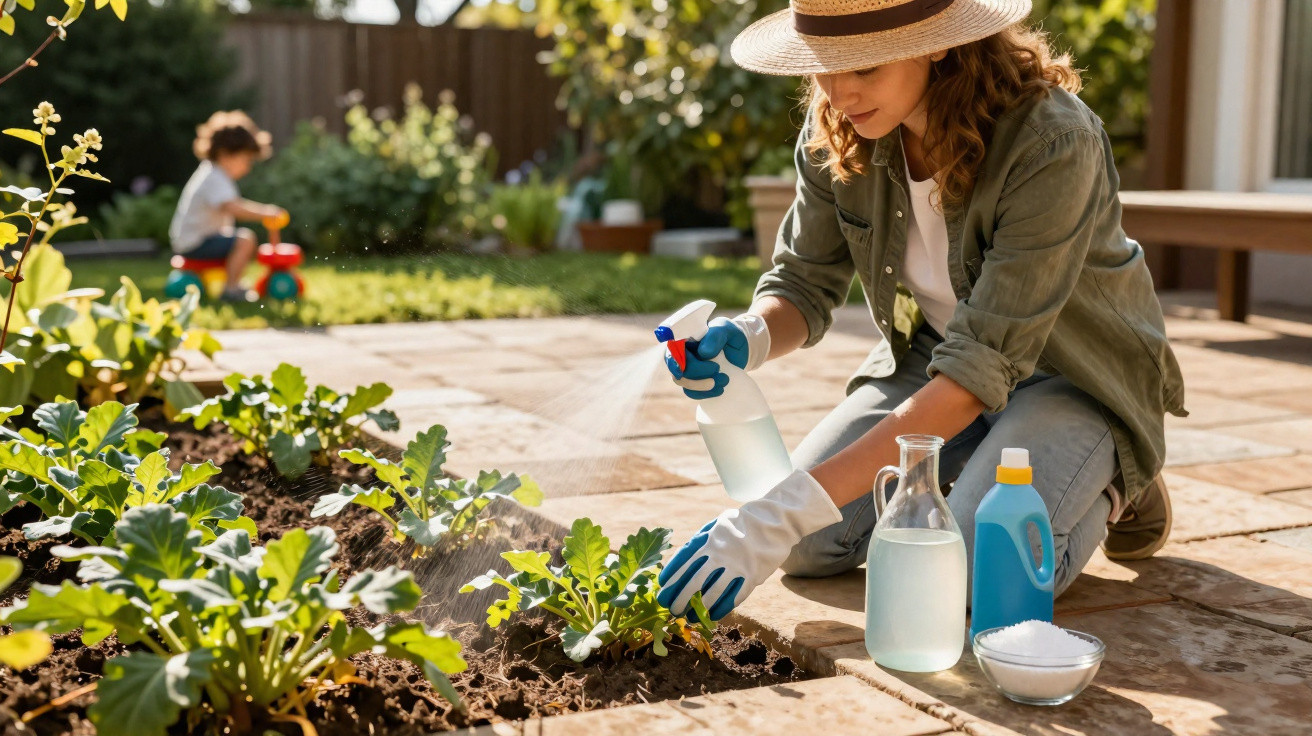
Anyone who has spent hours on their knees pulling weeds from paving joints knows the frustration: no sooner is everything tidy than the growth returns. White vinegar is often seen as a quick, “natural” answer, yet the results are usually short-lived. Increasingly, another kitchen product is taking centre stage in gardens, using a simple trick that can have a more lasting effect.
Why white vinegar quickly reaches its limits against weeds
White vinegar mainly acts on the surface. Its acidity attacks leaves and green shoots, causing them to discolour, wilt and collapse. Visually, the area can then look perfectly clean.
Beneath the paving, however, the situation is different. The roots often remain largely unharmed, protected within the ground, and can send out fresh shoots after a few days or weeks. What appears to be a thorough clean-up can therefore be misleading.
Vinegar “burns” the visible parts of the plant, but often leaves the roots below ground alive – and that is exactly where the next flush of growth begins.
For isolated, very young seedlings, vinegar may be enough. But anyone maintaining a whole driveway, long paths or wide patio joints this way will need to repeat the work constantly. Repeated treatments take time and test patience.
For this reason, many amateur gardeners look for an added effect that works more deeply without turning to harsh chemical products. Surprisingly, it is close at hand – right beside the kitchen sink.
Washing-up liquid: a hidden ally against weeds in paving joints
Ordinary household washing-up liquid contains substances known as surfactants. In daily use, these help loosen grease and make it easier to remove dirt from dishes. In the garden, they can have a different but equally notable effect.
Plant leaves have a naturally slightly waxy coating. This repels water and protects the plant from drying out and from outside substances. Surfactants disrupt that protective layer, allowing water and other ingredients in the mixture to cling for longer and penetrate further into the tissue.
Applied neat, washing-up liquid gradually reduces the treated parts of the plant’s ability to retain moisture. The above-ground growth dries out. When combined with vinegar, the effect becomes noticeably stronger.
Washing-up liquid acts like a door opener: it opens the leaf surface so that vinegar and water remain where they are intended to cause damage.
This mixture is primarily suited to hard surfaces, including paving, slabs, gravel paths and driveways. Vegetation is generally unwanted in these places, where permanent planting is not the aim.
A simple kitchen recipe for paving weeds
A version commonly used in everyday gardening contains just three basic ingredients:
- 1 tablespoon of washing-up liquid
- 1 litre of water
- optional: 1 cup of white vinegar
Put all the ingredients into a watering can or, for more controlled application, a pressure sprayer or hand sprayer. Shake thoroughly until combined, then spray directly onto the unwanted plants.
Dry, sunny weather is the best time for application. The liquid stays on the leaves for longer, while sunshine supports the drying effect. Many weeds begin to show discolouration after a few hours, then collapse over the following days.
Variations for different garden problems
Gardeners adjust the proportions according to the location and the severity of the growth. The options range from mild to fairly drastic.
Mild mixture for light weed growth
For young shoots in paving joints or gravelled areas, a gentle recipe is often sufficient:
- 1 litre of water
- 1 tablespoon of eco-friendly washing-up liquid
This version contains no vinegar at all. It can be used in places that are maintained regularly, such as driveways or areas around wheelie bins and garden gates.
Stronger version with white vinegar
Where dense mats of growth have already developed, many people use a higher proportion of vinegar:
- 1 litre of white vinegar
- 2 teaspoons of washing-up liquid
This mixture works more forcefully and quickly, but should only be applied to surfaces with a purely mineral base. It can cause considerable damage in flowerbeds, lawns or around shrubs.
Radical salt solution – only for difficult areas
Some gardeners use an even harsher combination, for example on old, completely overgrown yard driveways:
| Ingredient | Amount | Area of use |
|---|---|---|
| White vinegar | 1 litre | mineral surfaces only |
| Table salt | 40 g | heavily weeded joints |
| Washing-up liquid | 10 ml | adhesion and wetting |
This mixture often suppresses plant growth for a long time. However, it can harm not only weeds but also soil life and the ground’s ability to absorb water. Anyone using it should restrict it to places where absolutely nothing is intended to grow permanently – such as along kerbs or in unused corners well away from beds.
Spray precisely rather than treating whole areas
Even though the ingredients originally come from the kitchen, the mixture works like a herbicide. It should only be used where plant growth is not wanted.
A few practical gardening tips:
- Always spray individual plants or joints precisely, rather than covering entire beds or lawns.
- Choose still days so that spray mist does not drift onto roses, perennials or vegetables.
- Take particular care around cracks in asphalt or concrete, as liquid can run into nearby planted areas.
- Watch the forecast after treatment: heavy rain on the same day weakens the effect and can wash residues sideways.
A finely adjustable spray nozzle and a little patience during application produce better results than hurried blanket spraying.
How washing-up liquid mixtures affect soil and the environment
Many people choose household remedies because they expect them to be a “gentle” alternative to synthetic products. Washing-up liquid is still a manufactured substance, however, not a garden tea. Some of its surfactants inevitably reach the soil.
There, they may alter the soil structure. Water can sometimes drain away more quickly instead of being retained properly. This is particularly relevant on very sandy soils or steeply sloping ground. High salt levels intensify these effects, harm soil organisms and may affect the underground microclimate over the long term.
Using the mixture only in targeted spots, perhaps once or twice a year over limited areas, keeps the impact within narrow limits. Spraying entire paths every week, however, can create new problems over time: compacted, dried-out zones where even desired plants later struggle to establish themselves.
Practical examples from everyday gardening
A typical case is a terraced-house patio made of concrete slabs with narrow joints. The first blades of grass and chickweed emerge in spring. Here, the mild mixture of water and a little washing-up liquid is often enough. Two to three treatments per season are sufficient for many gardeners to keep the surface looking tidy.
A different situation is an old gravel driveway with long-established deep-rooted weeds such as dandelions and plantains. In this case, a treatment using a vinegar and washing-up liquid mix may be suitable when combined with mechanical methods. Following up by working the paving joints with a joint brush or paving scraper removes the dried remains and further weakens the root system.
For tiny areas – such as a narrow strip by the garden gate – an entirely different approach can sometimes be worthwhile: refill the joints completely, for example with jointing mortar or a specialist permeable jointing material. This can remove the need to reach for a spray bottle for years.
Alternatives and smart combinations for a sustainable garden
Many gardeners combine washing-up liquid use with other mechanical techniques. Hot water from a kettle weakens fresh seedlings on a driveway. A paving scraper or narrow hoe can then loosen the remains. For large surfaces, weed brushes are available for attachment to a drill or brushcutter.
Deliberately planted joints offer an interesting alternative. In rarely used areas, joints can be planted with tough, low-growing cushion plants, such as thyme varieties or low stonecrop. These “wanted” plants take away space and light from weeds. The garden looks livelier, while vinegar and washing-up liquid are needed less often.
The same principle applies to every method: early, regular action means less aggressive mixtures are needed. The younger the weeds, the easier they are to manage. Combining a little equipment, kitchen household remedies and suitable planting makes hard surfaces easier to maintain – while being kinder in the long run to patience, knees and soil life.

Comments
No comments yet. Be the first to comment!
Leave a Comment