
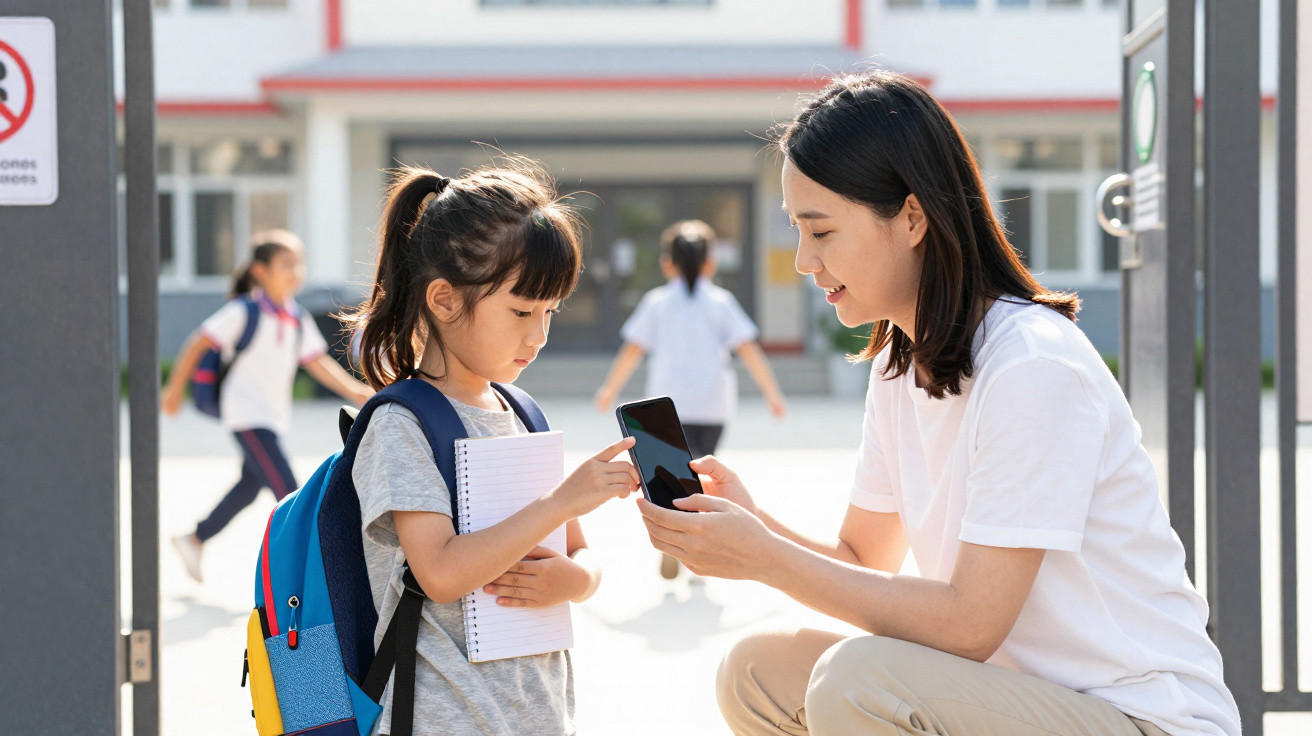
Backpacks thud against lockers, children call to one another and trainers squeal across the floor. Yet amid the noise sits an odd pocket of silence: a cluster of Year 4 pupils with bowed heads, their fingers moving over illuminated screens.
One boy shares a meme, another flicks through TikTok, while a girl checks the class WhatsApp group that her mother joined “to stay informed”. Nearby, two children sit on a bench and watch, feeling both relieved and left out because their parents said “no phone before middle school”.
At home time, the same issue erupts among adults in the car park. Some describe smartphones as “today’s pencil case”. Others call them “slow brain damage” and seem sincerely alarmed. Parents are caught between worries about exclusion and fears of addiction.
And children are placed squarely in the middle of it all.
Smartphone in the backpack: small device, huge argument
At first glance, a smartphone at primary school hardly seems dramatic. It is simply a rectangle tucked into a pocket, used for a selfie or for sending “I’m at the gate” to an anxious parent. It can appear to be an ordinary, almost dull, practical tool.
Look more carefully, though, at 8.20 am outside nearly any school. Children stand along the railings without speaking, each enclosed in their own pixelated world. The playground turns into a place where they wait for notifications. When the teacher opens the door, they look up as though emerging from a brief but intense dream.
Some teachers report noticing the effect. The opening minutes of lessons become “decompression time” after the digital tunnel of the journey to school. A child who has just watched three YouTube Shorts may struggle more to settle into a spelling lesson. Moving from intense stimulation to calm attention can feel harsh - for adults as well, frankly.
At one suburban school near London, staff quietly began tracking how many pupils arrived carrying phones. By Year 5, it was almost half; in Year 6, nearly three in four. One teacher recalls a boy proudly producing the newest iPhone, which cost more than her own. His mother said, partly in jest and partly seriously: “Everyone in his football team has one. I don’t want him to be the weird kid.”
A few weeks afterwards, that boy was sent to the headteacher’s office following an unpleasant incident in the cloakroom: someone had secretly filmed a video, posted it in a class group and prompted a rush of mocking laughing emojis. No one was physically injured. However, the child in the video refused to return to school for two days.
In another town, a headteacher found that arguments between pupils were no longer starting in the playground but on Snapchat the previous evening. The dispute then came through the gates with them the next morning. Teachers were left handling tears and anger over stories they had never even seen. The phone wasn’t just in the backpack; it was in their heads.
Psychologists working with children repeatedly make the same point: the phone itself is not a monster. What puts pressure on a young brain is the relentless switching. Homework one second, a notification the next; then a video, followed by a message from Grandma. A primary-school child’s sense of identity is still like soft clay and readily marked.
Attention is not developed through silence alone; it grows during long, mildly boring periods when little happens. Those are the moments when imagination can enter and the brain practises staying with one task. A feed that updates every second teaches the reverse habit: scanning, jumping and chasing the next flash of interest. Adults already struggle with this daily. For an 8-year-old, it shapes the brain while its circuits are still being built.
Neuroscientists refer to “dopamine loops” and impulse control. Parents see the child who erupts when told “time’s up”, or who looks vacant when asked a straightforward question because their thoughts are still partly caught in the last video. Let’s be honest: nobody manages that supposedly perfectly controlled “responsible use” every single day.
Setting smartphone boundaries without losing your mind - or your child
There is an awkward reality on which most experts agree: a total phone ban until 15 may look simple on paper, but for many households it is close to impossible in practice. Children may walk home alone, parents may work late, and separated families may organise life through group chats. Family life is complicated.
Rather than declaring “never” or “always”, some parents begin with particular purposes. They might choose a basic handset, or a smartphone locked down to calls and GPS alone. No social media before secondary school. No personal YouTube account. Screen time restricted to one or two apps selected together. It is not flawless, and the target keeps moving, but it creates a framework.
One practical approach often found in households that seem less anxious about phones is a “family contract”. It is not a legal agreement, but a handwritten sheet placed on the fridge. It sets out the phone’s purpose - safety and messaging close relatives - where it stays overnight - not in the bedroom - and what follows if rules are broken - the phone goes in a drawer for a while. Children sign it, and parents sign it too. Everybody understands the agreement, even if it is sometimes broken. And it will be.
On a Tuesday after dinner, when everyone is exhausted and the washing-up is piled in the sink, giving in can be incredibly tempting. You are cooking, your younger child is screaming and homework has not even been started. The easiest response imaginable is: “Fine, take my phone, just be quiet ten minutes.” We have all faced moments when getting through the evening beats any long-term parenting plan.
The problem comes when that emergency measure becomes the everyday norm. A child’s brain gradually learns that boredom is intolerable and that a screen will always fill the empty space. Over time, siblings play together less often. Bedtime stories become shorter. The child develops less patience for any wait, whether for food, answers or entertainment.
Parents can also get caught up in the idea that “I trust him, he’s careful”. In truth, a 9-year-old brain does not have the same internal brakes as an adult one. Curiosity combined with an unrestricted browser at 11 pm rarely leads to restful sleep. Children do not need to seek out horror or pornography; algorithmic recommendations and innocent searches that go wrong can bring such material to them.
A more measured response is to say plainly: “I know you want to be like your friends. I also know your brain is still growing. My job is to protect it, even when it annoys you.” It may sting at the time, but that openness builds trust over the longer term.
Many child therapists end up offering parents versions of the same observation:
“The question is not ‘phone or no phone’; it’s ‘how much of your child’s mental space do you want this object to occupy before their personality is even formed?’”
To help protect that mental space, some families rely on several straightforward anchors:
- Create one or two “phone-free” areas at home, such as the dining table and bedrooms.
- Set a clear nightly “digital sunset” time.
- Discuss what children encounter online without ridiculing or shaming them.
- Keep one day, or half a day, each week free from personal screens for everyone.
These are not magical solutions. They are imperfect tools that work if parents follow them too. A child who watches their mother scroll through Instagram over dinner quickly learns that rules are negotiable. The phone then represents power rather than a shared tool. By contrast, a father putting his own phone in a basket at 8 pm sends a silent but strong message: “We’re in this together.”
Between fear and reality, parents create the smartphone rules
Speak to parents outside schools and an unusual mixture emerges: guilt, anxiety and quiet resignation. Many feel trapped between two frightening possibilities. On one side is the fear of bringing up a child who is excluded from their peers and mocked for being “the only one without a phone”. On the other is the fear of a brain taken over by blue light and endless scrolling before it has finished developing.
Most parents are not chasing perfection. They want less damage. They want a phone that does not consume their child’s childhood whole, and a way to permit a device without giving every app designer in the world control of their child’s attention. Some quietly admit they regret giving a phone “too early” after watching sleep deteriorate and mood swings increase. Others acknowledge, silently, that they use the smartphone as a co-parent.
Children themselves are beginning to object as well. Some 10-year-olds say they are fed up with being filmed constantly, exhausted by cruel messages in class chats that continue long after the school day ends, and weary of feeling they must “be funny” in every video. A smartphone creates a permanent stage, yet not every child wants to perform all day.
Ultimately, the central issue may not be whether smartphones are good or bad for primary-school children. It may be who sets the rules: families and schools, or notification systems built to extract every available second of attention. Each “just one more video” at the age of 9 is also a line of code running in Silicon Valley.
A child raised with clear, occasionally strict but properly explained screen limits has an advantage: they understand that “enough” is an available choice. A child who never hears that word in relation to technology may carry that invisible permission into adolescence and adulthood. That is when the real fight for their brain starts.
Perhaps the most truthful thing a parent can say now is: “I’m learning this with you. I’m scared too. Let’s figure it out together.” Those words do not erase the risks or somehow shield a vulnerable brain. They do, however, keep communication open before the screen’s glow becomes the only voice in the room.
| Key point | Detail | Why it matters to the reader |
|---|---|---|
| Age is not the only factor | Maturity, circumstances and family habits matter just as much as the date of birth on a calendar. | It helps you move away from rigid rules about the “right age” and towards more realistic choices. |
| Rules are better than bans | Clear, agreed boundaries around time, places and uses work more effectively than complete prohibition or complete freedom. | It provides practical measures you can put into place at home tonight. |
| Modelling matters more than lecturing | Children imitate adults’ phone habits far more readily than what adults tell them about phones. | It encourages you to change your own habits to help protect your child’s brain. |
Frequently asked questions
- What is a reasonable age for a first smartphone in primary school? There is no magic age, although many experts advise waiting until at least the final year of primary school and beginning with a highly restricted device for calls and messages only.
- Are smartphones really damaging my child’s brain? Intensive, unsupervised use can undermine sleep, attention and mood; moderate, supervised use within a structured setting carries much less risk.
- How can I reduce my child’s screen time without constant fights? Agree simple rules together, alter the environment with measures such as no phones in bedrooms, timers and baskets, and provide real alternatives such as games, outings or calls with friends rather than chats.
- What should I do if my child sees shocking content? Remain calm, ask what they saw and listen first. Then explain in simple language why it is unsuitable for children and how you will both try to prevent it happening again, using filters, switching off private browsing and avoiding devices alone at night.
- How do I handle “everyone else has a phone” arguments? Acknowledge how they feel, set out your reasons clearly and, where necessary, offer a compromise such as a shared family phone or a basic device with firm restrictions.





Comments
No comments yet. Be the first to comment!
Leave a Comment