
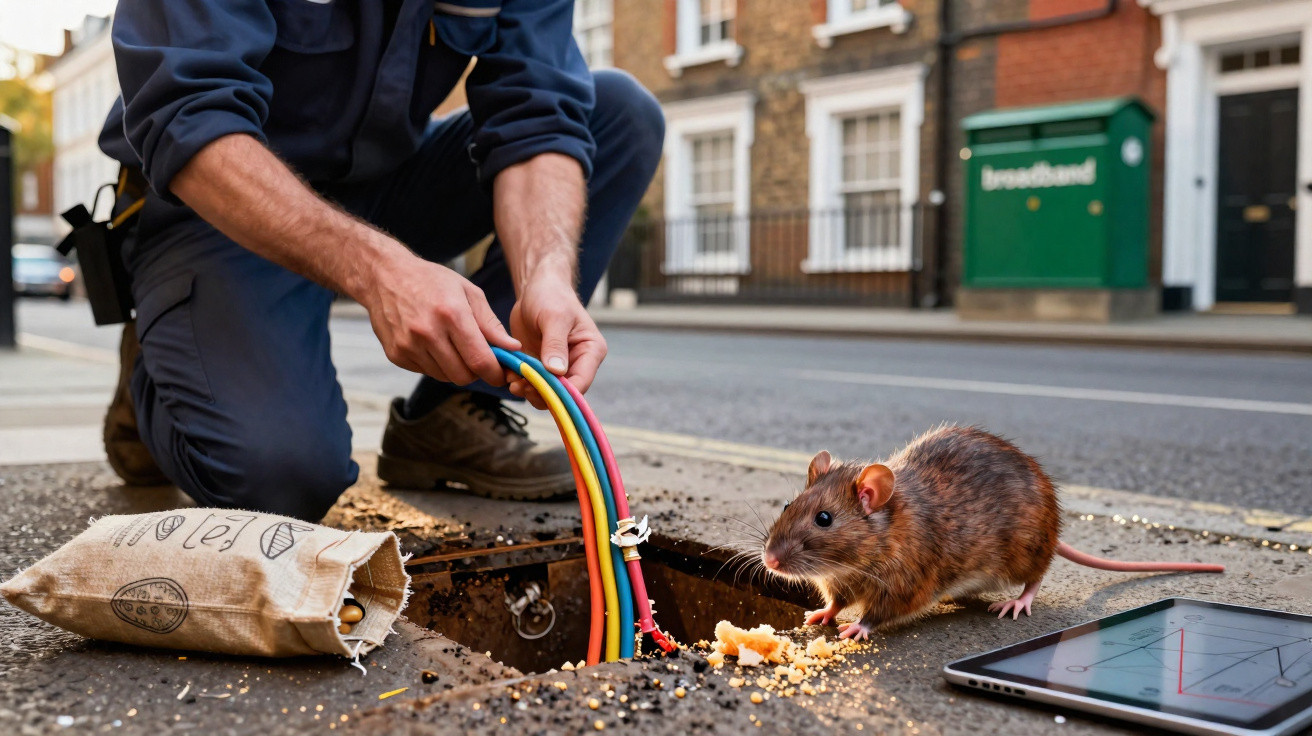
What started as an ambitious full-fibre deployment intended to future-proof parts of the capital became a warning of how seemingly minor design decisions can bring down a business valued at hundreds of millions of pounds.
Rats help finish off a struggling broadband provider
London-based G.Network had presented itself as a challenger ready to connect the city with quick, dependable fibre-optic broadband. It took on substantial borrowing to install cables in major boroughs and gained tens of thousands of customers.
Reports put its debt at about £300 million. The management team began looking for a purchaser prepared to assume control of the company, its roughly 25,000 remaining customers and its infrastructure. A rescue appeared to be within reach.
Competitor Community Fibre came forward and began reviewing the accounts. On the face of it, buying G.Network’s fibre network offered a faster route to wider London coverage than excavating every road a second time.
The deal collapsed when engineers realised large chunks of the network had literally been eaten away.
As part of its due diligence, Community Fibre discovered widespread rodent damage in sections of G.Network’s underground cable network. Because of the extent and positioning of the faults, a buyer would be taking on more than a network: it would also face a major repair programme beneath some of Europe’s busiest roads.
Why these particular cables are a nightmare to fix
Rats gnawing through fibre lines is not unusual. Telecommunications operators worldwide periodically suffer outages caused by rodents, foxes and even inquisitive pets. In most cases, engineers identify the break, draw replacement cable through existing ducts and restore the connection.
However, G.Network chose a different approach for much of its build. Rather than primarily using the existing ducts beneath pavements, it frequently used a method known as “micro-trenching” directly in the road carriageway.
Micro-trenching: cheap to install, brutal to repair
Micro-trenching consists of cutting a slim channel into a road’s tarmac, placing fibre cables within it and then resealing the surface. It is clearly attractive during construction: the cuts are narrow, excavation takes less time and up-front costs are lower than for extensive digging.
For G.Network, this enabled quicker deployment with less initial disruption. The technique, however, carried an underlying expense.
- Each repair requires the road to be cut open again.
- Road closures and traffic diversions are necessary.
- Permits from councils and coordination with transport authorities delay the work.
- Repeated cuts may damage road surfaces and frustrate local residents.
Community Fibre chief executive Graeme Oxby noted that this network layout transformed ordinary rodent damage into an exceptionally costly civil-engineering task. Rather than spending a day drawing new cable through a pavement duct, crews could need to excavate new sections of asphalt repeatedly across a patchwork of boroughs.
Every gnawed cable was not just a technical fault, but a fresh construction site in already congested London streets.
Once the prospective buyer accounted for recurring roadworks, difficult permissions and labour expenses, the financial case for the purchase no longer worked. Acquiring G.Network meant taking on its roads as well as its fibre.
The unexpected role of soy and corn in this mess
Why, then, were rats drawn to these cables in particular?
Rodents have a natural urge to gnaw. Since their front teeth continually grow, they must wear them down on hard surfaces. Plastic ducts and cable sheaths provide suitable resistance, while a single firm bite can break fragile fibre strands and interrupt service.
In response to environmental pressure, cable producers have increasingly moved some materials towards bio-based plastics in recent years. Such blends can contain elements made from soy or corn.
Although these materials may support sustainability targets, they can also create an unintended consequence.
Engineers suspect that soy- and corn-based compounds in some sheaths gave off odours that rodents interpreted as food.
Rather than simply being convenient items to bite, the cables may have smelled like food. For creatures with highly sensitive noses and a natural tendency to nibble, this mix proved hard to resist. Once rats locate a pathway beneath a road that smells like food, they are likely to revisit it and continue gnawing.
The cables’ location deep inside narrow road channels also made prompt access more difficult for maintenance teams, allowing rodents extra time to cause damage before faults were identified.
How a sustainability tweak can clash with resilience
The case illustrates a challenge for infrastructure developers: balancing greener materials against lasting resilience in difficult, unglamorous places such as sewers, tunnels and ducts.
Bio-based plastics can reduce reliance on fossil fuels and might break down more safely after disposal. They may appear durable in controlled laboratory testing. Yet real urban networks must withstand rats, damp, oil, vibration from heavy traffic and inadequately recorded legacy pipes.
| Design choice | Short-term benefit | Long-term risk |
|---|---|---|
| Micro-trenching in roads | Cheaper, faster rollout | High repair cost, traffic disruption |
| Bio-based cable sheaths | Greener manufacturing image | Greater rodent attraction |
| Standard ducting under pavements | Slower construction | Easier access, cheaper repairs |
For investors, these compromises are as important as headline broadband speeds. Telecommunications infrastructure is intended to remain in service for decades. Where every metre of cable has a greater chance of failure and is costly to repair, the entire business model changes.
Could this happen in other cities?
Damage by rodents to telecommunications networks is not exclusive to London. New York, Paris, Tokyo and numerous other densely populated cities contend with increasing rat populations that flourish on food waste, warm underground passages and concealed spaces.
Comparable problems can arise wherever operators rely on micro-trenching or fibre with limited protection. The danger increases when several conditions coincide:
- high rodent density
- long underground cable routes
- limited visual inspection
- bio-based or soft protective materials
Some firms now use bitter-tasting chemicals or more robust outer layers to discourage chewing. Others are reconsidering duct routes and the ease with which cables can be accessed for repairs. A small number are trialling monitoring systems that detect unusual light loss along a line, which may provide an early warning of physical damage.
What “micro-trenching” and “fibre” actually mean for users
To many customers, phrases such as “full fibre” and “FTTH” (fibre-to-the-home) can feel abstract. At street level, they represent practical choices about where excavations take place and which plastics are placed beneath people’s feet.
Fibre-optic cables transmit data as light pulses through glass strands thinner than a human hair. The glass is unexpectedly robust, but a connection is only as resilient as its external protection. A sharp bend or a bite can cause the light signal to fail, leaving a building without service.
Micro-trenching enables providers to cut a narrow slit-often just a few centimetres wide-into existing asphalt. This can reduce schemes that might otherwise last months to a matter of weeks. For residents waiting impatiently for fast broadband, that can appear to be a worthwhile exchange. But enthusiasm soon diminishes if repeated outages occur.
For landlords and local councils considering new broadband construction, the case highlights several practical questions for providers:
- Precisely where will cables be installed, and how will engineers reach them?
- Which materials are used for the sheathing and ducting?
- How many comparable networks has the company built, and what is their fault record?
- Who bears the cost if roads must repeatedly be reopened for repairs?
Broader risks and future choices for digital infrastructure
The G.Network story also demonstrates how a seemingly ordinary threat can bring down an operator that is already financially vulnerable. Competition in the market, higher interest rates and slow customer take-up had already put the company under strain. Rats chewing through soy-scented cable sheaths changed a difficult position into an unworkable one.
For regulators and urban planners, the broader issue is how to support fast fibre rollout without incentivising shortcuts that could impose costs on taxpayers or motorists several years later. Certain cities already provide guidance on preferred duct routes and materials, and more may do so as cases such as this are discussed in boardrooms.
From an engineering perspective, many locations are likely to move back towards more traditional ducting, alongside more intelligent materials. Research laboratories are exploring rodent-repellent cable coatings, hybrid metal-plastic armouring and sensors capable of detecting the slight vibrations of chewing before a line is completely cut.
Ultimately, the events beneath London’s tarmac show that digital infrastructure remains dependent on intensely physical conditions. Fibre speeds and polished marketing slogans count for little when something as commonplace as a hungry rat can repeatedly bring both a network and its business to its knees.





Comments
No comments yet. Be the first to comment!
Leave a Comment