
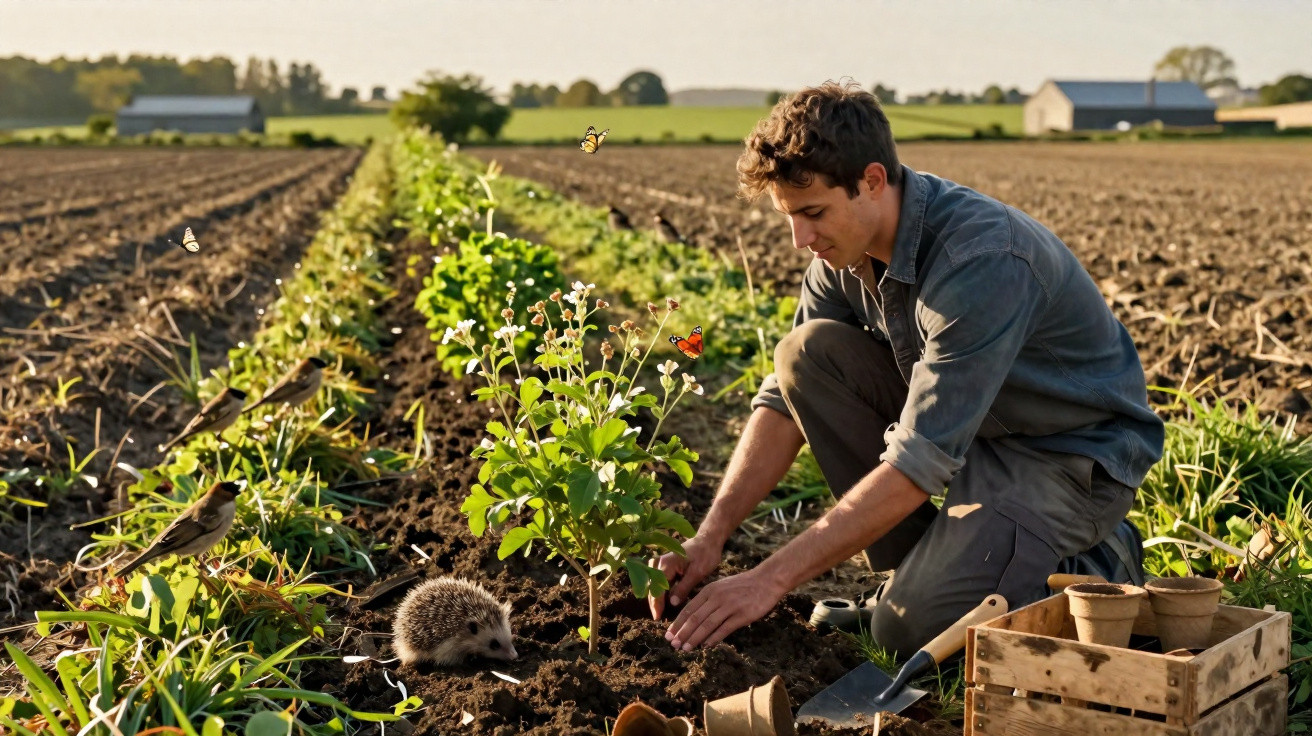
As you draw nearer, though, the atmosphere changes. Bees drone around white flowers, a wren darts through the thicket, and the ground beneath your boots is yielding rather than lifeless and powder-dry. A tractor rumbles past somewhere behind you before the quiet settles again, dense with life.
The farmer beside the hedge is not discussing yields or subsidies. Instead, he gestures towards beetles, fungi and minute tunnels in the bank. Ten years earlier, this boundary had been nothing more than wire fencing exposed to the wind. Today, it is a passageway. A refuge. A gradual revolution unfolding around the edges of his farm.
Expand that image across a continent and its significance comes into view: something substantial, and quietly transformative.
From bare fields to living hedgerows
On a wet spring morning in northern France, volunteers make their way along a field in what resembles a muddy production line. One digs a hole, another sets a young hawthorn in place, and a third presses the soil down with a boot. They chat through the cold, laughing at times and swearing at the clinging clay at others. Within an hour, twenty metres of hedgerow stand where there had previously been only wind and surface runoff.
Repeat that scene thousands of times and the scale becomes clear. More than 90,000 kilometres of hedgerows have been replanted across Europe and elsewhere in recent years. That is approximately the distance of travelling twice around Earth at the equator, formed not from concrete or fencing but from living green arteries. Every new section acts as a small climate buffer, a haven for wildlife and a defence against soil erosion.
The figure can feel remote until you recall that each kilometre begins with a hole, a young plant and somebody’s hands.
In south-west England, researchers followed an established farm that had removed its hedges during the 1970s in the name of “modernisation”. Harvests initially rose, but later levelled off as the soil became thinner and pests moved more easily through open fields. When the family started restoring hedgerows in the 2000s, planting several hundred metres each winter, the results surprised them. Birds came back first, followed by bats. Pest damage had fallen within five years, allowing them to reduce their pesticide use.
Soil analysis revealed a less conspicuous shift. Organic matter increased beneath the hedges, while earthworm numbers doubled. Rainwater that had once rushed in sheets across the farm began soaking into the densely rooted banks. There was nothing dramatic about it: simply modest improvements accumulating year after year along field margins that appeared “productive” while gradually losing their vitality.
This pattern is playing out in landscapes where industrial agriculture has been pushed close to its limits. Hedgerows are not an exercise in nostalgia; they are a form of insurance.
Viewed beyond a single holding, the case for hedgerows is almost painfully obvious. An uncovered field becomes a fast track for water and wind. Heavy rain dislodges soil and sends it downhill, while summer heat strips moisture from exposed ground. With nowhere for wildlife to shelter, pests can flourish because the predators that keep them in check have disappeared with the habitat.
A hedgerow disrupts those processes. Its roots bind the soil and slow the flow of runoff. Its uneven form breaks up wind, creating calmer pockets where moisture remains longer. Fallen leaves and twigs nourish fungi and micro-organisms, which improve soil structure from above. Birds, beetles, spiders and small mammals use the hedge both as a route and a home, quietly restoring balance to food webs in neighbouring fields.
So, when you hear “90,000 kilometres of hedgerows”, it really means 90,000 kilometres of small-scale climate regulators and biodiversity refuges woven back through damaged countryside.
How hedgerows are restored - and how to avoid damaging them
The central idea appears almost disarmingly straightforward: dig a line, establish a mixture of native shrubs and trees, protect them for several years, then allow natural processes to take hold. In practice, the strongest projects depend on understated expertise. Farmers and restoration groups choose species adapted to the local conditions, including hawthorn, blackthorn, hazel, dog rose and field maple. They plant densely, sometimes in three or four rows, to create a robust core rather than a thin, broken strip.
Planting distance is important. Set plants too close together and they compete; leave too much room and openings allow wind to cut straight through. The aim is a balance where branches grow into one another, creating both a protective barrier and rich habitat. Mulch keeps weeds down during the first few years, while low fencing prevents damage from livestock or overenthusiastic tractor drivers. Initially it can seem rather painstaking. Eventually, it vanishes into the landscape as though it had always belonged there.
People often embrace the principle of hedgerows but fall into familiar errors once planting begins. Some use one species for long distances because it costs less and is simpler to manage. The result may look orderly, yet it is more vulnerable to disease and provides fewer habitats for wildlife. Others trim new hedges into rigid, sterile blocks every year, treating them as living fences rather than functioning ecosystems.
Timing creates another difficulty. Cutting during the height of the bird nesting season can destroy entire broods in one operation. Many countries now encourage or mandate winter cutting, when birds are not nesting and most berries have already been eaten. There is also a less obvious concern: allowing a hedge to become sparse at its base. Such gaps invite erosion and let wind through. A healthy hedge is thick from the ground upwards, rather than resembling lollipop-shaped trees above bare banks.
At a farm in Brittany, a hedgerow specialist expressed the point to new landowners in one simple sentence:
“Treat a hedge like a line of wild neighbours, not a piece of garden furniture.”
That approach alters the way everything is managed. Dead wood is left for insects. A degree of untidiness at the margins is accepted because this is where much of the richest life exists. Hedges are cut less frequently and with greater purpose, using traditional techniques such as laying - partly cutting and bending stems to make the base denser - instead of shearing the top flat every year.
For those looking to support this change, a few straightforward principles are useful:
- Put diversity first - mixed native species provide greater resilience and better wildlife habitat than uniform hedges.
- Height and depth are important - tall, multi-row hedges protect soil and provide genuine cover.
- Manage gently - less frequent, better-timed cutting retains nests, berries and structure.
- Think in corridors - each hedge has greater value when it links with another habitat patch.
Let’s be honest: nobody truly manages to do this every day. Yet whenever someone favours the wilder, slightly untidy option over a perfectly neat line, they are supporting a future that can genuinely breathe.
A quiet hedgerow network that could change farming
Stand beside one of these restored hedgerows and trace it with your gaze. It leads to a small oak copse, then another hedge, then a low, damp area that occasionally becomes a seasonal pond. The farm suddenly looks less like a collection of rectangles and more like a web. It is through these links that climate resilience takes root.
Farmers who previously considered hedges an inconvenience increasingly describe them as allies. Some find that fewer crops are blown flat by strong winds. Others see water lasting longer through dry periods, held in the shaded soils beneath the hedge line. A few put it plainly: without these buffers, they say, the next drought or heavy downpour would have affected them far more severely. In poor weather, hedgerows can mark the difference between “a rough season” and major losses.
There is also an emotional dimension that reports rarely acknowledge. Walking beside a hedge full of unseen rustling on a misty evening feels unlike crossing a bare field that has been sprayed. You feel connected to a place rather than merely moving through a unit of production. That may seem insignificant on a global scale, but on a human one it is enormous.
More than 90,000 kilometres of replanted hedgerows are already improving soils, protecting wildlife and helping landscapes withstand more severe weather. The total will increase, bringing further questions: How far can this model extend across intensive farming areas? Who funds the quiet work undertaken at field edges? What will children say about these once-neglected green lines when they grow up and walk the same paths?
Every new hedge represents a wager on a slower, more abundant way of using land. Some will not survive, some will be cut back too severely, and some will prosper beyond expectations. All convey the same message: life at the margins is not a minor concern; it is central to the story. The next time you pass an untidy line of shrubs and trees between fields, it may be worth pausing for a moment simply to listen.
| Key point | Detail | Why it matters to the reader |
|---|---|---|
| Hedgerows rebuild soil | Roots stabilise banks, organic matter rises, and water infiltrates rather than running off | Helps explain how simple landscape features protect food security |
| 90,000+ km replanted | A vast network across farms is creating wildlife corridors and climate buffers | Shows that this is a genuine, large-scale change rather than a handful of “green” pilot projects |
| Management matters | Mixed species, careful cutting and corridor thinking turn boundaries into ecosystems | Provides practical options for landowners, voters and consumers seeking an impact |
FAQ:
- Where are most of these new hedgerows being planted? Much of the present surge is taking place in Europe - particularly France, the UK, Ireland, Belgium and Germany - often with public funding, although comparable schemes are spreading across North America and parts of Asia.
- Do hedgerows reduce crop yields by taking up space? They use a small amount of land at field edges, but many farms achieve stable or even improved net yields over time because of healthier soils, reduced erosion and lower pest pressure.
- How long does a new hedgerow take to become valuable for wildlife? Birds and insects begin using it within a few years, but its full structure - dense cover, cavities and abundant soil life - generally develops over 10–15 years.
- Can small landowners or gardeners follow this approach? Yes. Replacing a sterile fence with a mixed native hedge, even on a very small plot, creates shade, food and shelter while connecting with nearby green spaces.
- Are hedgerows genuinely relevant to climate change? They store carbon in woody material and soils, but their greatest climate benefit is buffering extremes - slowing floods, limiting wind damage and helping landscapes retain water.






Comments
No comments yet. Be the first to comment!
Leave a Comment