
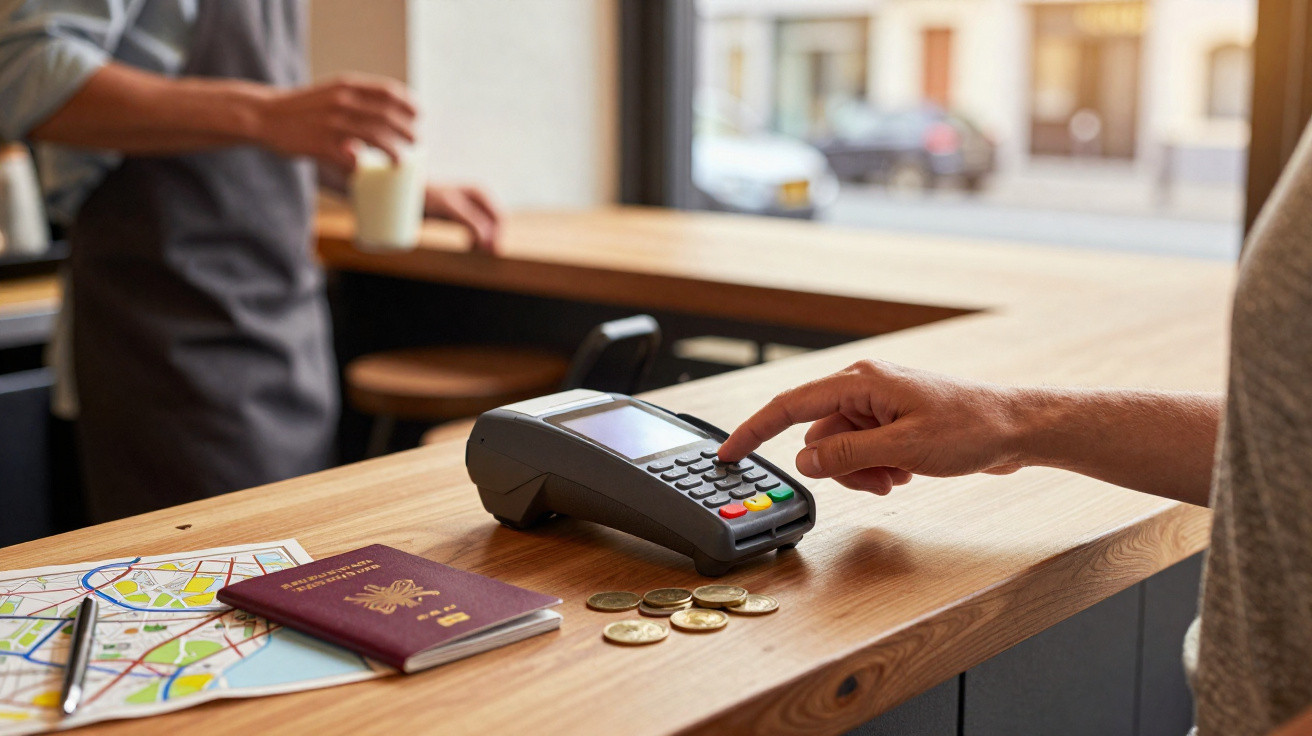
The display flashes what appears to be a helpful question: “Would you like to be charged in your home currency?”
You are jet-lagged, the air is humid and an impatient queue is building behind you. Paying in pounds or euros rather than an unfamiliar ATM currency seems like the safer option. One tap, and it is sorted. Back to enjoying the holiday.
At first, the figures appear reasonable. It is only later, when you are back at the hotel and connected to Wi-Fi, that you check your banking app and feel your stomach drop. The exchange rate is dreadful: a discreet 6–10% worse than the rate you saw on Google. There was no warning or flashing red signal, merely a hidden charge exploiting your uncertainty.
The most deceptive part? You voluntarily pressed “yes”.
The “helpful” screen offer quietly eating into your travel budget
Your first encounter with dynamic currency conversion rarely seems like a scam.
Instead, it feels as though the ATM or card terminal is helping you. “We can convert this for you. You’ll know exactly how much you’ll pay in your home currency.” It sounds clear and reassuring. It sounds protective.
In reality, the ATM operator or merchant is placing itself between you and your bank.
It offers its own exchange rate, with a substantial margin included. There is no obvious warning; what you see is something familiar: pounds, euros or dollars. Your tired mind thinks, “Oh, good, that’s my money language.” That is when the cost of a few coffees or a meal can quietly vanish from your budget.
A British couple in Barcelona faced precisely this decision when withdrawing €200 from an unremarkable ATM near Las Ramblas.
Option 1 was to pay in the local currency, EUR. Option 2 was to pay in GBP at a “guaranteed rate”. Reassured by the £179 figure, they selected GBP. When they checked later, they found that €200 should have cost roughly £170 at the genuine interbank rate that day. They had paid about £9 extra for reassurance they had never needed.
This is far from unusual. Travel-money surveys put DCC mark-ups at between 3% and 12%.
Across a lengthy trip involving repeated cash withdrawals and card purchases, this is not a minor drip of spending; it is a gradual puncture in your holiday fund. Worse still is the emotional after-effect: discovering that money disappeared simply because of a screen button can leave an unwelcome, lasting mark on an otherwise happy trip.
The mechanism is straightforward. Dynamic currency conversion, or DCC, allows the overseas bank or merchant to choose the exchange rate.
Your own bank or card scheme, such as Visa or Mastercard, cannot apply its typically better rate. The ATM processes your transaction, converts it immediately into your home currency and adds a sizeable spread. It then presents that spread in comforting language about “knowing the exact amount in your home currency”.
There is no mystery involved.
Banks and ATM operators understand that people favour certainty over ambiguity, particularly when dealing with another language, a crowded shop or a station late at night. They are not simply offering currency conversion; they are making money from your brief hesitation. Once you recognise this, the supposedly helpful button takes on a very different meaning.
Choosing local currency abroad in three seconds, every time
The rule could not be simpler: whenever you withdraw cash abroad, always choose to be charged in the local currency.
If the machine offers to convert the amount into your home currency, decline it. Select the option showing the currency of the country you are visiting. In Japan, choose JPY; in the US, USD; and in Thailand, THB. Allow your own bank to carry out the conversion afterwards.
In many cases, this requires selecting the less prominent option.
The button offering payment in your home currency may be larger, highlighted or labelled “recommended”. Disregard it. Your understated advantage is spotting the tactic instantly: local currency is good; home currency abroad is bad. You do not need to calculate exchange rates while on holiday, only to maintain that single habit.
Many travellers assume their bank is the main culprit in these situations.
Some banks do offer poor terms, certainly, but many major card networks use reasonably fair rates alongside a modest fee. The real cost often results from accepting DCC at the wrong time. This is why two people using the same card, in the same city and on the same day, can pay 2% and 9% in fees respectively: it can come down entirely to one touchscreen choice.
The first common error is agreeing because the screen feels alarming or urgent.
Statements such as “Your bank may charge fees if you choose local currency” are intended to trigger concern. What they omit is that they are about to charge considerably more through their own conversion. Another familiar scenario occurs at a busy bar, where the card machine is held in front of you and the server selects “home currency” on your behalf “to make it easier”.
The second common error is trusting familiarity instead of the numbers.
Seeing your own currency is comforting, particularly when you are tired or not confident with figures. Social pressure plays a part too. Few people want to delay a queue while examining tiny rates or asking staff what a message means. That is entirely understandable on a human level, but expensive financially. “Let’s be honest: nobody really does that every day.” You do not need to become someone who checks mid-market rates over every lunch. You only need one automatic response: local currency.
There is an emotional cost to feeling misled as well. Across a long journey, these small, avoidable losses can turn into real irritation.
You may begin to question every ATM and card terminal, and feeling slightly foolish can sting more than the lost money. This is why it helps to decide how you will respond before travelling, rather than trying to work it out under neon lights with people waiting behind you.
“Dynamic currency conversion is marketed as transparency, but in reality it’s a way to charge tourists extra for doing nothing wrong – except tapping the ‘comfortable’ button,” says a London-based travel blogger who tracks exchange rates on the road.
To keep the choice obvious when you are rushed, stressed or exhausted, it is useful to picture a small internal checklist.
You do not need to remember figures, only a straightforward way of interpreting the screen before you. Treat it as a mental sticky note carried from airport to airport, ATM to ATM and terminal to terminal.
- When you are abroad and a machine offers your home currency, mentally identify it as the “expensive option”.
- If one option says “without conversion” or “charge in local currency”, select it.
- If another person attempts to make the selection for you, politely stop them and choose the local currency yourself.
The quiet pleasure of avoiding an invisible travel fee
Once you consistently select local currency, a small but meaningful change takes place in the way you travel.
You are no longer simply a passive tourist facing inscrutable screens. Instead, you become someone who understands, at least slightly, the financial machinery operating in the background. It is a subtle confidence boost. You leave the ATM knowing that you may not have received the absolute perfect rate, but that you have avoided the worst one.
This is not about becoming fixated on every penny.
It is about declining to pay an invisible charge for your own uncertainty. During a week in New York or Lisbon, the saving could mean another museum admission, a better bottle of wine or a taxi back to the hotel instead of a long rainy walk. On a month-long backpacking trip, it could determine whether you cut a destination short or spend one more day by the sea.
We do not often discuss these decisions because they are not glamorous.
Nobody posts on Instagram, “Look at this great interbank rate I got!” Yet concerns about money provide a quiet background soundtrack to many holidays. One small, repeatable choice - local currency, every time - will not fix everything, but it removes one frequent source of regret. On a human level, that matters.
| Key point | Detail | Benefit for the reader |
|---|---|---|
| Always choose local currency | Allow your own bank to set the exchange rate rather than the ATM operator or merchant | Cuts hidden mark-ups of 3–12% on every transaction |
| Recognise DCC wording | Terms such as “pay in your home currency” and “guaranteed rate” indicate dynamic conversion | Helps you make the right choice when tired or under pressure |
| Establish a simple travel-money habit | Decide on your rule before departure and follow it at every ATM and terminal | Safeguards your budget without complicated calculations while travelling |
FAQ
Should I ever choose to pay in my home currency abroad? In almost every case, no. Selecting your home currency activates DCC and will generally produce a worse exchange rate than the one offered by your bank or card network.
What if the ATM says that my bank might charge additional fees? This message is often intended to steer you towards DCC. Your bank may apply its standard overseas-usage fee, but the DCC mark-up is generally greater than that fee.
Does this also apply to card payments in shops and restaurants? Yes. Whenever an overseas terminal offers your home currency, choose the country’s local currency and let your bank complete the conversion.
How can I find out what DCC has cost me previously? Compare receipts showing the DCC rate with that day’s mid-market rate, using a service such as XE or Wise. The percentage difference gives a rough indication of the mark-up.
Are there cards that avoid these issues completely? Certain travel cards and fintech services provide low-fee overseas spending, but you must still reject DCC at ATMs and payment terminals to benefit from their favourable rates.





Comments
No comments yet. Be the first to comment!
Leave a Comment