
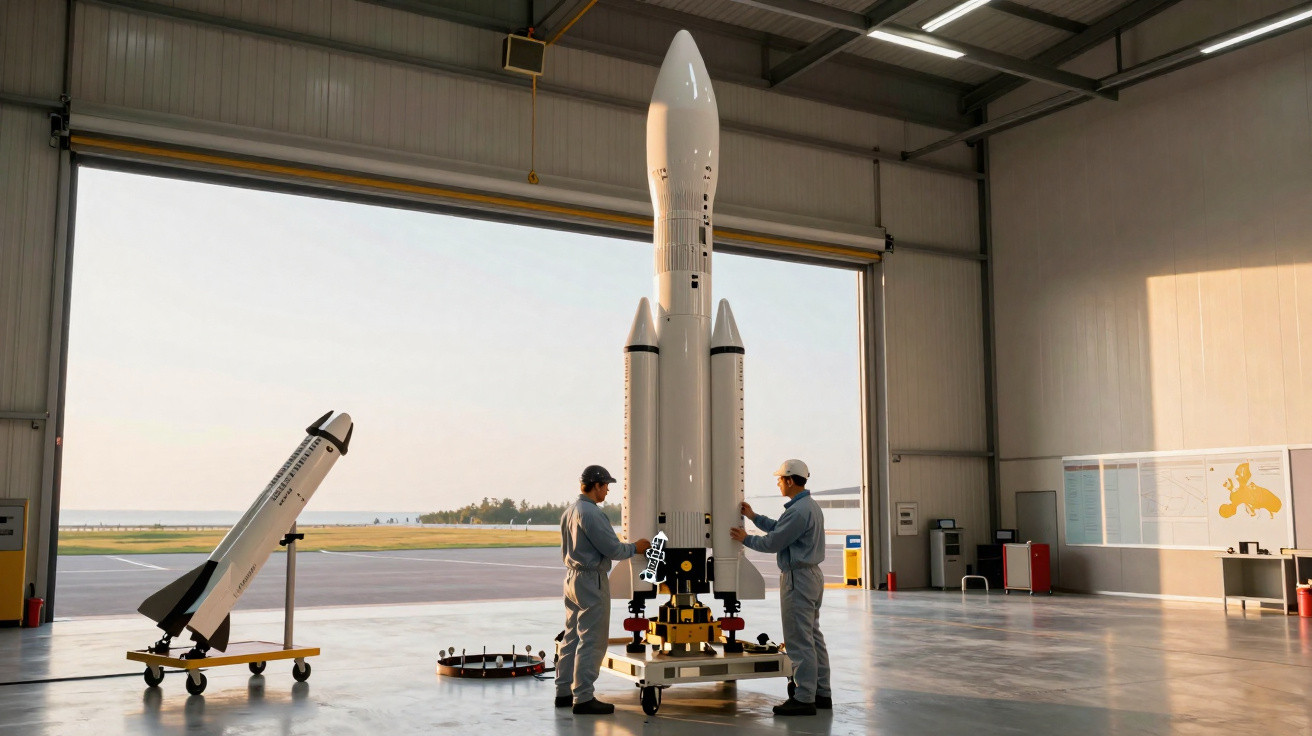
A reusable rocket built in France has quietly won a long-term contract to carry low-Earth-orbit satellites, marking a determined European effort to reduce reliance on American launch providers for strategically important space infrastructure.
A French rocket secures a major OneWeb contract
Eutelsat, the satellite operator, and French start-up MaiaSpace have concluded a multi-launch agreement covering the deployment of part of the OneWeb broadband constellation from 2027.
Revealed in mid-January, the arrangement is expected to run for several years and may account for most Maia rocket flights during the first three years of its commercial service.
Following its 2023 merger with UK-based OneWeb, Eutelsat operates Europe’s only low-Earth-orbit (LEO) broadband constellation. The network currently comprises around 650 satellites orbiting at approximately 1,200 kilometres, delivering high-speed connectivity for governments, armed forces, businesses and remote communities.
This launch deal anchors OneWeb’s future growth on a European rocket, rather than on SpaceX or other foreign players.
Previously, Eutelsat and OneWeb had few alternatives. Political circumstances made Russia’s Soyuz unavailable in 2022, forcing launches largely towards SpaceX in the United States and India’s space agency. The Maia agreement provides the operator with a European option as assured access to orbit becomes an increasingly central sovereignty concern for Paris and London, both major Eutelsat shareholders.
MaiaSpace and Europe’s push for reusable rockets
Established in 2022 as an ArianeGroup subsidiary, MaiaSpace draws on the industrial organisation behind the Ariane rocket family. Its objective is clear: to develop a partly reusable launcher capable of competing with SpaceX’s Falcon 9 and other next-generation rockets.
The company’s answer is Maia, a medium-lift rocket fitted with a 3.5-metre fairing. In its expendable configuration, Maia is intended to deliver up to 4 tonnes to low-Earth orbit, serving constellation deployments as well as institutional missions. A planned optional upper stage, known as Colibri, would add mission flexibility, including the ability to place satellites into separate orbits during one launch.
Before the end of this year, MaiaSpace plans its first suborbital demonstration mission from Europe’s spaceport in French Guiana. Provided the test programme proceeds as intended, commercial flights may begin in 2027, before increasing to roughly 20 launches annually in the early 2030s through a mix of reusable and expendable versions.
Maia is not designed to be a European copy of Falcon 9, but a launcher tailored to the emerging market of frequent, medium-capacity flights.
Key features of the Maia launcher
- Partly reusable first stage, intended for controlled recovery and refurbishment
- Up to 4 tonnes to low-Earth orbit in expendable mode
- Optional Colibri upper stage for adaptable mission profiles
- Launch complex at Kourou, French Guiana, operating under the European Space Agency’s umbrella
- Goal of around 20 launches a year during the next decade
Why Maia and OneWeb matter for European sovereignty
The Maia–OneWeb arrangement is more than a straightforward commercial transaction. It addresses a strategic weakness that has troubled European capitals for years: dependence on non-European rockets at a time when space is increasingly becoming a major theatre of geopolitical competition.
Eutelsat has commissioned around 440 new satellites from Airbus Defence and Space to refresh and enlarge the OneWeb constellation. Deliveries are expected to commence before the end of this year. These spacecraft will gradually take the place of the oldest satellites, which are nearing the end of their planned operating lives.
Launching hundreds of satellites requires a consistent and predictable flight schedule. Dependence on only one or two overseas providers can leave Europe vulnerable to political disputes, export restrictions or a simple shortage of launch opportunities when US customers fill SpaceX’s manifest.
By adding Maia to its roster, Eutelsat spreads risk and ties the future of European broadband infrastructure to a European launch base.
The decision also sits within a wider political setting. French President Emmanuel Macron has repeatedly called for the EU to move faster on its space strategy, pointing to rising tensions involving Russia and China, alongside the rapid militarisation of near-Earth orbit by leading powers.
Competition with Starlink and Amazon
OneWeb faces fierce commercial competition. SpaceX’s Starlink already operates thousands of satellites, providing consumer broadband, in-flight Wi-Fi and essential communications, including services for the Ukrainian military. Amazon’s Kuiper project is preparing a comparable network supported by the firm’s vast cloud-computing and retail resources.
In this environment, OneWeb presents itself as the “European-backed” option, despite operating worldwide and working with partners internationally. Its customers are more heavily concentrated in government, defence, maritime connectivity and corporate networks than among individual users installing dishes on their homes.
At least partial control over the launch chain therefore becomes a competitive advantage. Faster access to orbit, a reduced likelihood of disruption and stricter security requirements could allow OneWeb to market itself to public bodies and critical-infrastructure operators as a more dependable and predictable partner.
What Maia means for the launch market
Maia is entering a competitive sector. Rocket Factory Augsburg in Germany, Isar Aerospace and Spanish company PLD Space are all developing small- to medium-class launch vehicles. At the heavier end of the market, Ariane 6 is at last approaching operational service after extensive delays.
Nevertheless, a reusable European medium-lift rocket able to launch groups of constellation satellites could still fill a gap. Many smaller launchers are aimed at payloads of only a few hundred kilograms, whereas heavy rockets are frequently too large and costly for customers requiring regular, bespoke missions.
| Launcher | Origin | Reusability | Typical payload to LEO | Main target market |
|---|---|---|---|---|
| Maia | France / Europe | Partial (first stage) | Up to ~4 tonnes | Constellations, institutional missions |
| Falcon 9 | United States | High (first stage) | Over 20 tonnes (expendable) | Large satellites, mega-constellations |
| Small European launchers | Europe | Mostly expendable | Up to ~1 tonne | Small satellites, tech demos |
From that perspective, the Maia–OneWeb partnership reduces risk in Maia’s commercial case. Winning a substantial anchor customer from the outset helps support investment in reusable technology and the ground facilities in French Guiana.
How reusable rockets alter the economics
Reusable launch vehicles seek to reduce the cost per kilogram delivered to orbit by recovering and reusing costly components, such as engines and guidance equipment. SpaceX showed that a recovered first stage can fly repeatedly with limited refurbishment, making rockets more comparable to aircraft than single-use missiles.
Should MaiaSpace reproduce even some of that capability, Europe would have a means of reducing launch costs while retaining industrial employment and sensitive expertise within its own borders.
Reusability is not just a technical challenge; it reshapes supply chains, workforce skills and the long-term sustainability of launch activity.
There are compromises involved. Engineering a rocket for recovery increases its mass and complexity, potentially lowering maximum payload capacity or requiring more powerful engines. Operators must consequently weigh the value of reuse against a mission’s specific needs. Maia is therefore planned in both expendable and reusable forms, allowing customers to select an option based on the weight and urgency of their payload.
Some key terms explained
Low-Earth orbit (LEO) refers to altitudes of up to roughly 2,000 kilometres. Orbits at these heights suit broadband constellations because the shorter distance reduces signal delay and enables faster internet connections. The drawback is that each satellite serves a smaller area, meaning global coverage requires a large number of spacecraft.
Constellation satellites are generally smaller and less expensive than conventional geostationary communications satellites. They are built for shorter operational lifespans, often 5–7 years, before being replaced. This renewal cycle creates continuing demand for launches, while any interruption to the launch timetable can rapidly affect service quality.
Risks, scenarios and potential problems
The Maia–OneWeb plan still carries several risks. Demonstration flights could fail and delay the start of commercial operations. Problems with the reuse system might require MaiaSpace to conduct more expendable missions than anticipated, increasing costs. Changes to regulations or export controls could also restrict cooperation between European and non-European supply-chain partners.
Geopolitical possibilities must also be considered. A major worsening of relations between leading powers could limit Europe’s access to US technology or launch capacity. Under those circumstances, an operational and domestically controlled launcher such as Maia would shift from being “nice to have” to “vital”, particularly for government and defence users.
Conversely, if Maia demonstrates reliability and competitive pricing, it could draw non-European customers wishing to diversify away from US or Chinese rockets. That outcome could make French Guiana a more active launch centre, generating a cycle of investment, innovation and a higher launch rate.
What this means for everyday users
Most people will never see a Maia rocket, but decisions being made today may influence how their devices access the internet over the coming decade. As data traffic increases and fibre networks either reach their limits or prove too costly in isolated locations, LEO constellations will carry more backhaul and backup connections for mobile networks, shipping fleets, airlines and emergency services.
If Europe secures independent access to orbit, its governments and businesses will gain greater influence over that communications backbone. A reliable, self-sufficient launch capability lowers the chance that a political decision made thousands of kilometres away will suddenly disrupt communications across the Atlantic, the Arctic or rural areas from Scotland to Sicily.





Comments
No comments yet. Be the first to comment!
Leave a Comment