
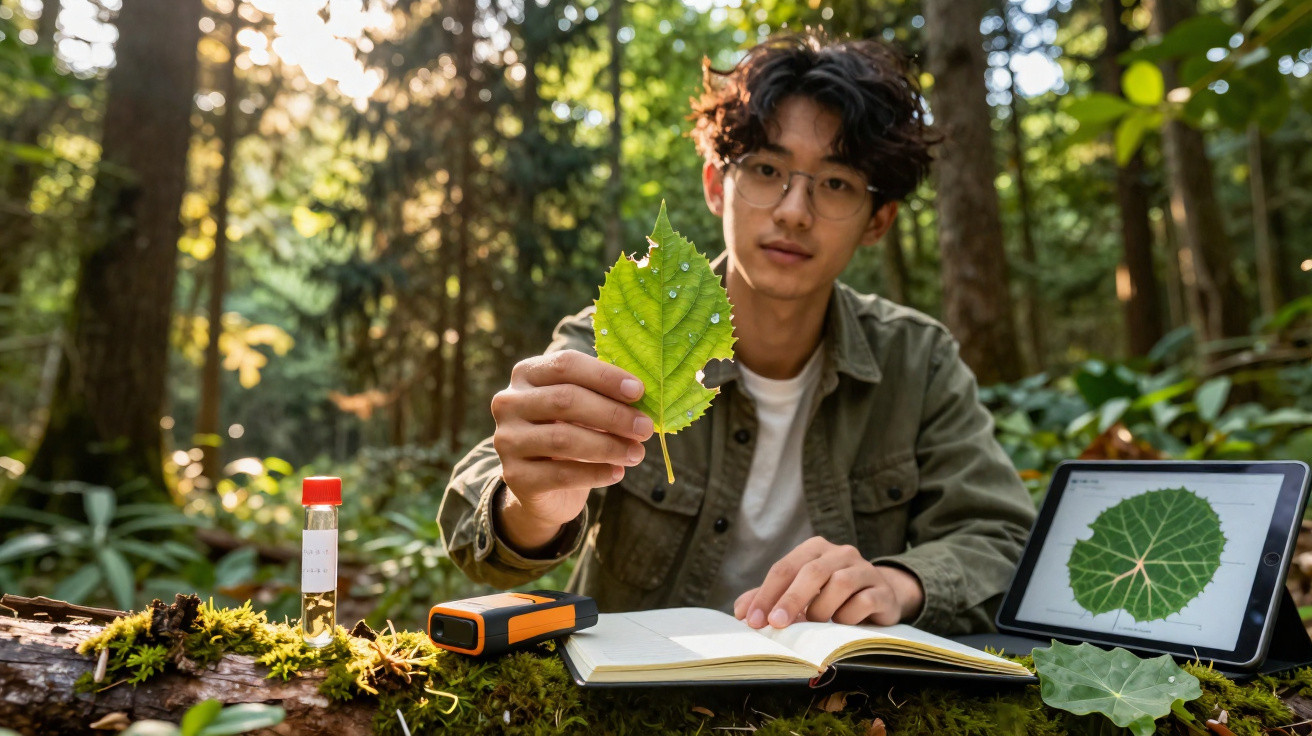
Leaf toughness is among ecology’s most readily understood concepts. The logic is that leathery, fibrous foliage takes insects more energy to chew, meaning trees that invest in more robust leaves ought to experience less damage.
However, fresh measurements from dozens of forest species in China directly challenge this assumption.
Insects appeared to favour the tougher leaves, while the most effective protection came from a much less conspicuous trait.
Measuring insect leaf damage
The research was headed by Longxin Lu at the South China Botanical Garden (SCBG), which is part of the Chinese Academy of Sciences.
Lu’s team assessed leaf damage in 61 tree and shrub species across five forests with different climates.
For every species, they calculated the proportion of leaf area removed by insects, known as leaf herbivory, and compared this with 11 measurable leaf traits.
Mean leaf loss across all forests was roughly six and a half percent. Even before one particular trait stood out, a notable pattern had emerged.
When every factor was considered together, the leaves’ inherent characteristics were better at predicting damage than either climate or the local insect community.
Why leaf toughness can increase herbivory
Leaf toughness delivered the study’s most unexpected result. Plants with durable, leathery foliage – the sort expected to exhaust a feeding caterpillar – experienced greater, rather than lower, damage. This ran counter to textbook expectations.
“The herbivory patterns were far from what we expected. Species with tougher leaves actually suffered more herbivory,” said Lu.
He interprets the finding as part of a continuing evolutionary arms race, in which insects gradually develop more powerful mouthparts capable of overcoming mechanical defences.
These Chinese forests are not the only places where this pattern has appeared. One study of plantation and natural forests likewise found that chewing-insect damage increased as leaves became thicker.
Silicon provides leaf armour
If toughness was not providing protection, another factor was. Leaves containing higher levels of silicon – a mineral that plants absorb from the soil – consistently had less area eaten by insects.
Silicon is believed to make leaf material more difficult to process, seemingly acting separately from a plant’s other defences.
In an experiment involving tropical tree seedlings, supplementary silicon reduced the damage that caterpillars were able to inflict.
This points to a defensive mechanism often omitted from conventional models. The authors say explanations of plant defence should account for silicon, rather than focusing solely on tougher tissues and the bitter chemical compounds usually assessed by researchers.
The heat-tolerance trade-off
Another surprise concerned a plant’s ability to withstand heat. Species with greater heat tolerance, which can keep their leaves working as temperatures rise, suffered more feeding damage rather than less.
“Surprisingly, species with higher heat tolerance experienced greater herbivory,” said study co-author Dr. Hui Liu.
The probable reason is that vigorous plants with strong performance present a more attractive food source.
A healthy, flourishing plant may offer a more nutritious meal and therefore attract insects instead of deterring them.
Heat tolerance, generally viewed as evidence of resilience, has a cost that had not been incorporated into researchers’ models.
The cost of being evergreen
It also mattered whether a tree retained foliage all year or shed it each autumn.
Evergreen species sustained more damage than decididuous trees, which lose their leaves in autumn and replace them each spring.
An evergreen leaf can remain on its branch for years, allowing insects to encounter it season after season. By contrast, a deciduous leaf is dropped in autumn and regrown in spring, effectively starting afresh.
That extended period of exposure accumulates. A leaf that remains available for several years supplies more feeding opportunities than one that survives for just one growing season: small bites repeated year after year.
Climate has a more limited influence
Hotter, wetter forests, which also supported a broader range of insect species, experienced greater overall leaf loss than cooler and drier forests. Climate and insects plainly had an effect.
This is consistent with observations from other forests. Leaf damage generally rises as local insect communities become more diverse, a trend also recorded by a study in subtropical China.
Yet, after the researchers assessed all influences together, leaf traits remained more reliable predictors of damage than weather conditions or the surrounding mix of insects.
The environment shifts the figures, but the plant’s own characteristics make most of the difference.
Wider implications of the study
Before this research, ideas about why insects prefer certain leaves were largely shaped by leaf toughness and growth strategy. The new findings alter that view in two ways.
Silicon appears to be an understated but genuine protective barrier. Heat tolerance, long regarded as wholly beneficial resilience, also functions as an unseen disadvantage. Ecologists had not considered either a principal driver.
As the climate becomes warmer and rainfall more unpredictable, this distinction may help forecasters identify forests likely to face the greatest insect pressure and the tree species at highest risk.
It also offers plant breeders and conservationists another factor to consider when choosing what to plant: silicon.






Comments
No comments yet. Be the first to comment!
Leave a Comment