
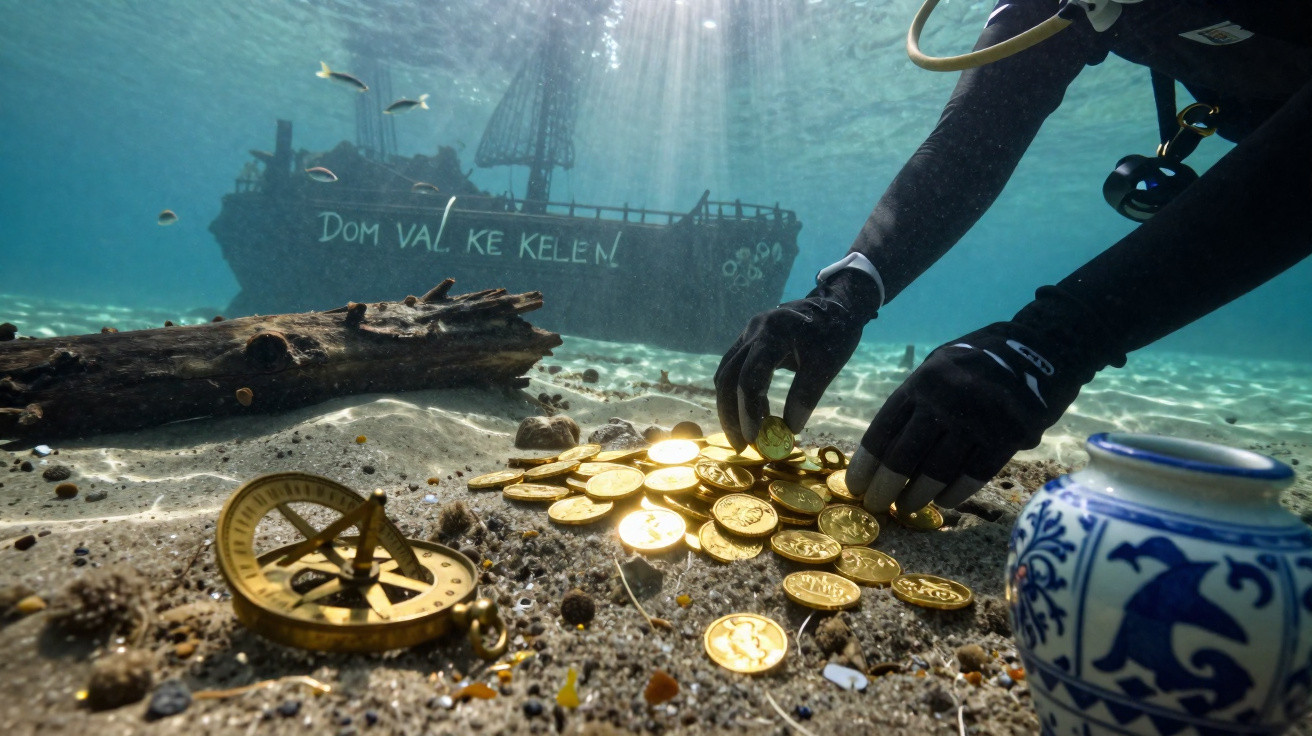
Three decades ago, divers exploring waters off Devon in south-west England noticed a flash of gold on the sand: first a small ingot, followed by 17 coins and eventually hundreds more.
No one could say which vessel had brought the items there, where it had sailed from, or why it had gone down so near the coast. At last, that mystery has been resolved.
Documents unearthed from legal records in London, some centuries old, have named the wreck as the Dutch merchant vessel Dom van Keulen. The ship sank in December 1633 while transporting a cargo of Moroccan gold to Amsterdam.
Gold and the Dom van Keulen
Ron Howell was the diver who first noticed the gold while working on the seabed in Salcombe Bay, Devon. Once he notified Britain’s Receiver of Wreck, a team began systematically surveying and mapping the location.
In the years that followed, investigators retrieved more than 400 gold coins, as well as ingots, jewellery and dispersed remnants of a working vessel.
David Parham, professor of maritime archaeology at Bournemouth University, headed the work to establish the wreck’s identity.
Parham and his fellow researchers determined that the coins were not items accidentally lost overboard. Instead, they formed an intentional bullion hoard: gold transported as commercial cargo rather than possessions carried by travellers.
The wreck itself revealed little at first about its ownership. It extends for about 30 metres (98 feet) across the seabed, rests roughly 18 metres (59 feet) beneath the surface, and contains cannons and anchors amid the scattered cargo. No contemporary image of the ship is known to survive.
The wreck’s decades of silence
Recovering the gold proved straightforward compared with identifying the vessel. Giving it a name required nearly 30 years, while initial theories proved entirely mistaken.
Some researchers proposed that it could have been a Barbary Corsair raider, among the North African vessels that attacked European coastal settlements. Others believed it was an English trading ship. Both explanations were discarded as more evidence emerged.
The cargo pointed towards another conclusion. Neither pirate spoils nor an English ship’s goods, it matched the manifest of a Dutch merchant vessel. That document, written in Dutch, was eventually located among records preserved for centuries in London archives.
Ancient records revealed the answer
The decisive discovery happened in a reading room rather than beneath the sea. Independent historian Ian Friel spent years examining old admiralty documents held at Kew in west London.
Within them, he located a report concerning a ship lost in December 1633. It had been reported by two Amsterdam merchants, whose vessel had departed Safi, then Morocco’s principal port, but never reached Amsterdam.
A statement from one merchant set out the cargo in detail: about 9,000 gold coins then called “Barbarye ducketts”, as well as bags of gum and skins. Every detail corresponded with the Salcombe wreck.
The coins also established the likely date of the sinking. As the newest coin recovered at the site had been minted in 1632, the vessel could not have gone down earlier.
Before Friel connected these papers with the seabed off Devon, the wreck had never been identified. It was the Dutch merchant ship Dom van Keulen.
Dom van Keulen cargo from across the Sahara
Its load represented a snapshot of early modern commerce. The Dom van Keulen sailed from Morocco carrying 150 bags of gum arabic, an acacia-tree sap used in inks and medicines, together with 64 bags of saltpetre, a component of gunpowder.
The cargo also comprised 320 goatskins and around 9,000 Barbary ducats, gold coins produced in Morocco. Because the crew knew precisely where the ship had sunk, they salvaged most of its cargo soon after the disaster.
The more than 400 coins left on the seabed were those that could not be recovered quickly enough. They are now held by the British Museum, which displays some of them with jewellery and other objects retrieved from the wreck.
The gold originated on the Barbary Coast, the historic European term for the area of North Africa centred on modern-day Morocco.
Morocco was then governed by the Sa’dian dynasty, whose prosperity and authority partly depended on West African gold carried north across the Sahara. This pure, plentiful gold was precisely what Dutch traders sought.
Everyday items reveal their own stories
The discoveries did not consist solely of valuables. Divers brought up the practical equipment of a working voyage, including a pewter bowl and spoon, pottery, a stamp seal and a fish-shaped lead sounding weight, which sailors lowered on a line to measure water depth.
Several finds were particularly unusual. Pills coated in resin endured on the seabed, providing an uncommon insight into medicines carried on a 17th-century merchant ship. Gold jewellery was also recovered: Moroccan workmanship rarely found within a securely dated setting.
The crew fared better than the vessel. When water flooded in, they dropped anchor about 400 metres (a quarter mile) from Salcombe before rowing to shore in the ship’s boat. All of them made land alive.
Coins that changed historical understanding
Before the discovery, historians possessed very little Sa’dian gold from a securely dated setting. The Dom van Keulen hoard is now the world’s largest known group of Sa’dian coins, minted in Morocco before 1633 and recovered together.
That firm date offers scholars a dependable comparison point for other coins. It also allows them to assess theories concerning the dynasty’s coinage, the source of its gold and the volume of gold in circulation at the time. No earlier discovery had combined such quantity with such a secure context.
“This provides important context for the wealth and architecture of the Sa’dian Sharifs, the trade in African gold, and tangible evidence of the flourishing 17th-century maritime trade linking Morocco, the Low Countries and Britain,” said Parham.
The gold’s unfinished journey
In Amsterdam, Moroccan coins of this kind usually did not retain their Moroccan identity for long.
Dutch merchants melted down foreign gold and reminted it as Dutch ducats, coins that became one of the world’s most widely accepted trading currencies for centuries.
The Dom van Keulen sank before its cargo could meet that end. Protected by British heritage law, the wreck site is closed to unlicensed divers, while the remains still on the seabed continue to be monitored.
Historians now possess the name of the ship, confirmation of its cargo and a fixed point in the gold trade that once connected Morocco with northern Europe.
Image credit: British Museum






Comments
No comments yet. Be the first to comment!
Leave a Comment