
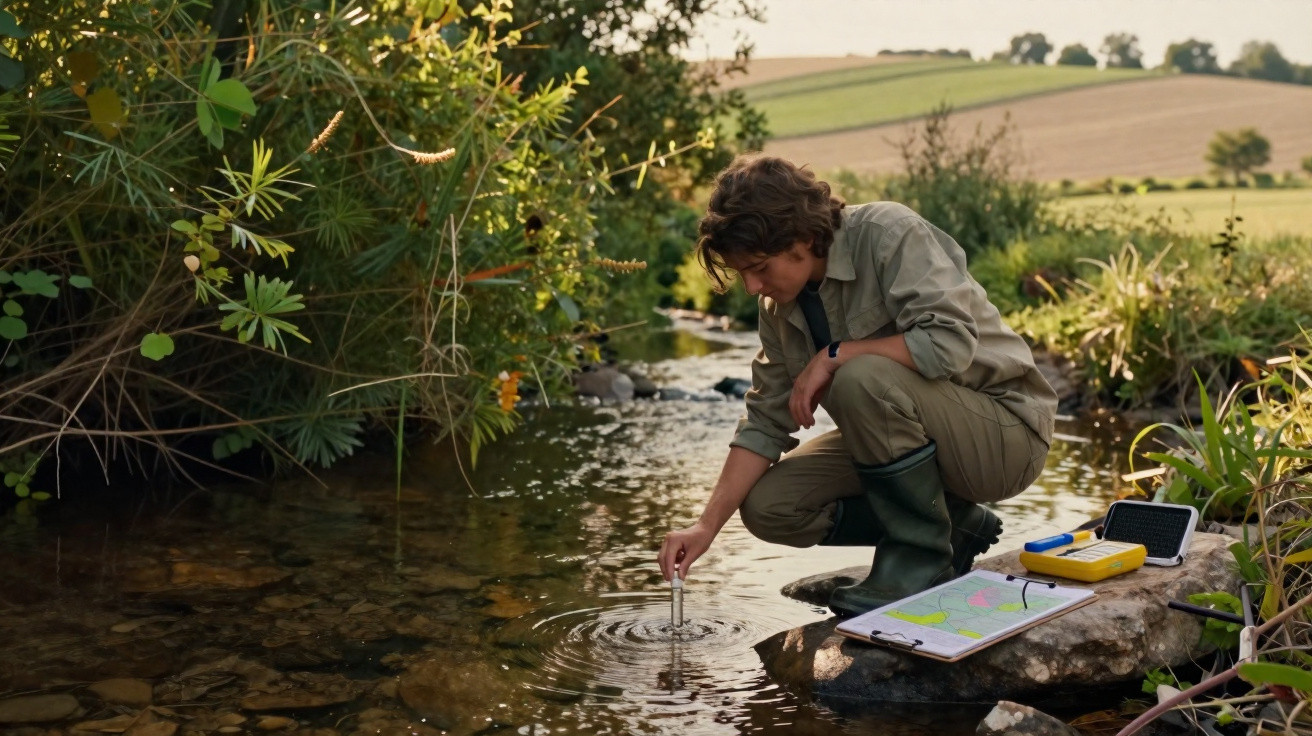
Pesticides sprayed across farm fields can ultimately reach the water we drink, a concern that remains troubling for both researchers and farmers.
Although pesticides support crop production by eliminating weeds and insects, they may also damage rivers, fish and human health.
Rain falling on agricultural land can wash these chemicals into nearby streams. To limit that threat, specialists commonly recommend planting bands of grass and shrubs beside watercourses, known as riparian buffers.
New research from Penn State indicates that these buffers can be effective in certain circumstances, though not in every case.
Streamside vegetation can cut pollution
The U.S. Department of Agriculture (USDA) promotes riparian buffers because vegetation can capture soil, nutrients and certain pollutants before runoff reaches a stream.
Plant roots stabilise the ground, while dense grass slows moving water. This helps prevent erosion and reduces the amount of sediment entering waterways.
For many farmers, buffers offer a straightforward, natural method of safeguarding water quality. Scientists, however, are still examining how effectively they prevent different pesticide types from reaching streams.
The Pennsylvania watershed
A Penn State-led research group examined Halfmoon Creek in central Pennsylvania.
The creek passes through a 24-square-mile (about 62-square-kilometre) watershed with karst geology. In this type of landscape, readily dissolved bedrock forms cracks, sinkholes and concealed underground channels, allowing water to travel rapidly through these hidden routes.
“In this research, we wanted to understand whether vegetative buffers can reduce the amount of various pesticides getting into streams in agricultural areas,” said Heather Preisendanz, professor of agricultural and biological engineering.
“We have seen evidence that buffers can protect streams from nutrients and sediment, but pesticides are a different story because they move with water in different ways, depending on the type.”
Surface water and groundwater pathways
There are two principal routes by which pesticides travel. Rain may carry chemicals across the land surface and into streams, a process known as surface runoff.
They can also seep into the ground and move beneath the surface with groundwater. In karst terrain, groundwater can flow swiftly through fissures and underground channels.
This water may reach streams from below, entirely bypassing the buffer zone. When that happens, vegetation on the streambank cannot prevent pollution arriving from underground.
Testing Halfmoon Creek water for chemicals
During the 2023 growing season, the researchers observed five locations along Halfmoon Creek. Water samples were taken every two weeks.
They analysed the samples for two weed-killing herbicides, Atrazine and Simazine. The team also looked for four insecticides frequently used as coatings on corn and soybean seeds – Clothianidin, Imidacloprid, Thiacloprid, and Thiamethoxam.
Comparing pesticide concentrations with stream-flow rates enabled the researchers to determine how each chemical moved through the landscape.
Pesticides detected in stream water
The findings revealed that pesticides were regularly present in the creek. Simazine was detected in 93 percent of samples, while Atrazine was found in 92 percent.
Clothianidin occurred in 75 percent of the samples. These high detection rates show that the chemicals remained in the stream for most of the growing season.
Levels of Atrazine and Clothianidin rose as stream flow increased following rainfall. This trend indicates that surface runoff transported these chemicals into the creek.
Riparian buffers do not capture underground pollution
Because Atrazine and Clothianidin are mainly carried by surface water, riparian buffers may help lessen their effects. Vegetation slows runoff, giving soil an opportunity to retain some of the chemicals.
Simazine, by comparison, acted differently. It was transported chiefly by groundwater and entered the stream via underground channels even when stream flow was low.
Within a karst landscape, groundwater may travel considerable distances before reaching streams beneath the buffer zone. Under these conditions, buffers cannot prevent much of the pollution.
Moving beyond one solution
“Our results here show that buffers are helpful, but only for pesticides that move in surface runoff – groundwater-transported pesticides, especially in karst watersheds, can bypass buffers entirely,” said Professor Preisendanz.
“Before we choose how to reduce pesticide pollution, we need to consider how pesticides actually move through the landscape, because we can’t greatly reduce pesticide pollution with buffers alone if the pesticides are slipping underground.”
The study demonstrates that stream protection needs more than a single approach. Farmers, scientists and organisations including the USDA need to account for the way each pesticide moves through the environment.





Comments
No comments yet. Be the first to comment!
Leave a Comment