
Plenty of people head off on holiday - but the uneasy question remains: what happens to your house and garden when nobody is home?
Alarm systems, smart cameras and solid doors are usually the first things that come to mind. One area, however, is often overlooked: the front garden. With the right planting, it can become a prickly buffer zone that discourages would-be thieves long before they reach a window or patio door.
Why a well-planned front garden really slows burglars down
Burglars look for easy targets. They want to get in quickly and quietly - and leave just as discreetly. Anything that makes access uncomfortable, risky or noisy can be enough to make them think twice.
“Thorny, dense shrubs plus crunching gravel create the exact opposite of a ‘quick entry’ - they slow intruders down, cause injuries and give them away.”
By placing spiky plants near fences, side entrances or easily reached windows, you create a kind of natural exclusion zone. The result is that:
- the route becomes tighter and harder to use
- scrapes and scratches are likely with every misstep
- noise on gravel or chippings is difficult to avoid
- traces in the ground remain visible
Criminals will often choose the next, more “convenient” property instead. Studies repeatedly show that homes with clearly visible obstacles and entrances that are easy to overlook from the street are targeted far less often.
One point matters: the garden is not a replacement for security technology - it supports it. Neglected planting can even create new hiding places, for example behind overly tall, untrimmed hedges. The aim is a balance of clear sightlines, carefully positioned thorn barriers and good lighting, such as motion-activated lights.
The four most effective plants for a natural security zone
For a protective “ring” around the house, four groups of plants work particularly well. They grow reliably in Central Europe and are generally undemanding.
Pyracantha: the thorny bodyguard on the boundary
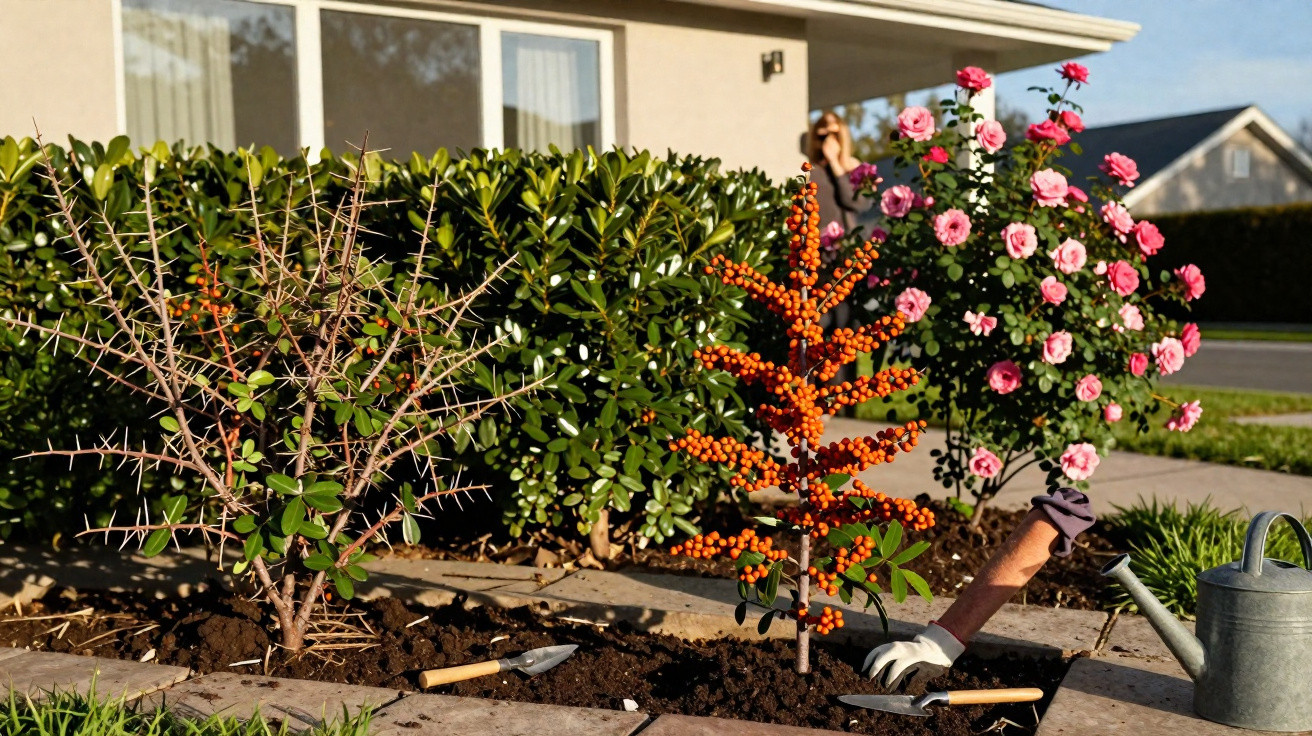
Pyracantha - often called firethorn - is an extremely spiky shrub. Its shoots form a dense mesh of thorns that very few people would willingly try to climb through.
- Best position: along the boundary, beneath low windows, against walls
- Spacing: around 50 to 70 centimetres between plants for a continuous hedge
- Height: usually 1.5 to 2 metres, depending on the variety and pruning
Beyond the security benefit, firethorn also produces bright berries that attract birds. If you have children, be mindful of poisonous plant parts and avoid planting the hedge directly next to play areas.
Berberis: a compact thorn barrier for narrow passages
Barberries (Berberis) grow into compact shrubs with strong thorns. They are ideal for blocking side paths or tucked-away access points.
Typical locations include:
- narrow side passages between the house and a fence
- access points to basement steps
- areas behind a garage or carport
Many varieties stay relatively low and dense, and some have coloured foliage. This creates an effective barrier that looks like an ordinary ornamental garden rather than a “fortress”.
Rosa rugosa: an innocent-sounding rose shrub with vicious thorns
Rosa rugosa - also known as Japanese rose - looks romantic at first glance. In reality, it forms a defensive cushion of thorns.
It is particularly suitable for areas directly beneath easy-to-reach windows, such as ground-floor windows facing the street or the patio. Anyone trying to step through a thorn bed like this from outside almost always pays for it with bloody scratches.
Rosa rugosa is often planted as a strip or low hedge:
- beneath floor-to-ceiling windows
- beneath windows that could be forced open easily
- as a boundary for garden areas that are poorly overlooked
Cherry laurel: a dense screen in front of glass
Cherry laurel (also known as laurel cherry) does not prick, but it offers a different kind of protection: it reduces visibility and creates distance.
“A dense cherry laurel hedge in front of large glass surfaces forces intruders to start further away - opportunistic ‘reach-throughs’ become difficult.”
Typical locations include:
- in front of large patio doors
- along garden sections that are visible from the street
- as a backdrop hedge combined with thorny plants in front
Cherry laurel stays green in winter, so the screening effect remains all year. If you do not want to shut neighbours out completely, leave sight gaps or use taller hedges only at critical points.
How homeowners should arrange these plants sensibly
With a straightforward plan, you can quickly create a coherent garden security concept. One proven layout looks like this:
- Facing the street: cherry laurel as a green screen, with a gravel strip at its base.
- Side boundaries: a mixed hedge of firethorn and barberry.
- Under vulnerable windows: a band of Rosa rugosa.
- Main route to the house: a path surfaced entirely with gravel or chippings.
It is important not to obscure the front door completely. It should remain visible from the street. Burglars tend to avoid entrances that can easily be watched by neighbours or passers-by - a clearly overlooked approach increases their risk.
Motion sensors on the façade, the garage and along side paths strengthen the effect even further. Anyone battling through gravel and thorns suddenly ends up in a bright cone of light - not an attractive situation for someone trying to stay anonymous.
What owners must pay attention to when planting
For all the enthusiasm about “thorn defence”, not every location suits every species. Before you start digging, it pays to consider soil, light and how the garden is used.
- Avoid heavily thorned plants directly next to play equipment or trampolines
- Keep adequate distances to boundaries (check local council rules)
- Prune at least once a year so dense hiding places do not form
- Keep emergency access routes clear for the fire service and ambulance crews
If you are unsure, mark out the future hedge lines in advance with string and stakes and walk the routes properly - including in the dark. This helps you avoid trip hazards and dead ends for your own family.
How much can plants actually reduce burglaries?
Criminologists and insurers have observed for years that longer approaches, noisy surfaces and visible obstacles significantly reduce risk. Dense, well-thought-out planting can almost halve how attractive a home is to burglars - especially compared with open, shady gardens that offer lots of hiding places.
Common weak points that planting can help to neutralise include:
- side entrances with no sightline to neighbours
- ground-floor windows that can be reached directly from outside
- patio doors at the end of long, dark gardens
Combined with robust locks, certified windows and modern lighting, this becomes a layered security strategy: first the garden, then the building envelope, then technology.
Practical examples and useful additions
A typical detached house in a quiet residential area could proceed like this: along the driveway, create a wide gravel strip with a narrow stepping-stone path. On both sides, plant barberry and firethorn so that access remains easy only from the owner’s side. Beneath the patio windows, a bed of Rosa rugosa limits any attempt to climb up. In front of the large living-room glazing, cherry laurel provides screening from the street.
If you already have an established hedge, you can “sharpen” it strategically. Add individual thorny shrubs between existing plants, reinforce vulnerable points with thorn bushes, and swap lawn for gravel surfaces at access routes - often a few adjustments are enough to turn a purely ornamental garden into a low-key security zone.
From a legal perspective, keep in mind that some shrubs are poisonous and some can spread aggressively. Garden owners should seek advice from specialist retailers and choose varieties that suit children, pets and the neighbourhood. If you opt for native species and consider insect-friendliness, you can combine burglary prevention with greater biodiversity - a side effect that adds extra value to the garden.


Comments
No comments yet. Be the first to comment!
Leave a Comment