
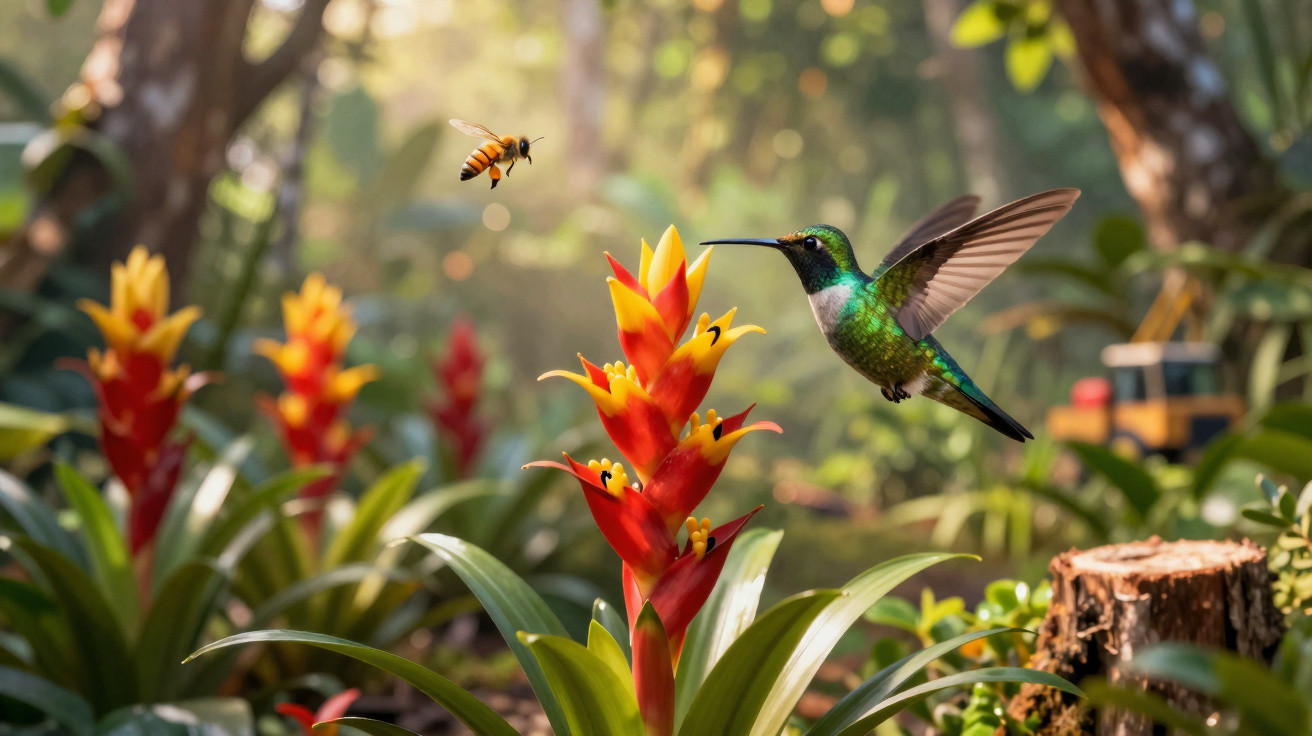
Plants that rely on hummingbirds for pollination split into new species at roughly double the pace of close relatives that depend on bees, bats or moths.
That result comes from fresh research on bromeliads - the tropical plant family that includes the pineapple and the “air plants” commonly kept on windowsills.
The work sheds light on how this single plant family managed to diversify into more than 3,700 species in a comparatively short evolutionary window.
It also links the prospects of many bromeliads to the fortunes of hummingbirds, a group whose numbers are now falling.
The pineapple’s quiet relatives
Most bromeliads look nothing like the pineapple sitting on a worktop. Almost all are native to the Americas, and many are much smaller, living perched on tree branches or clinging to bare rock.
A large number trap rainwater in a tight rosette of leaves, creating little reservoirs that provide shelter for frogs, insects and their larvae.
The air plants sold for windowsills and terrariums are part of the same family. The pineapple is too, though it looks like an oddity among its relatives because it grows rooted in soil and swells into a sizeable fruit.
Despite their variety, bromeliads trace back to a single ancestor and share a recognisable family style: strap-like leaves arranged around a central flowering spike.
Hummingbirds stand out among pollinators
The study was led by Elizabeth A. Forward, a PhD researcher at the University of Reading in England.
Forward and colleagues sifted through published sources to record which animals pollinate 403 bromeliad species, sampled from across most of the family’s major branches.
One group dominated those records. Hummingbirds appeared on roughly three in four of the plants, making them the most frequent pollinator by far in a family that also attracts bees, wasps, bats and moths.
Bees came first
Even so, hummingbirds were not the original partners. When the researchers mapped pollinators onto the bromeliad evolutionary tree, the earliest lineages emerged as bee- and wasp-pollinated, with hummingbird pollination arriving later.
Hummingbird pollination then became established at least twice on separate deep branches - once on the line leading to the air plants, and again in the ancestor of a large group that includes the pineapple.
From those starting points, hummingbirds spread through much of the family, but their dominance has not been fixed over time.
Swapping one pollinator for another
What caught the researchers off guard was how unsettled the pattern remained.
Instead of only a few ancient transitions, they identified around 110 well-supported shifts in pollinators across the family, with most occurring on relatively recent branches, close to living species.
Across different lineages, plants picked up new pollinators, shed existing ones, and in one case even dropped hummingbirds only to return to them later.
Forward and her co-authors interpret that churn as an ongoing dynamic rather than a historical relic.
“Time and again, different branches of the family swapped one pollinator for another, and that swapping is still going on today,” said Forward, the study’s lead author.
An engine for species
Tallying pollinator changes is only part of the story. Demonstrating that hummingbirds are associated with faster formation of new species required a separate analysis.
The team estimated how quickly each lineage was splitting and then tested whether hummingbird-visited lineages were dividing more rapidly.
They were - and by a marked amount.
Hummingbird-pollinated bromeliads generated new species at about 2.8 per million years, whereas other bromeliads averaged roughly 1.5, close to a doubling of the speciation rate.
No other pollinator group showed a comparable effect. The reason hummingbirds are linked to this acceleration is not fully resolved, although the researchers point to where hummingbird-pollinated bromeliads often occur.
What makes hummingbirds different
Many hummingbirds occur high in tropical mountains, where suitable habitat is split into scattered patches separated by valleys and ridges.
Dr. Jamie B. Thompson, a Leverhulme research fellow at Reading and the study’s senior author, said that populations isolated on different peaks can stop interbreeding and slowly diverge.
“Cut off from their neighbors, those groups drift apart over time until they become species in their own right,” said Thompson.
Hummingbirds also tend to transport pollen over greater distances than most insects. Their need for nectar is thought to have driven the evolution of many bromeliad flowers towards tubular, brightly coloured shapes that suit a bird that feeds while hovering.
In a separate study on cacti by one of the same researchers, rapid shifts in flower form - rather than any single fixed feature - were found to track with faster lineage splitting.
A pattern that holds
Connections between pollination and evolutionary speed often weaken when examined closely.
In several plant groups, an apparent advantage linked to a particular pollinator disappears once scientists account for the many other factors that can raise or lower speciation rates. In those cases, the effect simply vanishes.
Orchids provide one example: one study found that specialised pollination increased their overall number of species without increasing the underlying rate at which new species arise. By contrast, the bromeliad signal persisted where others have failed.
The team also checked whether the conclusion depended on different assumptions about how many bromeliads are pollinated by hummingbirds.
It did not: under each scenario, hummingbird-pollinated bromeliads consistently evolved more quickly than those pollinated by other animals.
A partnership under threat
That tight link between bird and plant now carries risks for both sides.
Many bromeliads inhabit mountain forests that are being cleared for agriculture or reshaped by a warming climate, and one broad assessment judged that more than four in five species may be at risk of extinction.
Hummingbirds are under pressure as well. About one in ten hummingbird species is threatened with extinction, and roughly six in ten are in decline.
Because so many bromeliads depend heavily on a single kind of bird, the loss of pollinators can also mean the loss of the plants that rely on them.
Some bromeliads reduce that vulnerability by accepting multiple visitors.
Around one in six of the species in the dataset attracted pollinators from more than one group - a flexibility that could improve their chances if their primary pollinator disappears.


Comments
No comments yet. Be the first to comment!
Leave a Comment