
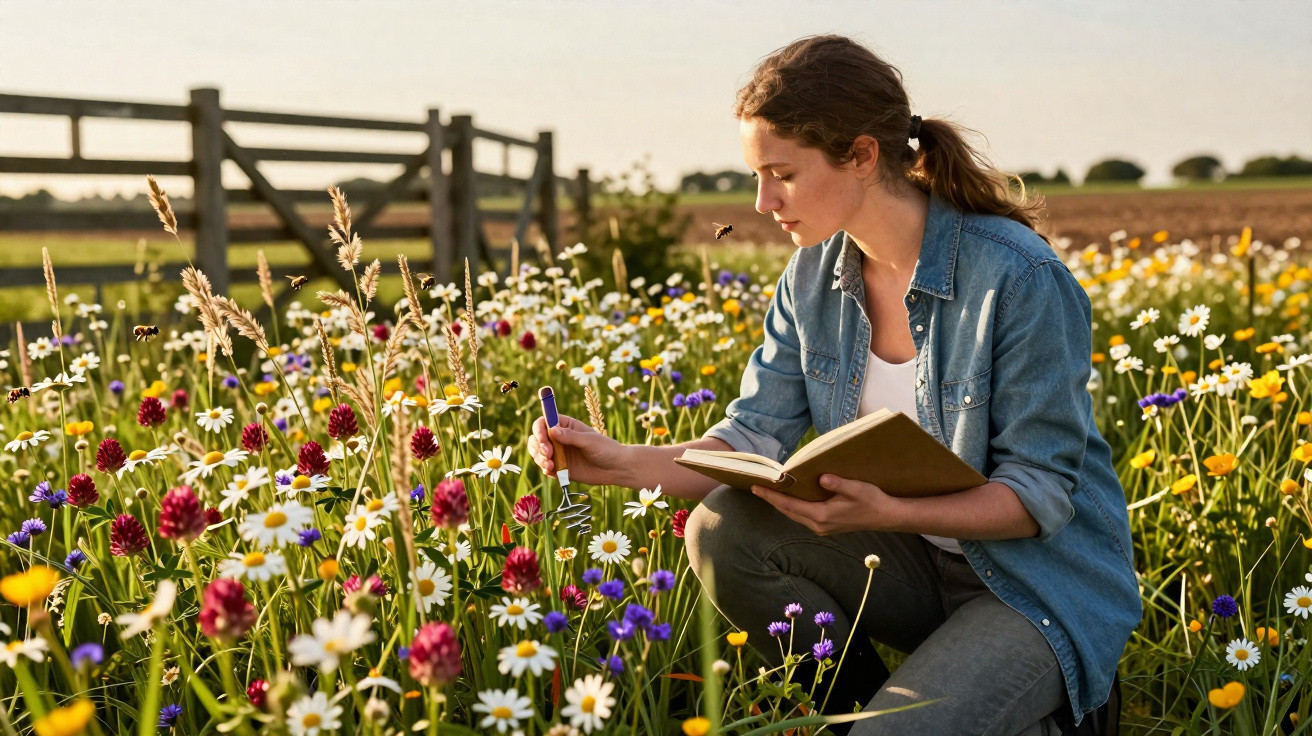
A piece of arable land that has been left alone for more than a decade has, almost unnoticed, developed into a flourishing wildflower meadow.
There was no need for costly seed mixes or heavy equipment. The comeback relied on time, a single traditional hay cut each year, and allowing natural processes to take the lead.
The discovery could influence how governments tackle one of conservation’s largest - and priciest - challenges.
Researchers from University College London (UCL) carried out the study.
They followed changes in vegetation from 2011 to 2022 on a 2-hectare parcel of farmland in Norfolk. The field had been taken out of production in 2005 after years of growing crops.
From that point onwards, the only management was one annual hay cut in the traditional way - and nothing more.
Nature beats the seed packet
The findings challenge the way many government-backed conservation schemes work, where buying in commercial seed stocks is typically the go-to method for turning farmland into wildlife habitat.
This research indicates that, in plenty of situations, that standard approach may not be necessary.
“Our study shows that resisting seeding and allowing nature to lead may be worth trying a lot more in wildflower meadow restoration,” said lead author Carl Sayer from UCL.
“Natural plant recovery better safeguards genetic diversity than seeding and ensures that local species thrive, making meadows less generic.”
“As things stand, the UK needs nature recovery fast, at big scales. In the push to achieve this goal, our study poses the question: Should we be employing patience over seed packet more often?”
What is at risk is substantial. UK wildflower meadows hold rare plants and are vital habitat for pollinators and other wildlife, yet they have fallen by more than 90 percent since World War II.
Bringing meadows back can deliver a host of gains - from cutting pollution to helping mammals and birds, as well as strengthening resilience to a changing climate.
Tracking how well farmland recovers
Restoring wildflower meadow on former farmland is often expensive and labour-intensive, commonly requiring commercial seed mixes, stripping away topsoil, or deep ploughing.
Yet, despite the interest in such projects, there has been very little UK research that follows whether abandoned fields can return to species-rich grassland with nothing more than straightforward hay cutting.
A key reason is the commitment needed: long-term, careful monitoring over many years, which few studies are designed to sustain.
In this case, the researchers were able to do it thanks to an unusually favourable arrangement.
Land with a detailed history
The work centred on Sayer’s Meadow in Bodham, North Norfolk. The site is owned by the lead researcher’s father - and co-author - Derek Sayer.
That family link helped ensure the annual hay cut happened reliably year after year, and it also meant the team could draw on detailed knowledge of how the land had been managed in the past.
At intervals of two to three years, Sayer and a friend, Pete Robinson, completed thorough vegetation surveys. They walked the field in a systematic way and recorded every plant species they encountered.
They also focused closely on two dozen one-metre-square plots positioned along two transects.
Watching diversity double over a decade
The results were unambiguous. From 2011 to 2022, the number of plant species recorded in the meadow increased gradually, year on year.
By the end of the decade, several locally rare species had arrived without assistance, including the southern marsh orchid, greater tussock-sedge, yellow rattle, and common centaury.
At the same time, the average number of species within a single survey plot roughly doubled, rising from around 10 in 2011 to nearly 20 by 2022.
Orchids and yellow rattle were a particular focus, as they are widely seen as dependable early signs that a meadow is recovering.
Survey after survey, the team logged the flowers’ exact GPS locations - until, eventually, there were simply too many to count one by one.
How some of the rarer species made it into the field is still not fully understood, particularly because the nearest known populations were so distant.
The researchers think deer might have brought seeds in, although they cannot confirm it.
From failed farmland to a village attraction
For Sayer, the work is not only about the figures.
“The field belongs to my family, and after an oilseed rape crop in 2005, we stopped farming it as the land was difficult to drain,” he explained.
“I really wanted a wildflower meadow and all the advice was to seed it, but I resisted the temptation, as I have always been interested in nature’s ability to recover itself.”
“When the first orchids started appearing in our surveys, we were thrilled, and now the meadow is unbelievably diverse, with thousands of orchids that delight locals in the village.”
“Our study shows what can be achieved by a traditional hay-cutting approach combined with nature’s brilliant spontaneity. A visit to the meadow is like stepping back through time.”
What this means for restoration
Across the UK and Europe, large areas of abandoned farmland remain. Governments are seeking practical ways to convert that land back into biodiverse habitat, including species-rich grassland.
Sayer’s Meadow points to an option with clear appeal: low cost, low effort, and capable of being scaled up - as long as restoration planners are prepared to wait, rather than immediately relying on a seed packet.
It will not be suitable in every location, and each site has its own complexities, including differences in soil, drainage, and the proximity of local plant populations.
Even so, Sayer’s Meadow suggests that, at times, the best conservation move is to step aside and allow a landscape to return to what it once was.

Comments
No comments yet. Be the first to comment!
Leave a Comment