
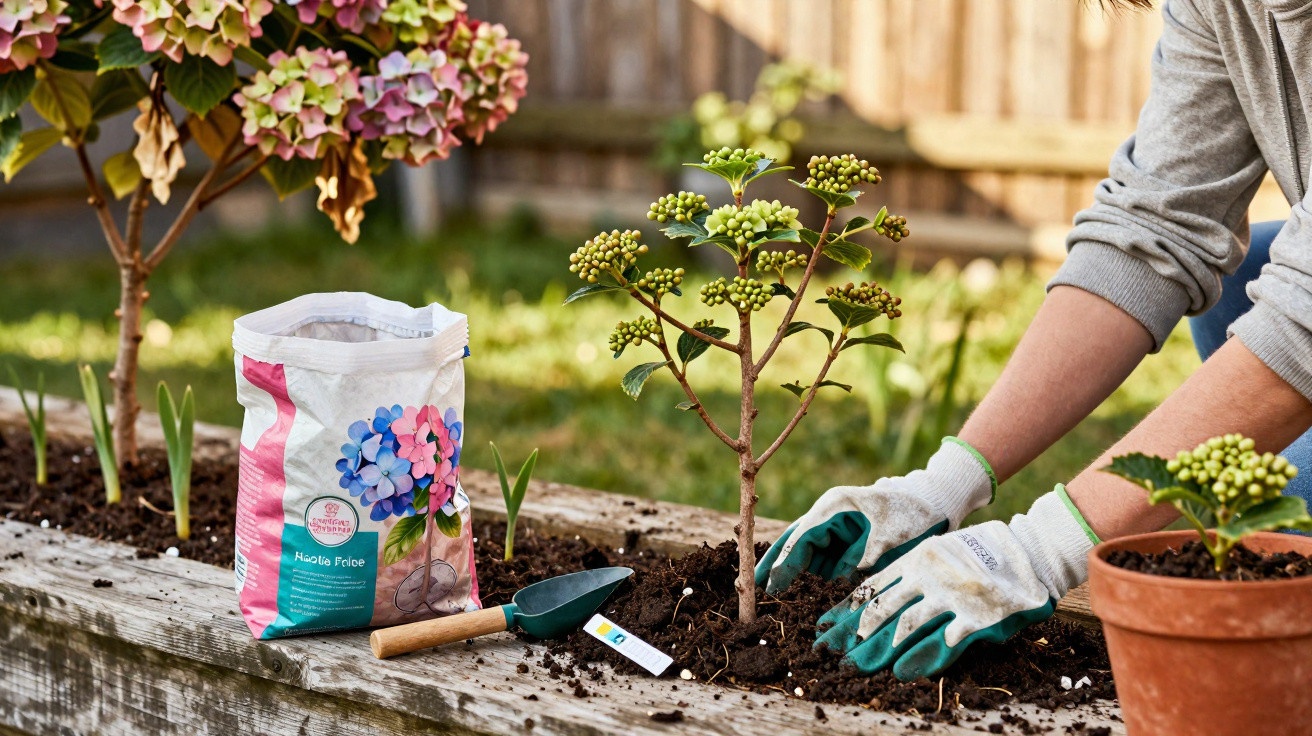
Those who act properly in late winter will be rewarded in summer.
The scene is repeated every year: vigorous hydrangeas with lush green foliage, yet only a handful of disappointing flower heads. The real mistake is not made in summer, but weeks before the first buds can even be seen. The crucial period is the final days of February and the start of March, when plants begin to emerge from winter dormancy.
Why care before March determines blooms or disappointment
Hydrangeas begin their gardening year very early. Sap starts moving within the plant again before fresh shoots become visible. At this stage, the plant decides whether to direct more of its energy towards foliage or flowers.
“Anyone who gives their hydrangeas targeted care between late February and early March directly influences the abundance of blooms later on.”
If the plant receives too few nutrients, it focuses on survival. It mainly produces leaf growth, as leaves support photosynthesis. From the plant’s perspective, flowers are a luxury. The familiar summer result is a dense, healthy shrub with hardly any colourful flower heads.
Gardeners who provide the first nutrient boost at the right time will see a different outcome. The hydrangea then has sufficient reserves to form leaves and buds at the same time. This decision is made within a very short window, often no longer than two or three weeks.
Which nutrients hydrangeas actually need
Hydrangeas are lime-sensitive, acid-loving plants. They prefer humus-rich, slightly acidic soil and can react badly to overfeeding with purely mineral fertilisers. Their ideal feeding regime is gentle but steady.
Mature compost as a natural all-rounder
The mildest option is often already available in the garden: well-rotted compost. As well as supplying nutrients, it improves the soil structure. This allows water and air to reach the roots more effectively.
- Compost must be fully matured and crumbly.
- Do not use coarse plant material or fresh kitchen waste.
- Use only material that is free from disease and fungal infection.
A noticeable result requires a reasonable quantity. In practice, a layer around 7 to 10 centimetres deep, spread around the shrub, works well. It should extend roughly 40 to 50 centimetres from the stem, covering the entire root area.
“A thick layer of compost works like a long-term buffet: every shower gradually washes fresh nutrients down to the roots.”
When a specialist hydrangea fertiliser is worthwhile
Anyone without homemade compost, or who wants to manage feeding more precisely, can use an organic or organo-mineral fertiliser formulated for hydrangeas. Two qualities matter most: slow nutrient release and a balanced ratio of nitrogen, phosphorus and potassium.
Typical formulations are around NPK 7-4-5 or 8-3-9. These blends provide enough support for growth and flower production without overwhelming plants with nitrogen.
- Application period: from February until March at the latest
- Form: granular slow-release fertilisers are ideal
- Dosage: use a restrained amount, at most slightly below the manufacturer’s recommendation
Applying too much disrupts the nutrient balance. The hydrangea may then produce vigorous foliage while holding back on flower buds. Using less, but applying it deliberately, produces far better results.
How to apply fertiliser correctly to hydrangeas
Whether using compost or specialist fertiliser, the method of application also affects the result. Incorrect placement and failing to water afterwards are responsible for many problems.
In the ground: one strong boost is often enough
For hydrangeas growing in borders, one carefully applied nutrient boost at the end of winter is usually sufficient. Proceed as follows:
- Spread the fertiliser in a ring around the plant rather than placing it directly against the stem.
- Cover an area approximately equal to the width of the canopy, as this is where most fine roots are located.
- Gently roughen the soil or work the fertiliser in shallowly with a rake, taking care not to damage roots severely.
- Water thoroughly afterwards so that the nutrients can soak into the soil.
Compost may remain visibly on the surface, where it also acts as a mulch. Granular fertilisers should not stick to shoots or sit directly on woody parts, as this can cause scorching.
In pots: limited space, greater demand
Hydrangeas in containers grow in a much smaller volume of compost. Nutrients are washed out more quickly, especially when watering is frequent in summer. For potted plants, a single late-winter feed is rarely enough.
The following approach is advisable:
- give a first, cautious fertiliser boost in late February or early March
- provide another, much lighter feed in late spring
- if necessary, add a small organic supplement in mid-summer if the plant looks exhausted
Liquid fertiliser made specifically for hydrangeas can be added to watering water, but begin at half strength to avoid overfeeding.
These common mistakes can leave hydrangeas struggling
Many issues in a hydrangea border have straightforward causes that can easily be corrected. Knowing the usual pitfalls prevents unnecessary frustration.
Too much nitrogen, too few flowers
General-purpose fertilisers with a high nitrogen content mainly encourage leafy growth. This may initially seem beneficial, but it creates an imbalance in hydrangeas. The shrub appears healthy, yet directs very little energy into flower clusters.
“Anyone relying on compost with added starter fertiliser, slow-release lawn feed or similar products risks creating a wall of leaves without any colour.”
Choosing specialist hydrangea products or mature compost almost entirely prevents this imbalance, because nutrients are supplied more slowly and in better proportion.
The wrong timing wastes the season
Many gardeners only consider fertiliser once the plant is already fully leafy. By then, the hydrangea has long completed its bud planning. Late feeding chiefly supports existing shoots rather than increasing the number of flowers.
The key period comes at the end of winter, when days lengthen and temperatures begin to rise slightly. Nutrients applied then have the greatest effect on the later display of blooms.
How soil, water and pruning support feeding
Nutrients alone do not guarantee masses of flowers. Three further factors also shape development: soil reaction, water supply and pruning.
| Factor | Problem | Simple solution |
|---|---|---|
| Soil | Too much lime, or soil that is too heavy or compacted | Improve it with bark humus, compost or specialist hydrangea compost |
| Water | Repeated dry spells in summer | Water regularly, mulch the soil and avoid waterlogging |
| Pruning | Flowering wood removed heavily in autumn or spring | Remove old flowers only just below their base; do not cut back hard |
Pruning in particular is often misunderstood. Many varieties produce flowers on the previous year’s wood. Cutting these shoots back heavily in autumn or early spring removes the basis for the coming flowering season.
Practical guide: how to recognise healthy development
By spring, it is already possible to judge whether the nutrient supply has been suitable. Several signs offer useful clues:
- Shoots quickly produce fresh, strong leaves.
- Compact buds appear at the shoot tips and in the upper leaf axils.
- Leaves are a healthy green, without yellow areas between the veins or pale patches.
If buds are largely absent or leaves remain unusually small, nutrient deficiency, root damage or excessive pruning may be responsible. In such cases, it is worth reviewing the soil and care routine carefully.
What gardeners should know about special hydrangea effects
Many varieties respond to soil pH with changes in flower colour, particularly blue hydrangeas. Aluminium in the soil plays a part here. In slightly acidic conditions, the plant can absorb this element, which strengthens blue colouring. In more neutral or lime-rich soil, the shade shifts towards pink.
Those aiming specifically for blue flowers should combine spring feeding with suitable hydrangea compost and, where needed, a specialist additive for blue colouring. These products usually contain aluminium salts and are applied in small quantities to control the effect.
Careful feeding before March does not merely lay the foundation for more flowers. It also makes the plants generally more resilient, helps them cope better with summer heat and enables them to recover much faster after heavy rain. In this way, a brief task in late winter pays off with an entire summer of colourful flower heads.



Comments
No comments yet. Be the first to comment!
Leave a Comment