
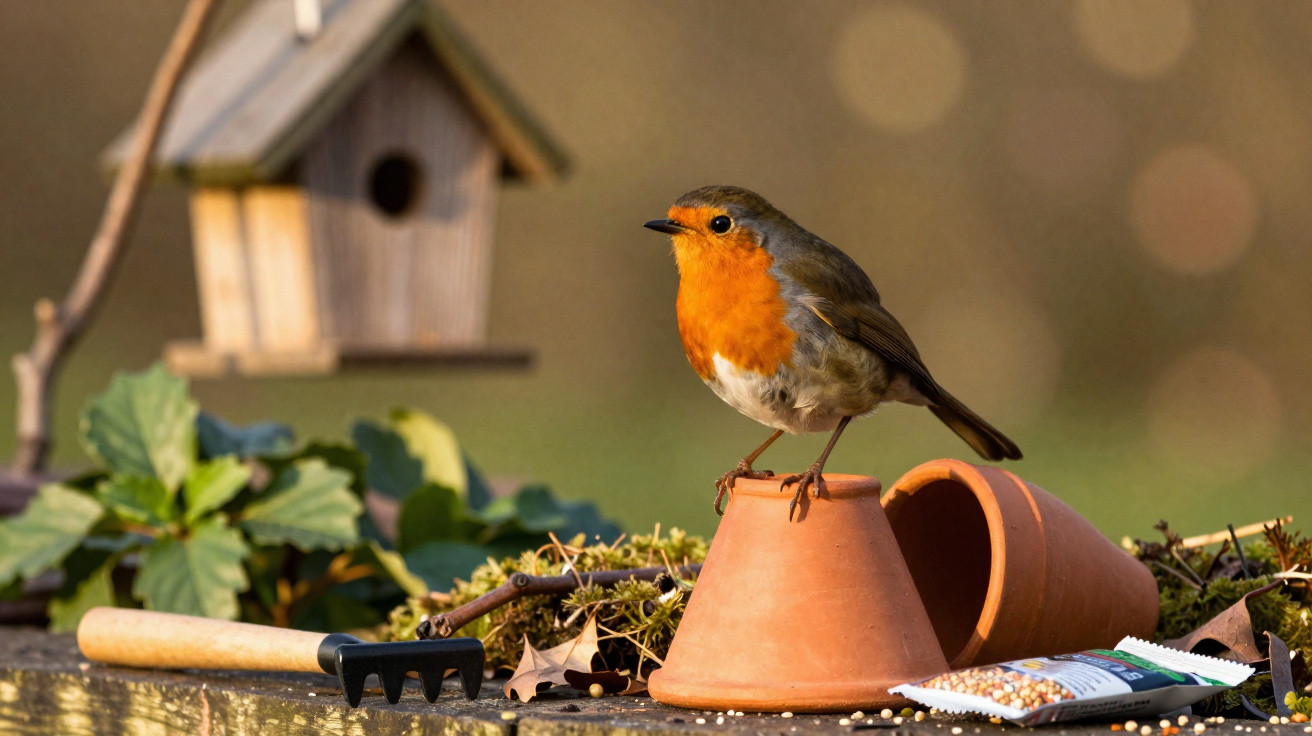
Many garden owners put up well-intentioned nest boxes, then wonder why the European robin ignores them. This small bird, recognisable by its orange-red breast, has very particular requirements for a breeding site. A plain terracotta pot, partly concealed in a shrub, meets those requirements remarkably well – and costs next to nothing.
Why European robins ignore conventional nest boxes
The European robin is regarded as a familiar garden bird. It confidently hops close to gardeners, picking insects and worms from newly raked beds, and appears barely timid. Yet when breeding, it becomes exceptionally cautious. This is where the usual misunderstandings arise.
Many people provide robins with enclosed nest boxes featuring a small entrance hole – the same type that works well for tits. For robins, however, this design is unsuitable. The species is considered a semi-cavity nester: rather than using narrow cavities, it favours broad niches open at the front, which are well hidden but not entirely enclosed.
“European robins prefer to breed low down, hidden in dense vegetation – not high up on a trunk, but close to the ground.”
Natural nesting places for European robins
Typical nesting locations in the wild include:
- dense hedges and bramble thickets


Comments
No comments yet. Be the first to comment!
Leave a Comment