
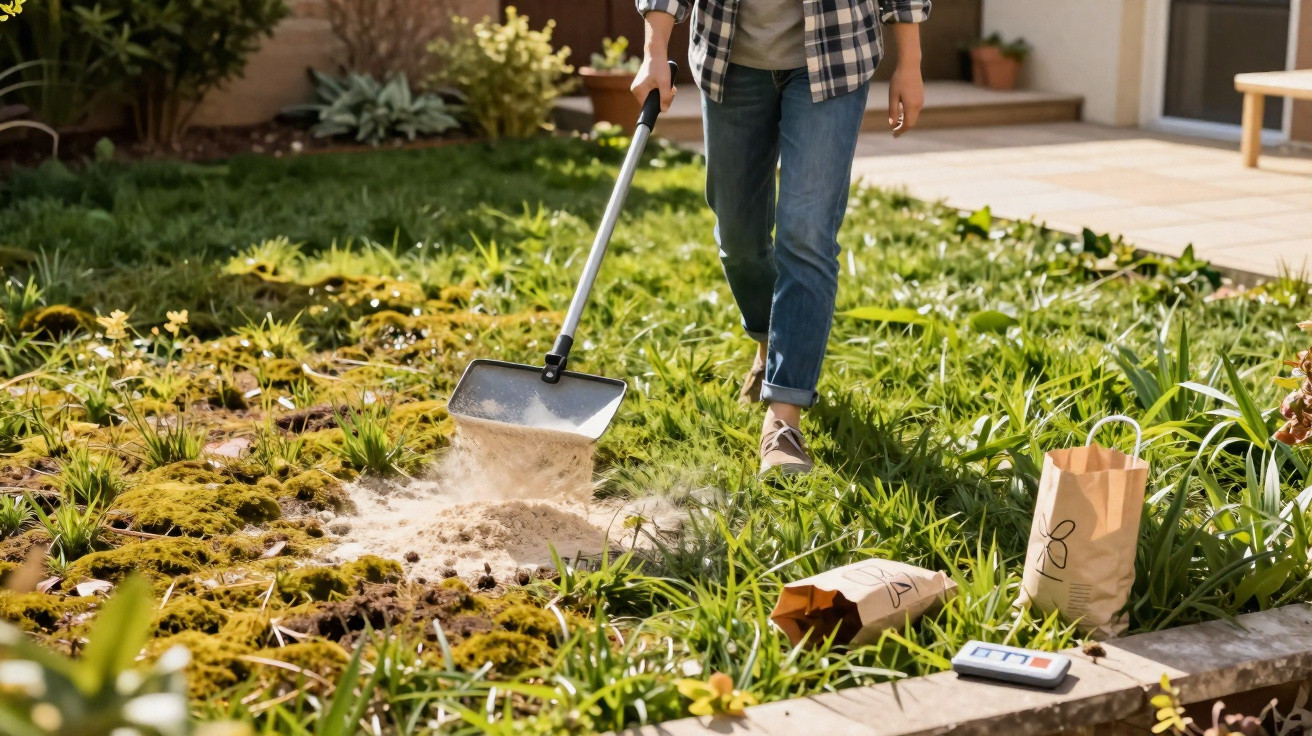
After a grey winter, lawns often look tired and patchy – but one simple March trick can transform everything.
Many gardeners know the disappointment: as soon as the snow has gone, the bare truth appears. Yellow patches, bald areas and thick cushions of moss. Rather than a lush green carpet, the lawn resembles a patchwork quilt. Taking targeted action in March can reverse this decline, using an unassuming powder that professional gardeners have relied on for years.
Why lawns struggle after winter
Winter puts lawns under far greater strain than is immediately obvious. Days are short, sunlight is weak, and the soil remains cold and wet for long periods. Moss thrives in precisely these conditions, while grass suffers.
By March, the ground is often still compacted. Roots receive too little air, water accumulates and nutrients cannot be used effectively. At the same time, rainfall and decaying leaves increase soil acidity. Moss loves this environment, but lawn grasses do not.
Weak, compacted and slightly acidic soil provides the perfect stage for moss – and marks the beginning of the end for a dream lawn.
Anyone who simply hopes that “it will recover” at this point misses the opportunity for a strong growing season. This is exactly when a targeted boost is needed, so grass can win its battle against moss and weeds.
The professionals’ secret: iron(II) sulphate against moss
For years, landscape gardeners have turned to a familiar product from garden care: iron(II) sulphate, commonly known simply as “iron sulphate”. It is sold as a powder, granules or liquid solution, and is available from almost every larger garden centre.
Its advantage is that it works in two ways.
- Powerful moss control: Within a few days of application, the moss turns dark, dies and separates from the grass.
- Rapid greening effect: Iron is an important component in chlorophyll production. Lawns often respond with visibly richer green growth.
This dual action makes iron sulphate a secret weapon for anyone who wants to quickly “rescue” their lawn after winter without having to start again from scratch.
Anti-moss treatment and turbo-charged green growth in one step – that is why many professional gardeners swear by iron sulphate in March.
The ideal time of year: why March matters so much
Starting too early can cause frost damage. Acting too late gives moss too much of a head start. The best window is early March, when:
- there is no longer persistent frost;
- the soil is slightly damp but not waterlogged;
- no heavy rain is forecast;
- the sun is not yet intense.
On a day like this, the powder can work to best effect. It remains on the moss cushions, is lightly washed in and does not scorch plants because of heat or unsuitable weather.
Applying iron sulphate correctly: avoiding scorched grass
Iron sulphate is potent, which is exactly why accurate dosing matters. Using more will not improve the result; it may instead damage the tips of the grass.
The manufacturer’s instructions should always be followed, but these approximate quantities provide guidance:
| Application | Approximate amount per m² | Note |
|---|---|---|
| Dissolved in watering water | approx. 20–30 g | apply evenly using a watering can or pressure sprayer |
| As granules | according to the pack instructions | ideally apply with a lawn spreader |
Even coverage is essential. Scattering it in clumps or passing over some areas twice can result in scorched patches. A watering can with a rose attachment is suitable for smaller spaces, while a lawn spreader is better for larger lawns.
The aim is a thin, even coating across the surface – not thick piles or missed areas.
Take care: preventing rust stains on patios and paths
Iron sulphate can be a blessing for the lawn, but it poses a risk to pale stone, concrete, tiles and patio slabs. If the powder reaches these surfaces in damp conditions, it can leave rust-brown marks that are often permanent.
A few straightforward precautions can prevent this:
- Protective equipment: Wear wellington boots and gloves so that residue does not remain on your footwear or hands.
- Distance from edges: Leave several centimetres between the treatment area and paving, steps or patios.
- Rinse immediately: If any product lands on stone or tiles, wash it away straight away with plenty of water – do not wait.
- Clean equipment: Thoroughly wash the watering can, lawn spreader and shoe soles after finishing the work.
Checking adjacent surfaces before spreading and keeping an eye on them during application can save costly cleaning attempts later.
What must happen once the moss has died
After around ten to fifteen days, the moss will usually be dark, dry and dead. This is when the second stage of lawn recovery begins – and it is every bit as important as the powder itself.
Scarifying: remove old debris and let roots breathe
The dead moss remains on the surface as a felt-like layer. Left in place, it can effectively smother the turf. A scarifier, whether electric or manual, lifts this layer out of the lawn. The material should then be carefully raked up.
The benefits are clear: grass roots can once again access air, water and nutrients. Although the lawn may initially look rather torn up after scarifying, it recovers surprisingly quickly – particularly if the next step follows.
Balance soil pH and fill bare patches
Iron sulphate tends to make soil slightly more acidic. This can be problematic where the soil is already acidic. A second part of spring lawn care can help: several weeks after treatment, lightly work in lime or dolomite flour to return the pH level to a neutral range.
Bare areas often remain after moss has been removed. These should not be left exposed, otherwise weeds will establish themselves there. A targeted lawn-repair overseeding mix, combined with an organic slow-release fertiliser, is a sensible solution.
Wherever nothing grows, something will always move in – so it is best to give healthy grass the advantage.
Practical tips: planning the perfect March lawn-care day
Gardeners who are unsure can divide lawn recovery into three straightforward stages:
- Morning: Check the weather, soil moisture and lawn area. Clear away obstacles and remove leaves from the grass.
- Midday: Apply iron sulphate at the correct dose, watch paths and the patio, then clean tools afterwards.
- Over the following days: Monitor the lawn, avoid mowing immediately after treatment, and minimise heavy rain exposure and foot traffic where possible.
After two weeks, proceed with scarifying, raking, overseeding and, if necessary, applying lime. Anyone who notes down this sequence will have a dependable spring plan for future years.
Risks, limitations – and when it is best avoided
Effective as iron sulphate may be, it is not entirely without risk. Treatment can be too aggressive for very young lawns, newly laid turf or extremely sandy soil. Households with small children or pets should also keep them away from the treated area for several days, only allowing access again after a heavy shower of rain.
Those with heavily moss-covered lawns should expect large brown areas to remain after treatment. It may initially look worse, but it is the beginning of a healthier lawn in the long term. In some cases, partial re-laying may even be worthwhile if there is more moss than grass.
Why the effort is still worthwhile
A dense, healthy lawn is more than simply decorative. It provides noticeable cooling on hot days, traps dust and gives children a soft area for play. Targeted March treatment with iron sulphate, combined with scarifying, overseeding and good ongoing care, lays the foundation for this.
Once this routine becomes familiar, the view from the window in summer provides the reward: not a brown patchwork lawn, but a richly green surface where moss has little chance of returning. That is when the impact of an unassuming powder and a well-planned March day becomes clear.




Comments
No comments yet. Be the first to comment!
Leave a Comment