
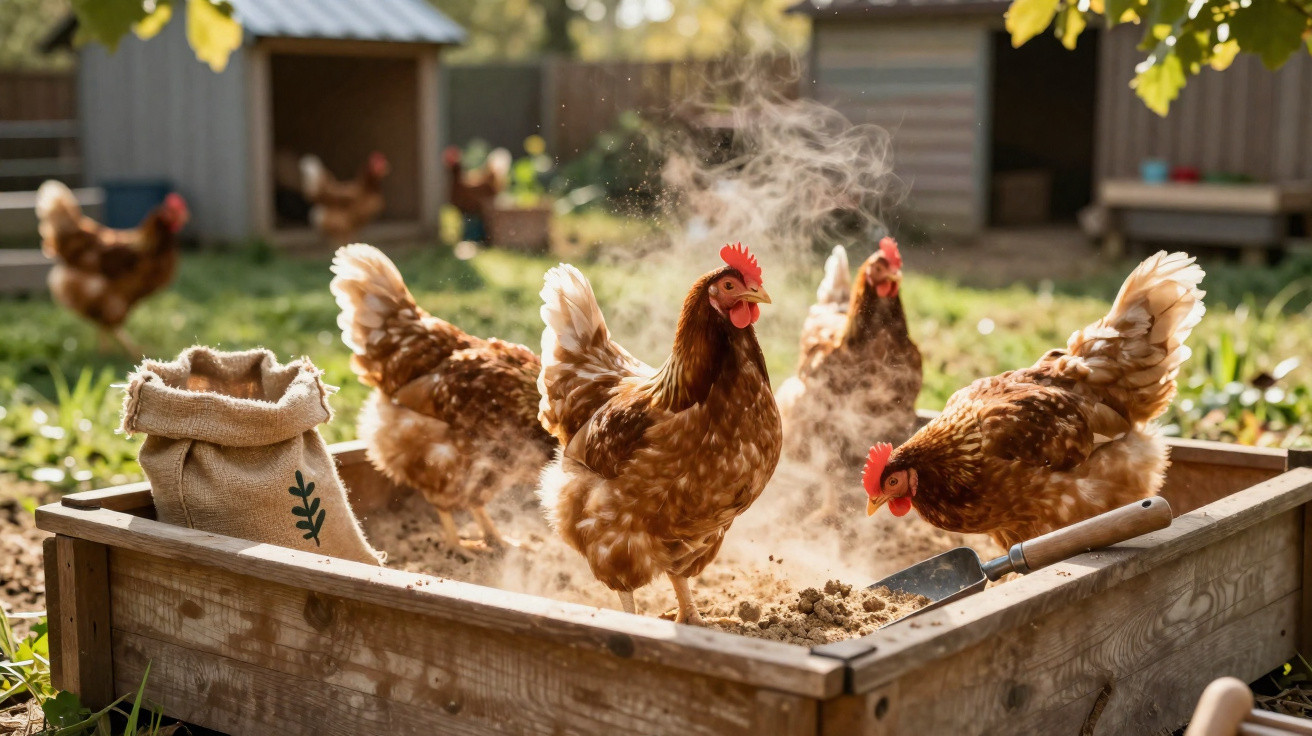
If you head to the coop in spring and find anxious chickens with ruffled feathers and noticeably fewer eggs, feed or illness are usually the first suspects. In countless cases, however, an old adversary is responsible: the red poultry mite and other parasites that hide in the coop’s timber and bite at night. While some keepers immediately reach for shop-bought sprays and powders, more and more are relying on a surprisingly simple solution in the run that few people use: a deliberately prepared dust bath.
Why a dust bath protects chickens better than any wash
Chickens are not naturally “water animals”. Anyone who has seen them in a puddle will quickly notice that they are not comfortable there. Dry soil is an entirely different matter. They scratch, roll around, flap their wings and practically lie on their sides. This is not play; it is a systematic form of body care.
“Fine dust particles reach right down to the skin, dislodge larvae and eggs, and absorb grease and dirt – parasites lose their grip and dry out.”
The red poultry mite in particular, which feeds on chickens overnight, favours damp, concealed places. A properly prepared dust bath provides the opposite conditions: dry, dusty and constantly disturbed. Parasites have little chance of surviving there over the long term.
A wet wash, by contrast, is actually counterproductive. Water weighs down the feathers and disrupts the insulating layer of air between them. Birds become chilled more easily and more vulnerable to illness, while bacteria and mites thrive even more in damp surroundings. Anyone wanting to “do their chickens a favour” by hosing them down achieves precisely the reverse.
The “secret formula”: creating an effective dust bath
You do not need costly specialist products to make a dust bath. Almost every smallholding, patio or garden has what is required. Its appearance matters less than how well it works and how dry it remains.
Choosing the right container
- a sturdy wooden box, old mortar mixing tub or durable plastic storage box
- internal dimensions of roughly 50 × 50 centimetres for four to five chickens
- sides around 15 centimetres high, so the dust is not flung completely out
- no sharp edges that could injure the birds
Many keepers repurpose old sandpits, feed troughs or tubs from DIY shops. The key is to choose a container that will last for a few years and can be emptied easily when necessary.
The mixing ratio: three ingredients, major benefits
The following blend has proved effective for a larger dust bath:
- 10 litres of dry, fine sand
- 5 litres of sifted wood ash
- 5 litres of very fine, stone-free garden soil
Each ingredient has a distinct role:
| Ingredient | Function |
|---|---|
| Fine sand | Acts like an exfoliant, mechanically removing mites, lice and dirt from the skin |
| Sifted wood ash | Draws out grease and moisture, clogs parasites’ airways and substantially weakens them |
| Fine soil | Binds the mixture together, gives it a pleasantly soft texture and extends the time the dust remains suspended in the feathers |
Wood ash must always be completely cold and come only from untreated timber. Varnishes, paints and barbecue briquettes have no place in a dust bath. Be sure to sift out stones, nails and larger pieces of charcoal before adding the ash to the container.
The best position in the chicken run
Moisture is a dust bath’s greatest enemy. As soon as rain gets into it, the mixture turns to mud – a condition parasites enjoy, but chickens do not. The dust bath therefore needs a covered position.
- beneath a small roof beside the coop
- in a dry spot under an awning or carport
- in a sheltered corner that is neither permanently shaded nor continually baking in direct sunshine
Place the container where the birds can access it at any time, including when the ground in the run becomes muddy. A firm base, such as paving, a wooden floor or compacted earth, is ideal so the tub stays level and cannot topple over.
“A dust bath belongs where chickens like to spend time – not in a distant corner they rarely use.”
Maintaining the dust bath: a few minutes, a significant effect
To maintain its effect against red poultry mites and other pests, the dust bath needs some care, though it does not require much effort. A brief weekly check is generally enough:
- use a small rake or firm hand brush to break up compacted areas
- remove droppings and loose feathers
- top up with dry mixture if required
Once the contents become noticeably darker, feel heavy or seem slightly damp, it is time to replace them completely. The used material can go on the compost heap. A little more frequent replacement is worthwhile in summer – chickens repay it with clean plumage and considerably less stress.
Signs that the chicken dust bath is working
After several weeks, many hobby keepers report clear changes in the coop:
- chickens scratch themselves far less often
- plumage appears smoother and glossier
- less feather pecking occurs between birds
- egg production becomes stable again
When infestation is severe, shining a torch into the coop at night often reveals red dots on perches, in cracks and around nesting boxes. With a dust bath that is used consistently, these signs often gradually disappear – especially when combined with a dry coop, clean perches and regular checks of cracks and joints.
Common mistakes that make a dust bath ineffective
Many keepers do put a tub in the run, yet later wonder why the mite problem barely changes. The following issues are often responsible:
- the container is left outdoors and repeatedly gets wet
- only heavy garden soil is used, without fine sand
- the wood ash has not been sifted and contains sharp fragments
- the location is so cramped that lower-ranking birds can barely use the dust bath
A second container elsewhere can significantly reduce tensions within the flock. For larger flocks, a “dust-bath area” with several tubs has even proved effective.
How the dust bath fits into a complete health plan
A dust bath does not replace good coop hygiene, but it can substantially reduce the need for chemical treatments. A well-considered approach includes several measures:
- a dry, well-ventilated coop with no persistently damp corners
- smooth perches that are easy to clean
- regular cleaning of nesting boxes and replacement of bedding
- controlled access for wild birds, which often introduce parasites
People new to chicken keeping often underestimate red poultry mites. They reproduce rapidly, especially on warm nights. A consistently used dust bath slows this process before an infestation becomes severe. It reduces stress, supports the birds’ immune systems and can save on veterinary costs.
Practical tip: adapt the mixture to the season and location
In particularly rainy regions, it is worth choosing a very sheltered spot, such as a coop corner with an additional board to protect against splashes. During dry, hot summers, chickens benefit from a little more fine soil in the mix, so that the dust cloud is not too harsh.
Anyone without a garden can buy sand from a DIY shop and obtain small amounts of fine soil from acquaintances. One point remains essential: the material must be dry before it goes into the tub. Drying it briefly in the sun or in a boiler room prevents problems later.
This turns a simple container of sand, ash and soil into a key tool against red poultry mites – and can often transform a “problem coop” within a few weeks into a calm flock of chickens with clean feathers and full nesting boxes.





Comments
No comments yet. Be the first to comment!
Leave a Comment