
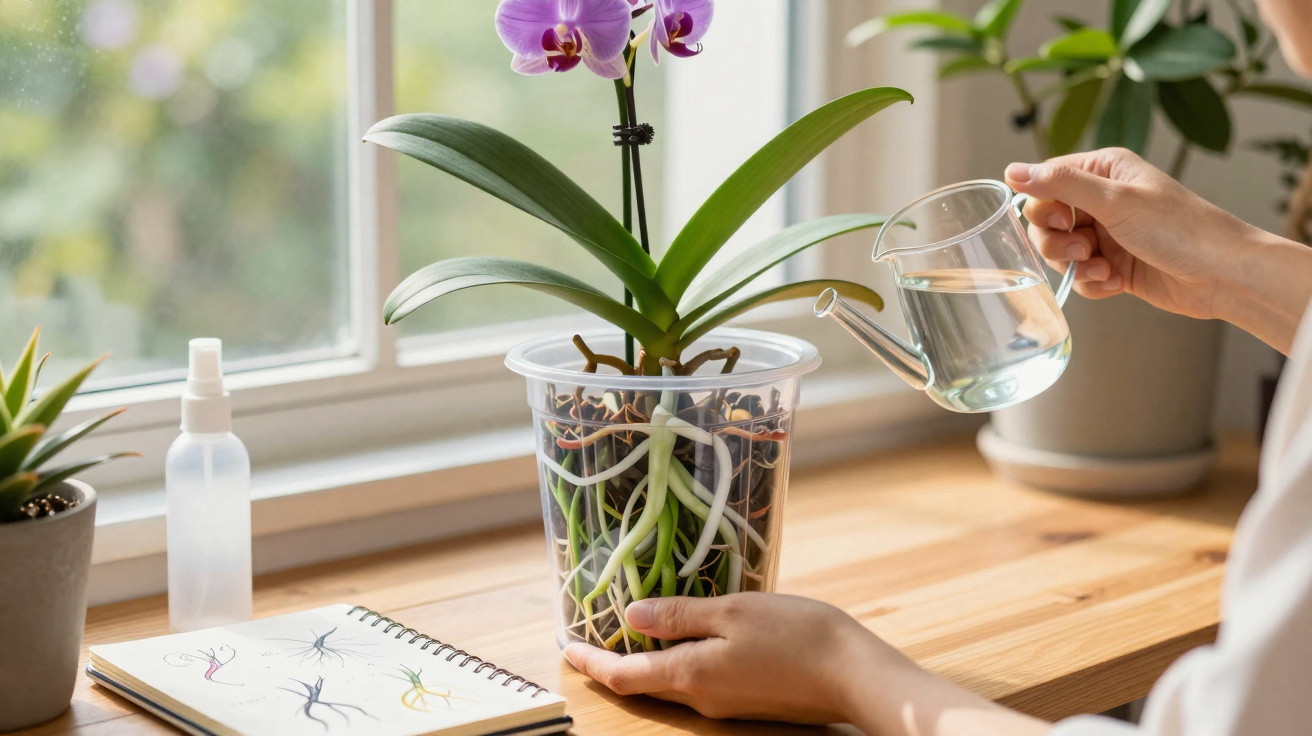
People who grow orchids regularly soon realise that an orchid’s internal clock rarely matches the calendar on the wall. Rather than watering on fixed dates, it is far more effective to pay attention to what the plant itself is telling you-especially the colour of the roots, which works as a practical moisture “thermometer”.
How does the colour of orchid roots show the right time to water?
Most house-grown orchids, particularly epiphytes, have roots covered by a spongy layer called velamen. This coating soaks up and holds water and nutrients, turning green or dark green when it is well hydrated-an indication there is still moisture available in the growing medium.
As water is used by the plant or lost through evaporation, the velamen dries out and the roots take on a greyish, whitish, or silvery tone. That duller appearance suggests the water reserve is running low and watering is approaching-provided the growing medium feels dry to the touch and remains airy.
What do the main root colours reveal day to day?
Taking a moment to observe the roots helps you read the plant’s overall condition and avoid overwatering. Below are common situations many growers learn to recognise easily after a bit of practice:
- Bright green roots: well hydrated, with no urgent need for water.
- Silvery or greyish roots: dry velamen, meaning watering is near-or can be done now if the growing medium feels light.
- Dark, soft roots or roots with an unpleasant smell: likely too much water, poor drainage, and a risk of rot.
- Very dry, brittle roots: a sign of prolonged dehydration and a need to adjust how often you water.
If the problem is waterlogging, adding even more water usually makes things worse. Check the drainage holes, replace very old growing medium, and improve airflow around the pot to help the root system recover.
How to adjust watering by root colour across different orchid types
The same colour logic applies across many genera, but watering pace changes depending on the species. With clear pots, it becomes easier to observe the roots directly, which helps you fine-tune care at home.
- Phalaenopsis: prefers relatively steady moisture. Firm green roots suggest a good water reserve; when the roots turn silvery and the growing medium has dried, it is time to water.
- Cattleya: has pseudobulbs that store water and can handle short dry spells. It is common to wait until a good portion of the roots are silvery and the pot feels light before watering again.
- Dendrobium: includes species that go through rest periods when watering should be more restrained. Even if the roots become paler, it is important to follow the specific cycle of each type.
Which environmental factors affect how you read root colour?
Temperature, light, and ventilation directly affect how quickly the growing medium dries and, in turn, the colour of the roots. In warm, bright, well-ventilated spots, roots tend to turn pale more quickly; in cooler or more humid environments, the green colour generally lasts longer.
The pot type also changes what you can rely on: transparent containers let you see the root system, while terracotta or opaque plastic pots require you to pay closer attention to the pot’s weight, the feel of the growing medium beneath the surface, and the local climate. By combining these visual and tactile cues, growers can water more confidently, encouraging healthy roots, steadier plants, and more regular flowering over the years.

Comments
No comments yet. Be the first to comment!
Leave a Comment