
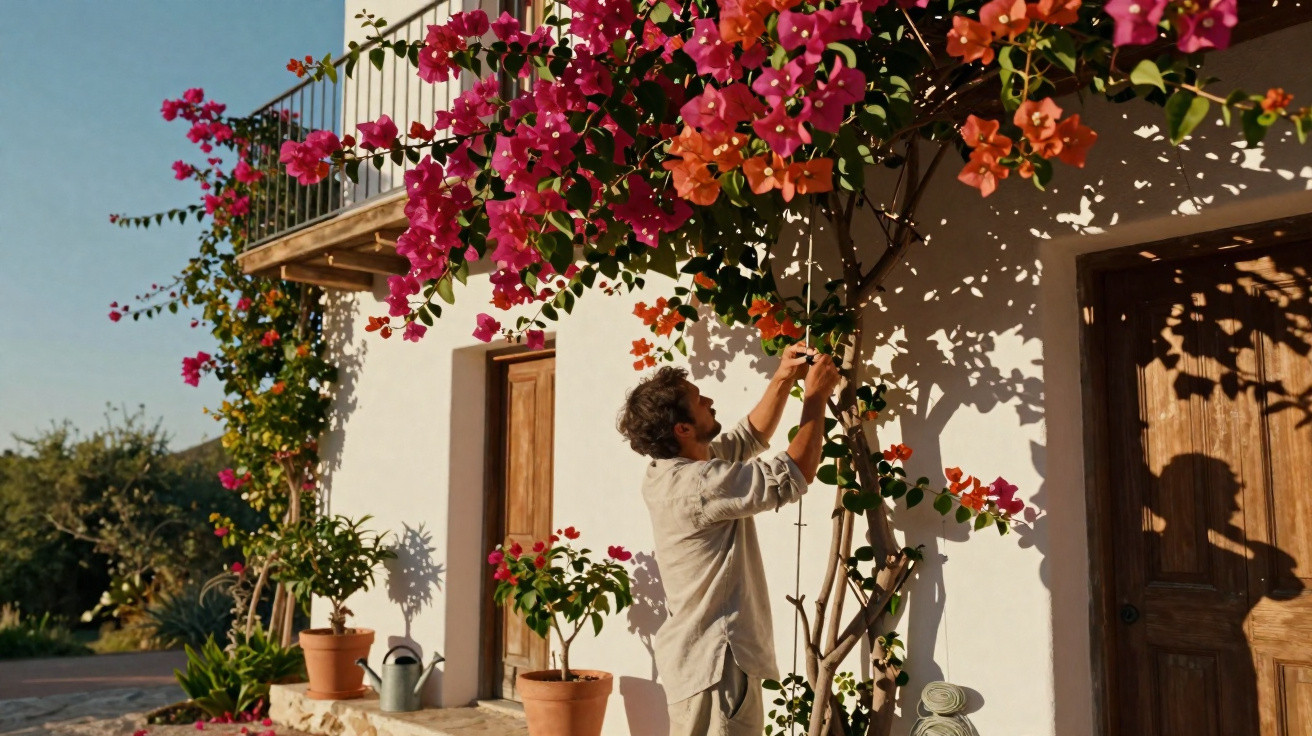
Bougainvillea-often nicknamed spring-is appearing more and more on the façades and boundary walls of Brazilian homes. It stands out for its masses of colourful bracts (frequently mistaken for flowers), its ability to fit into very different spaces, and the fact it needs minimal care, which is why it is so popular on residential frontages and in sunny commercial settings.
Why is bougainvillea (spring) ideal for façades and walls?
Among the choices of wall climber, bougainvillea is valued for being tough, fast-growing, and flowering for an extended period. In warm, bright climates it can stay colourful for many months of the year, spreading from a small planting bed to an entire large wall.
Beyond its strong visual appeal, the bougainvillea climber can also improve thermal comfort by forming a green screen that reduces direct sunlight hitting the wall surface. On the front of bungalows or two-storey homes, it can be trained over pergolas, arches, metal supports, or balconies, creating the feel of a mature garden even in built-up urban areas.
How do you care for bougainvillea to get longer-lasting displays?
The basics of how to care for bougainvillea are plenty of sun, regular pruning, and controlled watering. In tropical or subtropical conditions, it should receive direct sunlight for around 4 to 6 hours per day; the more sun it gets, the more intense and consistent the flowering tends to be across the year.
Watering should be moderate, as bougainvillea benefits from short spells when the soil is a little drier, which helps trigger fresh colourful bracts. In pots or planters, good drainage is essential; in heavy or compacted soil, mixing in sand and organic matter helps roots establish and lowers the risk of fungal issues.
What pruning and training methods make bougainvillea look its best?
Pruning is key to keeping a bougainvillea climber balanced and full of blooms, rather than letting it become messy or overly heavy. As a general rule, lightly prune after the main flushes of colour, cutting out dead, crossing, or overly long branches and encouraging new flowering growth.
For façades and walls, training bougainvillea (spring) relies on structures that guide growth and keep it safe to manage, since the plant has thorns. Commonly used supports include:
- Tensioned wires fixed to the wall to cover large surfaces
- Wooden or metal stakes, suited to narrow planting beds
- Pergola frameworks over garages, verandas, and entrances
- Trellis panels and fences on lower walls, forming a flowering living screen
Is bougainvillea the best wall climber for the garden?
Compared with other wall climber options, bougainvillea often stands out for combining ruggedness, long flowering, and the ability to blanket big areas with relatively little work. In smaller gardens, however, you may need to choose more compact varieties or prune more often so it does not take over the entire space.
When selecting flowers for the garden, many designs pair bougainvillea with flowering shrubs and groundcovers to create layers of colour and texture. In cooler regions the display can be reduced, but the plant remains resilient on sunny walls, delivering striking façades with the look of an established garden and maintenance that stays relatively straightforward throughout the year.
Comments
No comments yet. Be the first to comment!
Leave a Comment