
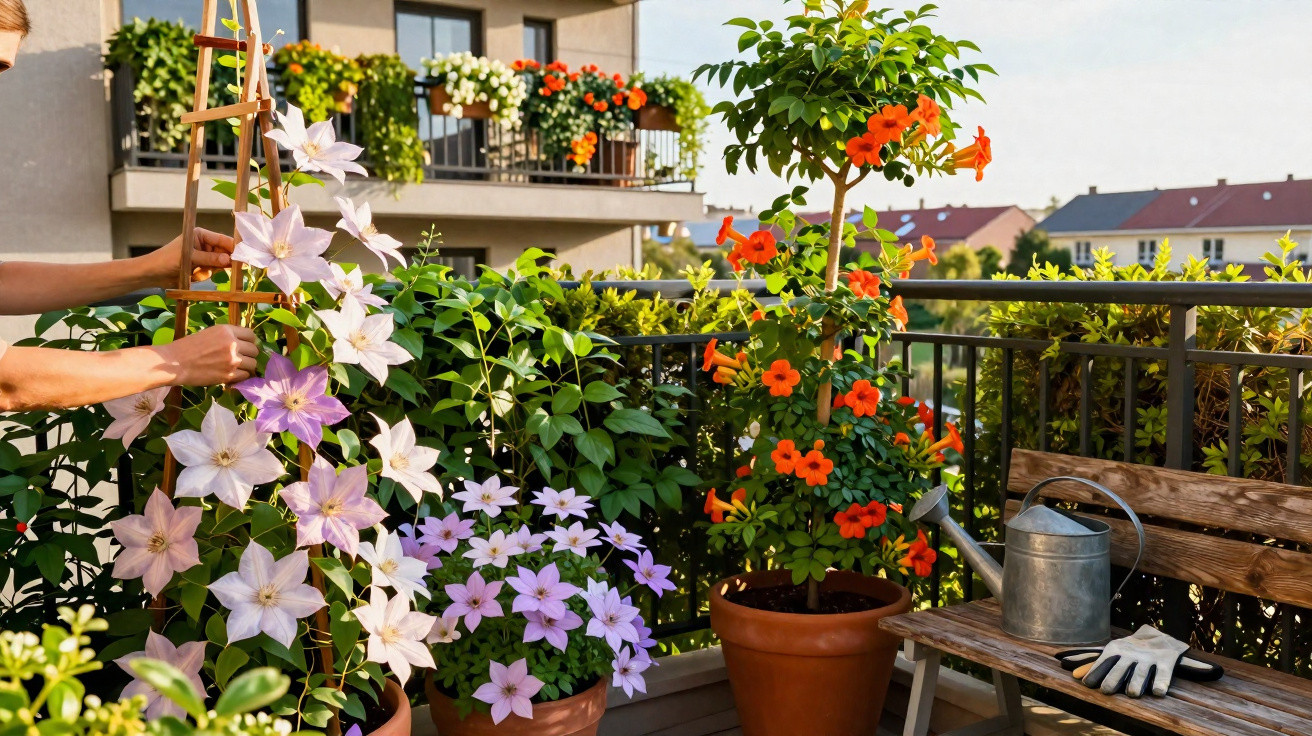
From winter bells to fiery summer trumpets, flowering climbers are taking centre stage in compact gardens and urban patios, transforming the way outdoor vertical space is used.
Why climbing flowers are having a moment
With gardens becoming smaller and outdoor living areas taking the place of traditional lawns, vertical colour has become an understated priority. One climber can cover a plain wall, cast shade over a window, conceal a neighbour’s shed and still leave enough ground room for a chair and coffee.
These plants also extend the garden’s season of interest. Many newer cultivars bloom for longer, some flower repeatedly, while a select few continue performing during the darkest weeks of winter. For city gardeners, this delivers genuine seasonal impact in a space scarcely wider than a drainpipe.
Climbing plants turn dead surfaces into living backdrops, giving depth, shade and colour without asking for much ground.
Year-round colour: from winter bells to summer giants
Winter charm: clematis cirrhosa and its cold-season cousins
Winter-flowering climbers still seem a little magical. Clematis cirrhosa belongs to the small group capable of flowering then, producing nodding, bell-shaped blooms in creamy white, frequently marked with purple speckles. It flowers while most borders are reduced to brown and grey tones.
This species does not tolerate severe frost well: temperatures below roughly −10 °C may damage it. The exception is tougher selections such as ‘Jingle Bells’, which bears soft cream flowers and withstands cold snaps slightly better. In areas with consistently hard winters, gardeners increasingly grow C. cirrhosa in substantial containers, placing them in a bright, cool conservatory or unheated porch.
Container-grown winter climbers can turn a chilly veranda or balcony into a seasonal display, even where the soil stays frozen.
Spring into early summer: clematis with oversized flowers
By late spring, large-flowered clematis take over as the garden’s main attraction. They have long been favourites in British and North American gardens. Breeders are still increasing bloom size, with cultivars including ‘Lawsoniana’ and ‘W. E. Gladstone’ producing flowers that may reach approximately 25 cm across.
Numerous other varieties regularly deliver blooms exceeding 15 cm in diameter, easily enough to command a small façade. Cultivars such as ‘Étoile nacrée’, ‘Nelly Moser’ and ‘The President’ are now established classics for pergolas and arches around front doors.
Double-flowered varieties create an even more dramatic effect. ‘Yvette Houry’, ‘Vyvyan Pennel’ and ‘Arctic Queen’ layer their petals into rosette-shaped flowers, resembling dahlias or old roses more than conventional clematis. They work particularly well as focal features at an entrance arch, beside a framed bench or at the far end of a narrow path.
Summer fireworks: intense colours and bold textures
As the weather warms, deeper tones take their turn. Akebia varieties offer rich wine-coloured flowers, almost chocolate in shade, which contrast beautifully with pale walls and silver-leaved planting. Bignonia ‘Mme Galen’ provides the opposite effect, its brilliant orange trumpets visible from afar and luminous in evening light.
For cooler blue shades, gardeners choose plants such as Sollya, known in some areas as bluebell creeper. Its vivid blue bells suit light trellises and balconies especially well. Used with care, these colours can make an unadorned wall feel more like a mural.
- Akebia: purple, wine-toned flowers, light scent, semi-evergreen foliage in mild climates.
- Bignonia ‘Mme Galen’: strong orange-pink trumpets, ideal for warm, sunny walls.
- Sollya: small, intense blue flowers, neat habit for compact supports.
Unexpected ways to use flowering climbers
Softening hedges and lengthening the season
Hedges seldom flower for an extended period, particularly tightly clipped evergreen ones. Garden designers now weave climbers through them, using the existing stems and foliage as a living framework. The intention is not to overwhelm the hedge, but to prolong its appeal by several weeks or even months.
In relaxed, country-style hedges, most moderately growing climbers are suitable, including roses, honeysuckles and lighter clematis. Where a hedge already flowers, select a climber that blooms before or after it, allowing the display to continue rather than compete.
Some species are better suited to the regular clipping required by highly formal evergreen hedges. Honeysuckles, ivy and many clematis cope with one or two cuts each year without complaint. This keeps the hedge’s crisp outline intact while adding an informal wash of colour.
Adding a climber to a hedge does not replace structure; it overlays a moving layer of colour and scent on top of it.
Using big trees as natural scaffolding
Mature trees can support striking floral displays. Vigorous rambling roses, mountain clematis, ivy and climbing hydrangeas can all rise into tall canopies. Once established, they produce garlands of flowers that tumble from branches which might otherwise appear bare from ground level.
The beginning is the crucial stage. Young plants should be directed towards the trunk using ties or soft twine, allowing them to take hold and start climbing. Most then continue independently, threading their way through bark and lower branches.
Climbers can also give dead trees a new purpose, converting bare skeletons into sculptural garden features. Rather than being felled and removed, the woody structure becomes a lasting support wrapped in changing foliage and seasonal flowers.
Letting climbers crawl as ground cover
Not all climbers need to grow upwards. When they have no vertical support, some naturally spread over the soil instead. Ivy is the clearest example, although honeysuckles and certain clematis will behave this way when no trellis is available.
When used intentionally, this growth habit forms a living carpet that suppresses weeds and keeps the soil cool. It is particularly effective on difficult slopes, dry spaces beneath trees or neglected strips at the foot of fences that sprinklers rarely reach.
| Plant | Best use | Height or spread |
|---|---|---|
| Clematis cirrhosa | Winter flowers on wall or in cool conservatory | Up to 3–4 m |
| Rambling rose | Climbing into large trees, big arches | 5 m and more |
| Ivy | Ground cover or dense wall green | Variable, very spreading |
| Climbing hydrangea | Shady wall or tree trunk | 10–15 m over many years |
Dividing terraces and balconies with living screens
On balconies and roof terraces, managing available space is essential. Gardeners use trellises supported by large containers to form green dividers, turning one open surface into several smaller outdoor “rooms”. Flowering climbers provide both privacy and softness.
Very vigorous plants can feel excessive in this setting. Medium-sized growers are more effective, including many clematis that reach around 3 m, compact forms of Solanum jasminoides or smaller-flowered jasmines. They grow quickly enough to create screening, yet remain light enough for containers and delicate structures.
On a small terrace, a single trellis with a climber can replace a solid wall, filtering views without shutting out sky and light.
Practical notes gardeners sometimes skip
Matching plant to climate and structure
Each climbing plant has its own preferred attachment method: twining stems, tendrils, aerial roots or adhesive pads. This influences its performance on wire, timber and brick. Aerial-root climbers, including ivy and climbing hydrangea, attach directly to walls, which appeals to many gardeners but concerns some building owners.
Tendril climbers generally require slender supports to grasp, such as mesh or wires, while twining stems coil around poles or posts. When a plant fails to thrive, the support arrangement is often responsible rather than the soil or fertiliser.
Climate is equally important. Frost-sensitive varieties, including some C. cirrhosa, require sheltered positions or milder regions. Heat-loving bignonias favour sunny, warm walls and perform poorly in cold, exposed gardens. Meeting these preferences avoids years of disappointment.
Benefits and risks: what vertical growth changes in a garden
Climbers alter more than just the appearance of a garden. They shade glass and brickwork, potentially reducing indoor temperatures slightly during hot weather, particularly across south- and west-facing walls. They also offer shelter and nesting places for birds, bees and innumerable insects.
There are compromises to consider. Extremely vigorous plants, including certain knotweeds used as climbers and often sold under older names such as Polygonum aubertii or Fallopia baldschuanica, may quickly exceed their allotted space and spread into gutters or neighbouring trees. Frequent pruning and clear limits are essential near roofs, drains and shared boundaries.
For new gardeners, a useful first step is to map all vertical features before purchasing plants: walls, posts, mature trees and balcony railings. Each feature can accommodate one or two climbers with flowering periods that overlap in sequence. This prevents overcrowding and makes every bare surface a possible source of colour throughout the year.

Comments
No comments yet. Be the first to comment!
Leave a Comment