
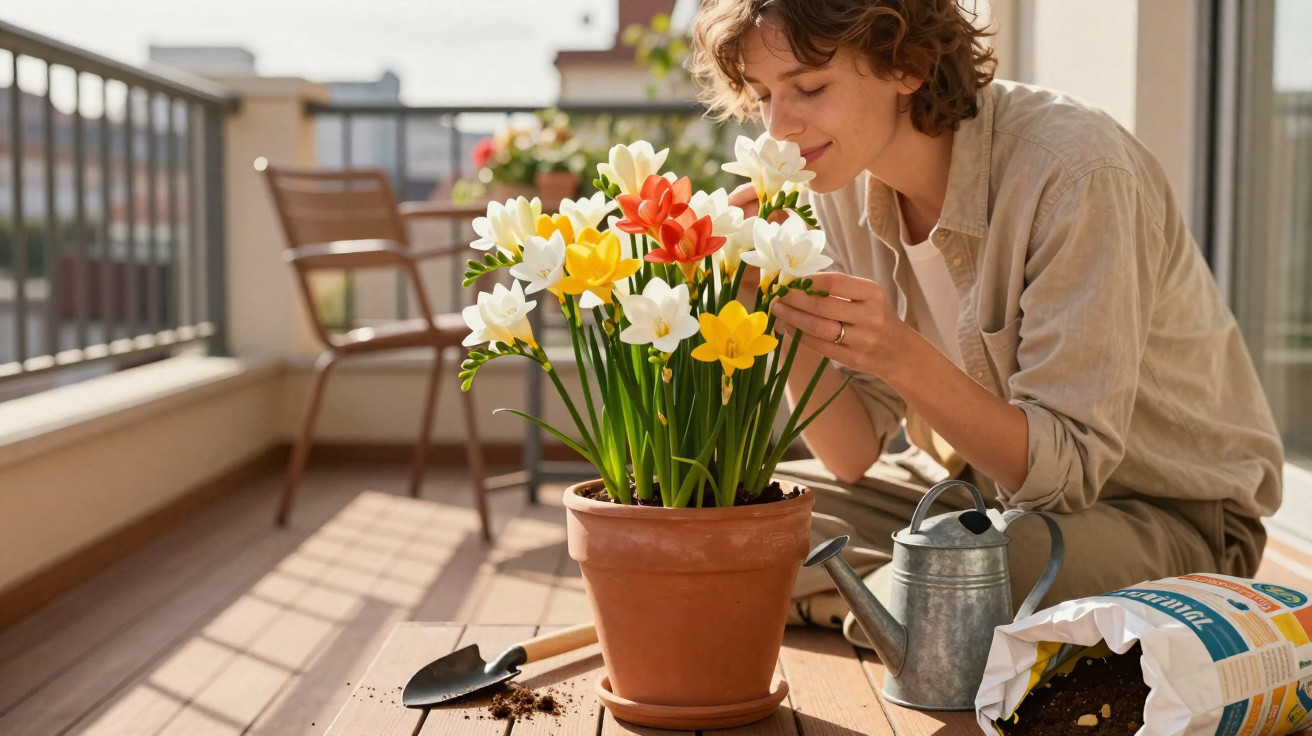
Not a dozen pots, but one carefully chosen plant.
Many balcony owners know the dilemma: you want a fragrant summer retreat, buy lavender, jasmine and roses, and end up with a half-jungle that takes up space and is difficult to maintain. Yet a noticeably scented balcony or terrace often needs just one type of flower - provided it is positioned deliberately and cared for correctly.
The overlooked fragrance powerhouse for balconies and terraces
The quiet star of compact outdoor spaces is the freesia. Botanically, it is a corm plant native to southern Africa that has long played a role in the perfume industry. Its fragrance is remarkably layered, recalling honey, citrus notes and a hint of freshly laundered linen. It is light and warm, without becoming overpowering.
Even just a few pots of freesias can reliably turn a small balcony or narrow loggia corner into a fragrant area.
The plant produces slender, gently arching stems, with blooms arranged along one side like little trumpets. Depending on the variety, they flower in white, yellow, pink, red, orange or violet. Many gardeners regard freesias as among the most intensely scented plants for containers - perfect for tight spaces, where their fragrance quickly gathers.
Why one species works better than twenty mismatched pots
Anyone trying to use lots of different scented plants soon reaches a limit: every species has its own requirements for light, watering and winter protection. Over just a few square metres, this can quickly become a maintenance marathon. Different fragrances also compete with each other, often creating a confused rather than harmonious effect.
Freesias follow a different approach: use only a few carefully positioned pots with a powerful scent. This brings several advantages:
- Space-saving: One large container or several medium-sized pots are enough.
- A clear fragrance profile: Rather than a jumble of smells, one delicate and recognisable note takes centre stage.
- Straightforward care: One plant type means one watering and feeding routine.
- Flexible positioning: Pots can be moved to your preferred spot - directly beside the balcony door, for example.
How to plant freesias in pots for maximum fragrance
The corms - more precisely, corm-like storage organs - are planted in pots or window boxes. In mild climates, they can remain outdoors; in areas with severe frost, they need lifting from the soil and moving into winter storage.
Choosing the right time
In places where temperatures regularly fall well below freezing, gardeners should plant the corms in spring, once night frosts are no longer expected. The plants will then bloom in summer. In very sheltered urban locations or wine-growing regions, autumn planting is also possible for earlier flowers in the year. In these areas, the corms are more likely to withstand light frost if kept in a well-protected corner.
Pot size, compost and planting depth
For a fragrantly planted balcony, choosing a slightly larger pot is worthwhile. Useful guidelines include:
- Diameter: at least 20 to 30 centimetres
- Depth: roughly the same, allowing the roots enough room to spread
- A drainage hole in the base is essential
A light, highly free-draining growing medium works well, for example:
| Component | Purpose |
|---|---|
| 50% potting compost | Provides basic nutrients and retains water |
| 25% sand | Allows excess water to drain away |
| 25% loose organic material, such as compost or coir fibre | Opens up the compost and supplies extra nutrients |
A pot measuring about 15 centimetres across holds around 5 to 7 corms. Plant them 3 to 5 centimetres deep, with the pointed end facing upwards and around 5 to 6 centimetres between each one. When they emerge, this creates a dense “bouquet of flowers” that will later look like one large, lush clump.
The best spot for freesias on a balcony or terrace
Freesias thrive on light and warmth. They need at least six hours of sunshine each day; otherwise, flowering will be less abundant. A position beside a house wall is ideal: the wall stores warmth, offers protection from wind and therefore helps carry the fragrance.
Particularly effective locations include:
- directly beside the balcony or terrace door, so the scent is noticed immediately
- within reach of the seating area, such as next to a lounge chair or bistro table
- slightly raised on a stool or plant stand, keeping the fragrance closer to nose height
If freesias are arranged thoughtfully beside the door or your favourite seat, two or three containers are often enough to fill the whole area with fragrance.
Care: keeping the pots vigorous throughout the year
Watering and feeding
After planting, keep the compost evenly moist, but never thoroughly wet. Waterlogging is fatal to freesia corms. Let the top layer of compost dry out slightly between watering sessions.
Once flower stems begin to form, the plants benefit from extra nutrients. Applying a liquid fertiliser for flowering plants about every two weeks is sufficient. A higher potassium content is important, as it supports blooms and stems without making the plant soft and weak.
Supporting and cutting
The stems can grow quite tall and tend to flop, particularly in windy sites or when flowering heavily. Thin canes or small plant supports are enough to hold them upright. Tie them in loosely so the stems are not constricted.
When freesias are flowering, some stems can be cut for a vase. Their fragrance also lasts well indoors on a dining table. As long as enough foliage remains on the plant, this has little effect on the overall scent on the balcony or terrace.
Overwintering the corms
In harsher regions, freesias quickly fail outdoors when frost becomes more severe. A simple approach helps: after flowering, allow the foliage to yellow naturally. During this stage, the corms are still drawing in energy. Watering should then be reduced considerably.
After the first light frosts, lift the corms, dry them for a few days and then store them somewhere dry, dark and cool - for instance, in a cellar or frost-free garage at 4 to 10 degrees Celsius. They can be planted again in fresh compost the following spring.
Colours, combinations and common mistakes
For the strongest fragrance, choose scented white and yellow varieties, which are often especially intense. Many colourful mixed selections sold in shops look spectacular, but their scent varies in strength depending on the breeding line.
On a balcony, freesias pair well with more restrained plants that have little or no scent, including:
- ornamental grasses in pots for structure
- herbs such as thyme or chives, which only release fragrance when touched
- small ornamental perennials without a strong smell
This keeps the freesia fragrance clearly noticeable without competing with other aromas.
Common mistakes include compost that is too heavy and constantly wet, a position in full shade, or a site exposed to persistent draughts. In each of these situations, the plant produces weaker flowers and less fragrance, even when the corms themselves are healthy.
Who benefits most from freesias
Freesias are an appealing choice especially for city dwellers with a tiny balcony and limited time. Their season is clearly defined, their care requirements are manageable and their impact is remarkably strong. Those who enjoy spending the evening outside with a glass of wine or a coffee benefit most: the fragrance becomes particularly pleasant during the calmer evening hours.
People with allergies who are sensitive to heavy rose fragrances may also often find freesias easier to tolerate, as their scent is intense but comparatively light. Naturally, every body reacts differently, so testing with just a few pots is sensible.
So, if you are considering filling the balcony with ten different containers again, try a different route this year: a few well-placed pots of freesias - and summer suddenly smells like a holiday, even if you have only opened the balcony door.
Comments
No comments yet. Be the first to comment!
Leave a Comment