
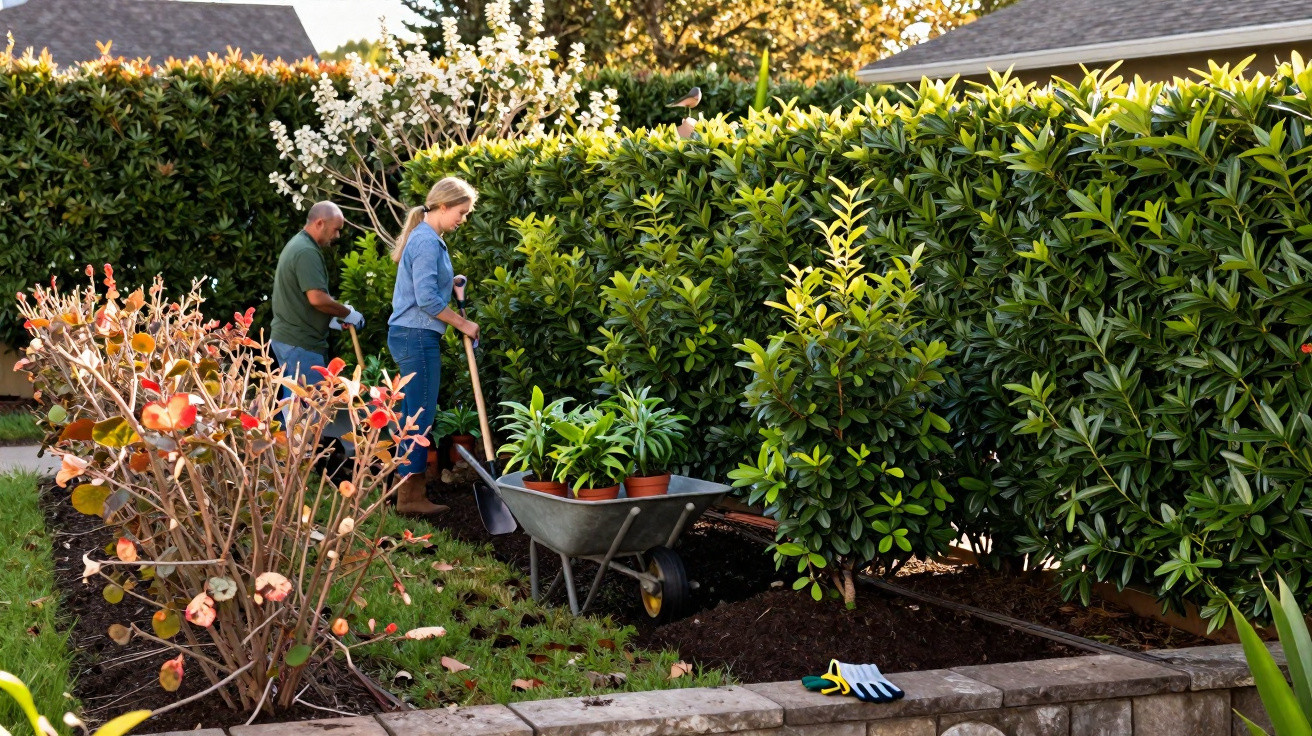
More and more amateur gardeners are frustrated by bare patches in their hedges and prying eyes from neighbouring properties. One former trend plant in particular is failing on a widespread scale. Landscapers are therefore switching to a different, colourful evergreen that is much more resilient and creates a dense screen.
Why the former hedge star is becoming a problem
Fungal disease is affecting entire housing estates
Photinia, often sold as red robin, was long considered an ideal choice: it grows rapidly, produces vivid red new growth and quickly forms a private barrier. Countless metres of Photinia hedging were planted in new-build developments. The picture has now changed markedly.
The reason is a fungal infection, Entomosporium leaf spot, which is spreading extensively. It initially produces small brown marks on the foliage. These spots enlarge, preventing the leaves from photosynthesising properly, and the leaves eventually fall.
Where dense red hedges once stood, there are now gaps, dried-out shoots and an unobstructed view of patios and living rooms.
The fungus benefits from mild winters and wet springs. This is precisely the type of weather becoming increasingly common across central Europe. Nurseries and local authorities report that the disease is now appearing in almost every region. Anyone with a long hedge made solely of Photinia risks the fungus spreading through the entire hedge like wildfire.
Costly sprays with limited results
Many garden owners try to take action by spraying fungicides, collecting diseased leaves and pruning more heavily. All of this takes time and money, with highly mixed results.
- Fungicide treatments need to be repeated regularly
- Their effect is often limited when neighbouring hedges are also infected
- Severe pruning temporarily destroys the privacy screen
- Collecting fallen leaves is laborious and still does not entirely prevent reinfection
Many amateur gardeners become disheartened when fresh spots appear after every rainfall. They are looking for a plant that is less susceptible and does not require continual chemical treatments.
Single-species hedges reveal their weaknesses
Photinia's decline recalls the problems suffered by Thuja hedges a few years ago. At that time, many people chose a single species, until drought, fungi and pests took hold. A hedge consisting of only one plant species is exceptionally vulnerable when a particular pest or fungal disease becomes established.
Gardeners and landscape contractors now report a sharp fall in demand for Photinia. Nurseries are expanding their range of alternative hedge shrubs, and one name comes up particularly often: Pittosporum.
Pittosporum: the quiet winner among privacy shrubs
Evergreen, dense and unexpectedly decorative
Pittosporum, also commonly sold simply as a Pittosporum shrub, is receiving growing attention from professionals. It is evergreen, compact and remains visually appealing throughout the year. Many varieties have bicoloured green-and-cream foliage, while others feature deep green leaves with a subtly lacquered sheen.
Annual growth is generally between 20 and 30 centimetres. This is sufficient to create reliable privacy within a few years, without the hedge needing drastic annual pruning.
Pittosporum offers exactly the combination many people are missing: permanent foliage, a dense structure and appealing colours, without becoming a high-maintenance problem.
This makes it ideal for terraced homes and small gardens: the shrub grows quickly enough to block unwanted views, yet remains easy to control. With regular light trimming, it forms an even, elegant hedge that does not become straggly.
Strong disease resistance means less maintenance
Compared with Photinia, Pittosporum is notably more robust against leaf fungi. Serious diseases have so far occurred only in isolated cases. This substantially reduces the need for fungicides, benefiting both the environment and household budgets.
Care requirements remain manageable:
- One shaping trim each year in late spring or summer is usually enough
- Water deeply during dry spells, but not every day
- Apply a light feed in spring using organic fertiliser or general garden fertiliser
- Choose a sheltered position that is preferably not in full shade
For anyone wishing to avoid chemical plant protection products, Pittosporum is a dependable choice. This is an increasingly important advantage in densely built-up residential areas, where children and pets spend a great deal of time in gardens.
Why experts still recommend mixed hedges
Despite these benefits, specialists warn against blindly planting entire streets with Pittosporum alone. The experience of Thuja and Photinia shows that when a single species is planted everywhere, the risk of widespread problems in the future increases.
Instead, gardeners recommend so-called mixed hedges. Pittosporum provides an important framework, but it is combined with other woody plants, for example:
- Elaeagnus (oleaster): robust, with silvery shimmering leaves, well suited to dry sites
- Hazel: native, valuable for insects and birds, and produces nuts in autumn
- Cornus sanguinea (common dogwood): bright red stems in winter and white flowers in early summer
- Cherry laurel varieties with high fungal resistance: providing a dark contrast within the hedge
The more varied the make-up of a hedge, the lower the risk that a single pest will disable the entire privacy screen.
How garden owners can plan the move to a new hedge
The best planting times and a gradual changeover
Anyone replacing a disease-ridden hedge does not need to clear it all at once. A phased approach is often sensible. Start by removing the most seriously affected sections, then plant new shrubs, such as Pittosporum, among the existing plants.
The ideal planting periods are:
| Period | Suitable for |
|---|---|
| Autumn (September–November) | Root establishment before winter and a good start in spring |
| Early spring (March–April) | Container-grown plants, once the ground is no longer frozen |
Important: heavily infected leaves and branches from the old hedge should not be placed on the compost heap. Dispose of them with household waste instead. This reduces the infection pressure in the garden.
Position, soil and variety selection for Pittosporum
Pittosporum prefers bright positions with some protection from cold easterly winds. Light partial shade is possible, but dense shade quickly results in sparse growth and bare areas inside the plant.
The soil should drain freely, as the shrub does not tolerate waterlogging well. In heavy clay soils, sand or grit can improve the structure. A mulch layer of composted bark or woodchip helps retain soil moisture and protects the root system.
Depending on the region, it is worth checking the frost tolerance of individual varieties. In mild areas along the Rhine or in large cities, more tender options may be suitable, while hardier types should be selected at higher elevations.
More than privacy: added benefits for climate and wildlife
Choosing Pittosporum and mixed hedges brings more than privacy. Dense evergreen planting breaks the wind, filters dust and gives birds somewhere to shelter. Combined with flowering shrubs such as dogwood or hazel, it creates a lively garden boundary that provides food and cover for many months.
At the same time, a varied hedge improves the garden's microclimate. It retains moisture, limits drying caused by wind and creates noticeably more pleasant corners of the plot on hot days. In densely developed neighbourhoods, this can create a small green buffer against urban heat islands.
Anyone unsure how Pittosporum will fit into their own plot should plant one or two specimens as a trial and observe their growth for one or two seasons. This makes it easier to judge which height, density and combinations suit their garden style and the surrounding neighbourhood.
Comments
No comments yet. Be the first to comment!
Leave a Comment