
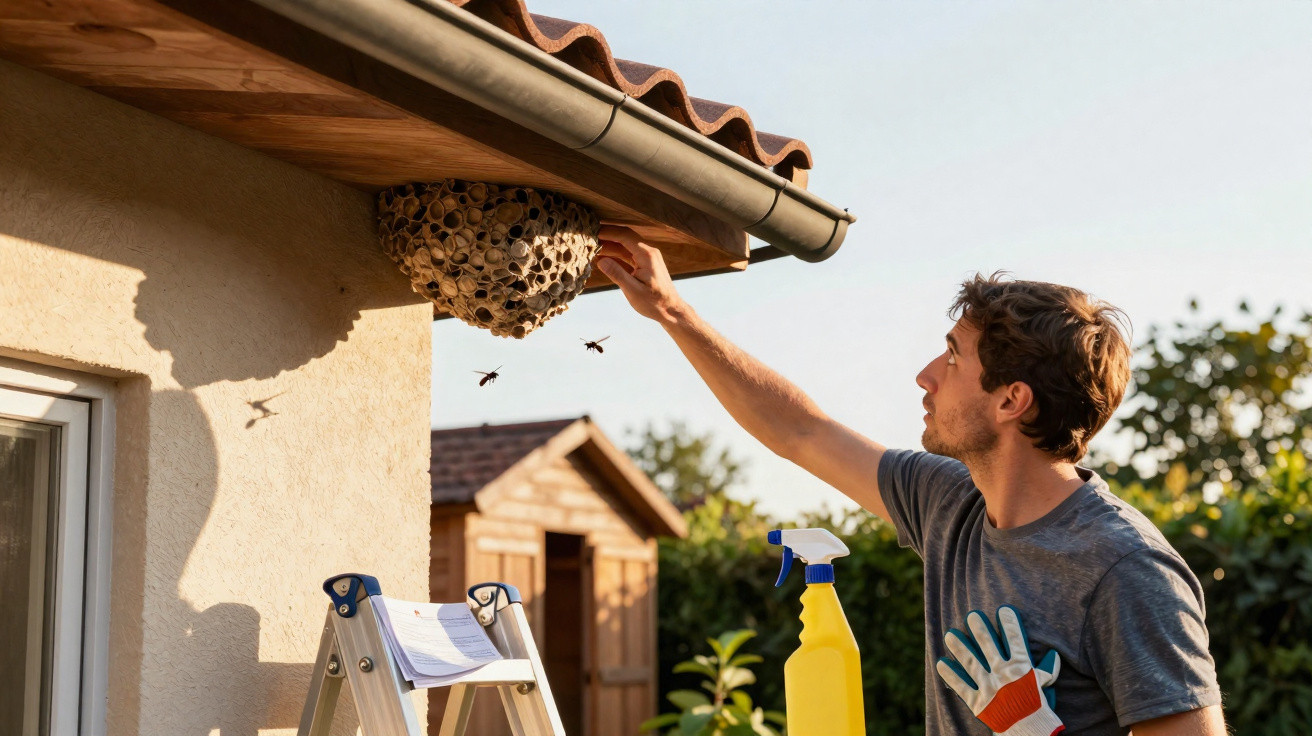
At first glance, everything seems peaceful: the sun is appearing and the lawn is calling. Yet high up beneath the roof or inside the garden shed, a small, carefully concealed building project may be under way. A lone Asian hornet queen is shaping a grey paper sphere – scarcely larger than a table-tennis ball, but with the potential to grow explosively over the summer.
The quiet danger in spring
In late winter and early spring, Asian hornet queens that have overwintered begin to emerge from dormancy. From mid-February until the end of May, they search for somewhere to establish themselves, often choosing areas around houses, garages and garden shelters.
Their first construction is known as a primary nest: it is tiny, easy to miss and generally only three to five centimetres across. This early stage is crucial. If the nest is spotted now and removed professionally, a large summer colony containing hundreds of workers cannot develop.
The earlier the first miniature nest is found, the lower the risk of a major population increase in late summer.
What initially appears to be an innocuous paper ball can become a striking structure within a few months, with hornets continually flying to and from it. As the nest grows, so do the risk of stings and the danger posed when someone gets too close, makes noise or works nearby.
Beneath the roof: the queen's preferred area
Most primary nests are found close to buildings, frequently straight beneath the roof edge. You do not need a ladder or specialist equipment for an initial inspection. Observing carefully from the ground is enough, provided you know where to look.
Roof areas that need regular checks for Asian hornet nests
- Porches and roof overhangs on the sunnier sides of the building
- Fascia boards and side cladding around the roofline
- Panels and coverings on balconies or carports
- Boxes and enclosures beneath guttering
Scan slowly along the underside of the roof edge. Focus less on spotting the nest itself and more on the insects' behaviour: one insect repeatedly flying to the same spot and briefly disappearing there is a clear sign.
Typical features of an early nest include:
- A grey-brown paper sphere, smooth or slightly marbled
- Size: roughly that of a table-tennis ball, sometimes slightly smaller
- An entrance facing downwards or to one side
- A sheltered location receiving some sunlight
The most common location is directly beneath the roof underside, close to the roof edge, in a protected area near timber.
Always remain several metres away. Trying to “take a closer look” from a ladder creates an unnecessary risk. It is safer to inspect from ground level, using binoculars if needed.
Garden sheds and shelters: a hidden second location
Alongside the roof edge of a house, a garden shed is a common site for the first nest. Many people do not enter their shed for months during winter, giving a searching queen ideal cover.
Where nests commonly hide inside a shed
Typical indoor locations include:
- The junction between beams and roof panels
- Dark corners close to the ceiling
- The underside of shelves or storage ledges at head height
- The inside of door lintels
The danger arises when someone opens the door in spring, ducks down, picks up a rake or spade, and works only centimetres from the nest without noticing it. The queen can quickly feel threatened and may attack.
For a safer inspection:
- Pause on the threshold before entering and look upwards.
- Use a torch to check the ceiling area and corners slowly.
- Do not make sudden movements or carry out “test drilling” in the ceiling.
A calm, thorough visual inspection in spring greatly reduces the likelihood of unpleasant surprises during tidying-up.
How to identify an active nest early
In addition to the small paper sphere, the insects' behaviour and faint sounds can offer clues. Even a single insect repeatedly travelling to the same point may be enough to confirm a suspicion.
Common signs of an occupied nest
| Sign | What it may indicate |
|---|---|
| Regular flights to a fixed point | A flight path to the nest, often with only one hornet visible |
| A quiet, deep buzzing sound near the nest | Building activity or movement inside, more likely with a larger nest |
| A hornet repeatedly following the same route along the roof edge | An orientation flight between a food source and the nest |
If there is no activity at a suspected location for one or two days, this does not necessarily mean there is no problem. Temperature, time of day and weather all affect flight activity. If you are unsure, check again at different times of day.
What you must never do
Many incidents happen because people try to intervene impulsively without protection. Reaching automatically for a broom, garden hose or spray can have serious consequences.
- Do not spray the nest with water.
- Do not burn or pierce the nest.
- Do not use ordinary insect spray near the nest.
- Do not seal up or block the entrance.
- Do not carry out noisy work directly beside the nest, such as using a drill, brushcutter or hammer drill.
The rule is: spot it, keep your distance, secure the area, report it – never try to “remove” it yourself.
What to do when you find a nest
If you discover a nest, move away calmly but decisively. Children and pets should no longer be allowed into the area. Keep windows and doors leading into the nest area closed.
Useful steps after making a discovery:
- Take a photograph from a safe distance, using maximum zoom and no flash.
- Record the location precisely, for example: “under the roof edge on the south side of the house, to the right of the balcony”.
- Ask your local council which specialist contractors are responsible.
- Restrict all activity in the immediate vicinity until the nest has been removed professionally.
In many areas, local authorities work with trained pest-control professionals who have protective clothing, specialist products and experience of Asian hornets. At an early stage, a primary nest can usually be removed more quickly and with less effort.
Why the Asian hornet is so problematic
Beyond the risk of stings, this species is particularly concerning for beekeepers and conservationists. Asian hornets hunt honey bees and other pollinating insects intensively. A large nest can substantially increase pressure on nearby apiaries.
Hornets also react very sensitively to vibrations and rapid movement close to their nest. Accidentally positioning a ladder against the roof area or using a brushcutter along the shed wall can trigger a defensive attack. Several stings over a short period can place considerable strain on the circulatory system, while severe reactions are possible for people with allergies.
Practical guidance for homeowners and gardeners
A few simple, regular routines can reveal many nests in spring before they become large. Setting aside a regular inspection date every few weeks is often enough.
- When mowing for the first time in March and April, look beneath the roof edge.
- Whenever opening the garden shed or garage, check overhead first.
- While having coffee on the patio, occasionally watch the guttering and roof overhangs.
- Keep a simple pair of binoculars handy to inspect suspicious places safely from a distance.
If you are building an extension, it is worth planning ahead: sealed cladding, closely fitted boards and fewer open gaps beneath roof overhangs leave fewer niches in which a queen can establish herself unnoticed.
Important advice on stings and behaviour
Anyone stung close to a nest should leave the area calmly at once. Do not hit at the hornets, wave your arms or make frantic movements. Moving a few metres away in the open is usually enough for the hornets to lose interest.
Call emergency services immediately in the event of multiple stings, stings to the head or neck area, or a known insect-venom allergy. Early symptoms such as breathing difficulties, dizziness, nausea or a rash across the whole body are warning signs.
For healthy people, individual stings are painful but usually manageable: cool the area, raise the affected limb and monitor it. Anyone who is uncertain should seek medical advice, especially where children or older people are concerned.
By staying alert, carrying out a few targeted checks in spring and being willing to call in professionals, the risk posed by Asian hornets can be reduced significantly – before a tiny spherical nest develops into a buzzing large colony.






Comments
No comments yet. Be the first to comment!
Leave a Comment