
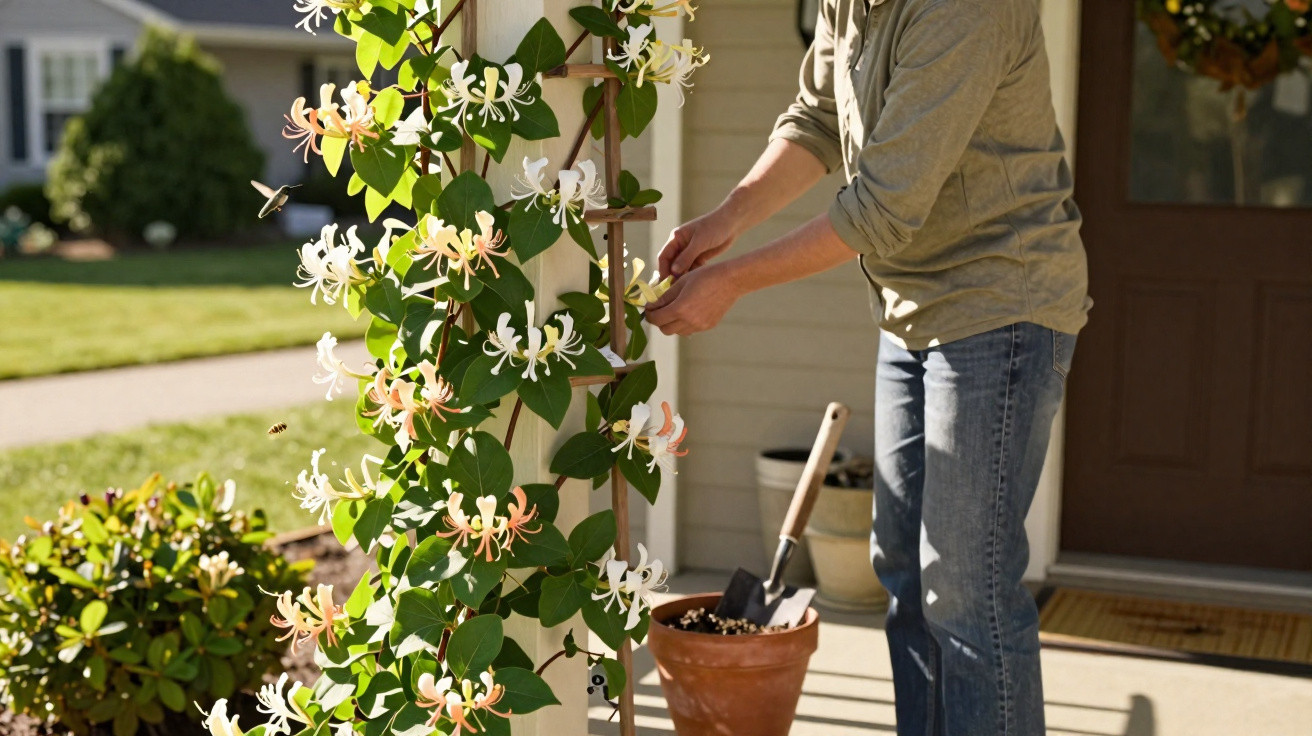
Many homeowners recognise the scene: the front of the house looks flat, colourless and somehow neglected. Rather than buying new pots every year, gardening professionals increasingly favour one carefully selected climbing plant that stays for the long term, smells richly fragrant and provides food for small nectar lovers throughout the year. This is exactly where evergreen honeysuckle comes into its own – especially when planted in April.
Why evergreen honeysuckle instantly transforms a front garden
The front garden is the house’s calling card. The area outside the door is the first thing visitors see, yet it often makes the weakest impression because it consists only of lawn, gravel and a tired-looking shrub. Vertical planting changes this immediately: in place of a bare wall, there is a living green surface that does not look naked even in January.
Evergreen honeysuckle (botanically, Lonicera) is ideally suited to this purpose. This vigorous climber produces slender shoots that can be trained along trellises, pergolas or arches. Many varieties retain their leaves through winter, so they do not become bare like roses or clematis. The entrance area therefore remains “dressed” all year round.
“One well-positioned honeysuckle can turn a bare house wall into a dense, fragrant, bird-rich backdrop – often within just a few months.”
There is a practical benefit too: anyone wanting to conceal unattractive garage walls, ageing fences or screening does not need costly building work. Add a sturdy support and a suitably large planting hole, and the framework will soon be covered by a thick layer of foliage and flowers.
Why April is the ideal time to plant
For many evergreen climbing shrubs, April signals the beginning of the growing season. The ground is no longer frozen, temperatures are rising and daylight hours are increasing. At this point, honeysuckle begins developing its roots – a crucial stage before the height of summer brings longer dry spells.
Planting in April gives the plant several advantages:
- Its roots can spread quickly through loose soil that is still cool and moist.
- The plant first directs its energy into root growth, followed by fresh shoots and flowers.
- By summer, the climber is already well established and less vulnerable to heatwaves.
In many temperate areas, evergreen honeysuckle grows dependably provided the soil does not remain waterlogged. Sunny to partially shaded positions receiving six to eight hours of light daily are ideal. It often grows even more vigorously in a front garden, where house walls retain warmth.
How honeysuckle attracts hummingbirds and other nectar lovers
Although butterflies, solitary bees and bumblebees tend to be the focus in the UK, regions with hummingbirds demonstrate particularly clearly how strongly honeysuckle appeals to nectar-feeding birds. Its tubular blooms are perfectly shaped for long beaks and tongues, provide plenty of sugar and flower for weeks.
The same effect can be brought into our gardens: nectar-rich tubular flowers are a magnet for pollinating insects. Choosing varieties that flower generously over a long period creates a kind of “nectar filling station” outside the front door. Many evergreen honeysuckles offer exactly this:
- trumpet-shaped flowers in red, orange, yellow or cream
- a long flowering period from late spring into late summer
- a pronounced cloud of fragrance, especially during the evening
Native insect species benefit particularly strongly from regional or site-adapted varieties. Studies show that these forms can sometimes be visited far more often than exotic cultivars. Anyone prioritising biodiversity should therefore specifically ask specialist retailers for robust, non-invasive varieties.
The fragrance that turns the front door into a scented haven
Once honeysuckle starts flowering, the atmosphere in the front garden changes at once. Its tubular flowers release a sweet scent often compared with honey, vanilla or ripe apricots. The fragrance becomes even stronger in late afternoon and evening, drawing insects in like a magnet.
Position the plant beside the front door, along a path or beneath a window, and its scent becomes part of everyday life – when coming home, taking out the rubbish or airing the house in the evening. These frequent, small moments of fragrance are what make it so appealing.
“A climbing honeysuckle at the house entrance acts like a natural ‘fragrance filter’ – you enter the home through a kind of green, sweet-smelling curtain.”
Site, planting and care: how to grow evergreen honeysuckle successfully
A few straightforward principles will help this climbing plant fulfil its potential. The key points are outlined below:
| Aspect | Recommendation |
|---|---|
| Position | Sunny to partially shaded, sheltered from wind, preferably against a warm wall |
| Soil | Loose, humus-rich and well-drained, with no persistent waterlogging |
| Planting time | April is ideal, provided the ground is not frozen |
| Watering | Water regularly during the first season; afterwards, only during prolonged dry weather |
| Feeding | Start in spring with an organic slow-release fertiliser or compost |
| Pruning | Lightly prune after the main flowering period to maintain its shape |
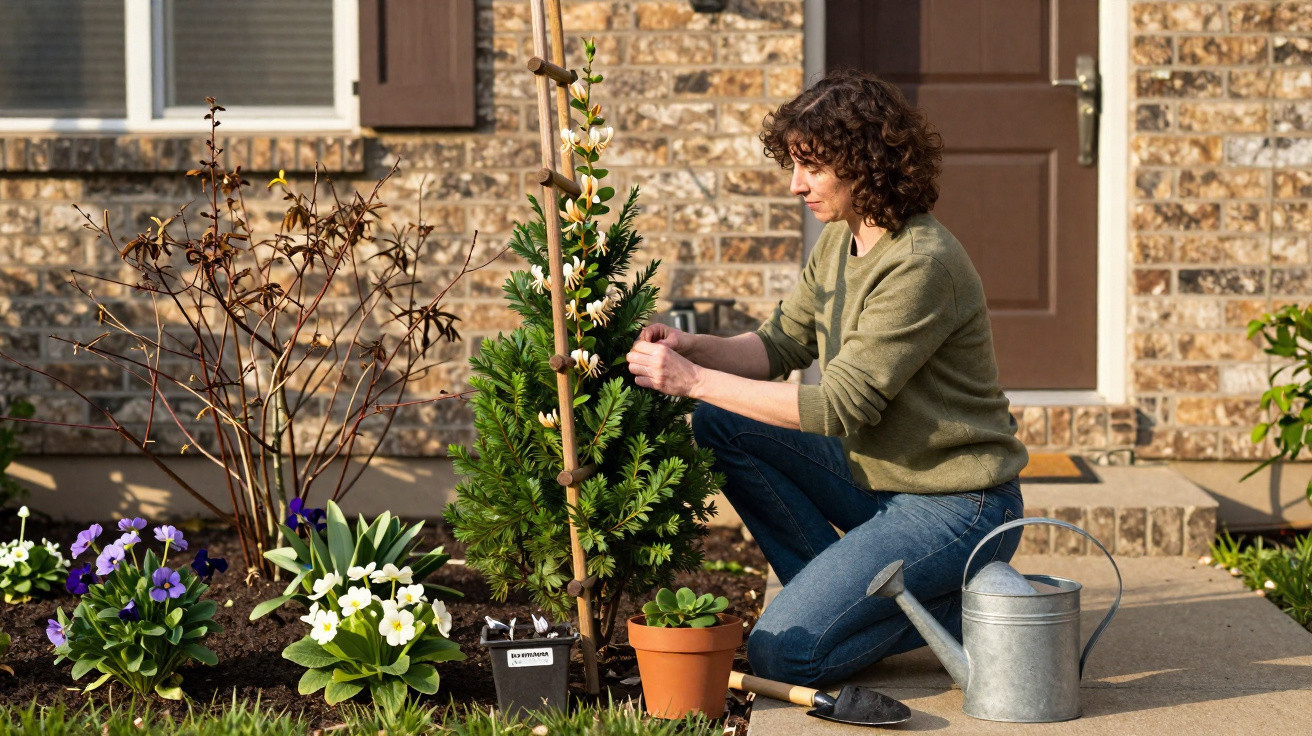
When planting, make the hole at least twice as wide as the root ball. A little compost or well-rotted manure at the bottom will give it a strong start. Importantly, install the climbing support at the same time so the shoots can be guided from the outset.
Pot or open ground: which is the better option?
Anyone without a traditional front garden can also grow evergreen honeysuckle in large containers – for instance on a balcony, roof terrace or by a narrow entrance. The container’s size and good drainage are the decisive factors.
- Allow for a pot capacity of at least 40–50 litres.
- Use drainage holes and a layer of expanded clay or gravel to prevent waterlogging.
- Feed regularly throughout the growing season.
- Insulate the pot in winter against freezing through if severe frosts are forecast.
In open ground, the plant can root more deeply and is easier to maintain over the long term. In a pot, its advantage is flexibility: if the space is redesigned, the container can simply be moved elsewhere.
How honeysuckle makes a garden more valuable for wildlife
Evergreen honeysuckle does more than enhance the appearance of a garden; it also offers considerable ecological benefits. Its dense leaves provide shelter for birds and insects. The flowers supply nectar, while birds may later use the berries of certain varieties as a food source.
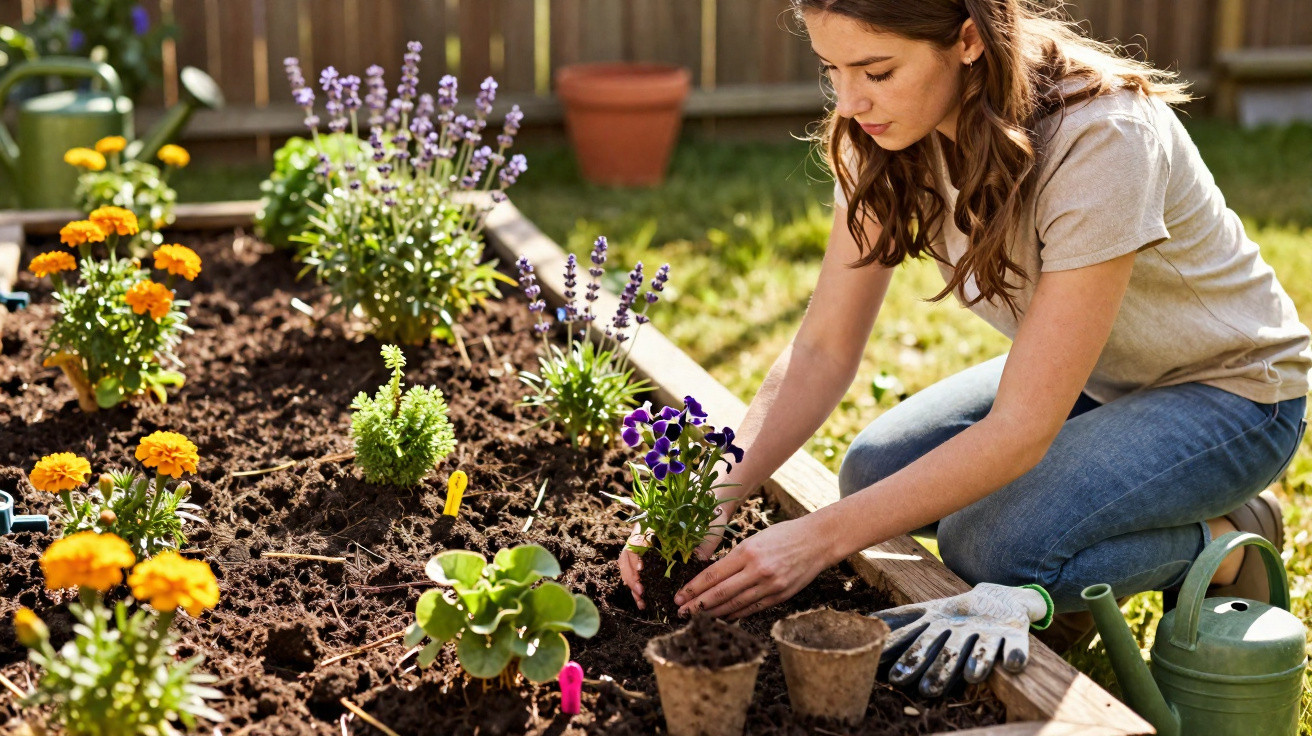
The effect becomes stronger when other suitable plants are combined around the climber, such as:
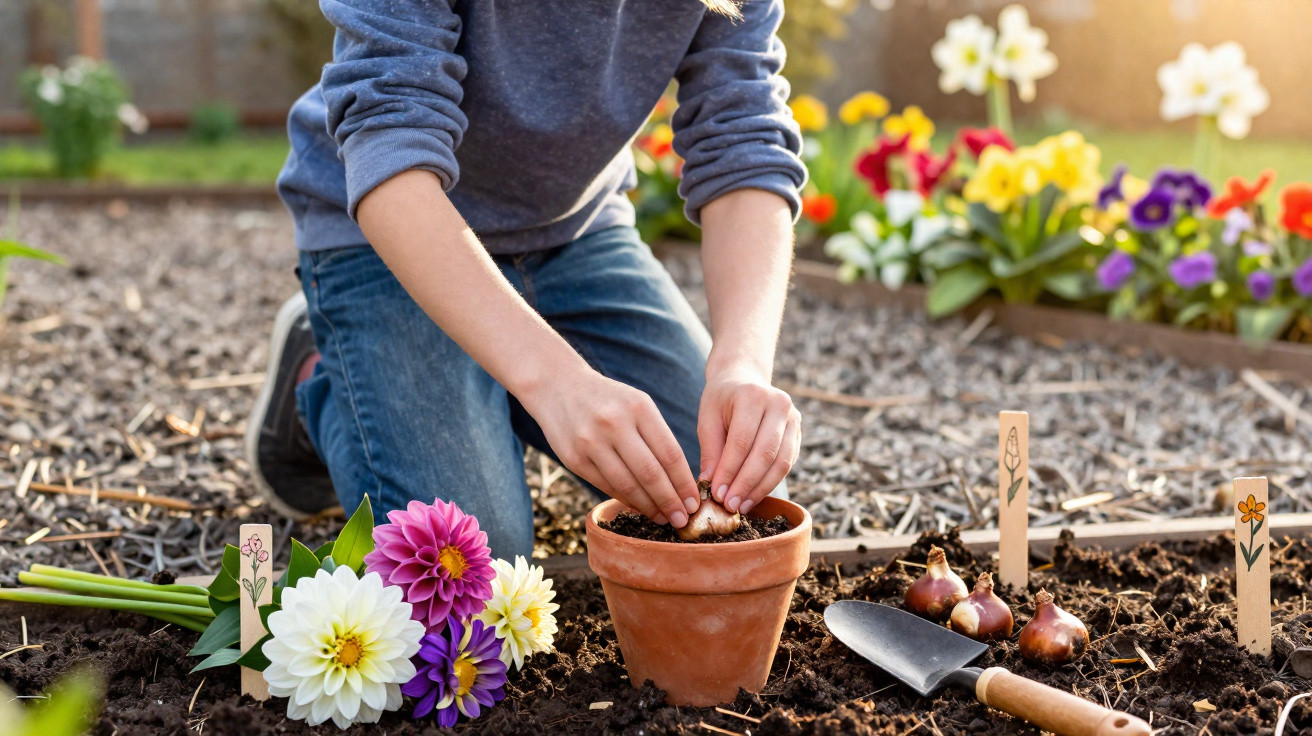
- early-flowering bulbs such as crocuses to begin the spring season
- lavender or sage as sun-loving partners at the base of the trellis
- wild perennials such as viper’s bugloss or knapweed for solitary bees
Avoiding chemical sprays creates a continuous “nectar corridor” from spring until late summer – directly outside the front door.
Risks and mistakes best avoided
Although honeysuckle appears robust, there are several potential pitfalls. The most troublesome are:
- permanently wet soil, which can cause root rot
- overly dark positions, where flowering remains sparse
- hard pruning at the wrong time, which removes flower buds
There is another consideration: some honeysuckle species are regarded as highly vigorous in certain regions. When buying from a specialist retailer, ask specifically for non-invasive varieties that will not spread uncontrollably around the garden.
Why this climbing plant is worth considering now
April offers an opportunity to rethink the front garden completely. Instead of planting the same geraniums every year, evergreen honeysuckle creates a permanent feature that combines colour, fragrance and wildlife. This approach is especially worthwhile for people with limited time or experience, because one well-maintained climbing plant makes far more impact than numerous scattered containers.
Those unsure which variety is suitable can ask at a garden centre for evergreen honeysuckle recommended for their local area. A young shrub already two to three years old will often produce visible flowers in its first year after planting – turning the front garden into an eye-catching feature more quickly than expected.

Comments
No comments yet. Be the first to comment!
Leave a Comment