
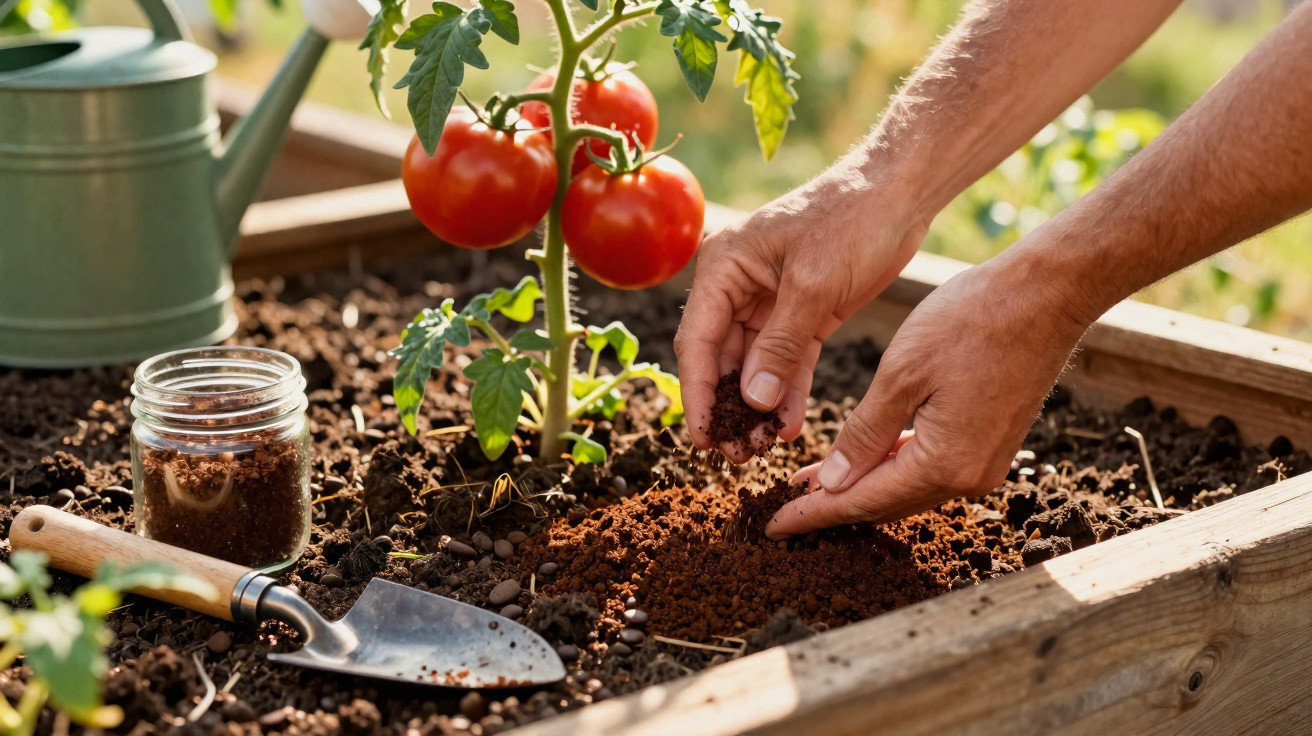
Putting coffee grounds in the soil around a tomato plant can add organic matter and small amounts of nutrients to your growing area. The residue needs to be cool, dry and used sparingly, because thick layers can compress the surface, hold too much water and make it harder for air to reach the soil.
What benefits do coffee grounds offer a tomato plant?
Used coffee grounds still contain organic compounds and may have roughly 2% nitrogen, although the exact proportion varies depending on the coffee and how it was brewed. This nitrogen is not available straight away: soil microorganisms must break down the material first, releasing part of it for the roots to take up.
Nitrogen is involved in building proteins and other molecules essential to living things. In tomato plants, it supports leafy growth and sturdy shoots that can photosynthesise, but it should not be supplied in excess during flowering and fruit production.
- Adds organic matter to the soil;
- Provides slow-release nitrogen;
- Feeds some decomposer organisms;
- Can help improve the structure of the growing medium when thoroughly mixed in;
- Helps you reuse a household waste product.
Why should the coffee grounds be dry before applying?
Damp grounds clump easily and can grow mould while in storage. To dry them, spread the material in a thin layer on a tray, keep it in a well-ventilated spot, and stir now and then until the grains separate freely.
- Wait until the grounds have cooled completely;
- Spread the residue out rather than leaving it in a heap;
- Do not store the material while it is still damp in a sealed container;
- Throw away any portion with a bad smell or heavy mould;
- Avoid adding sugar, milk or sweetener to the soil.
How do you put coffee grounds in the soil without harming the roots?
Apply only a very thin layer around the tomato plant, keeping it away from the stem. Afterwards, lightly work the grounds into the top layer of soil or mix them into organic compost beforehand, so they do not form a crust that restricts the movement of water and oxygen.
There is no single dose that suits every pot or bed. The right amount depends on the volume of soil, drainage and any other fertilisers being used. The safest approach is to apply a small quantity, watch how the plant responds, and alternate with mature compost rather than tipping all the grounds produced each day onto the same spot.
Can too much leave the tomato plant with lots of leaves?
An excess of nitrogen can push the plant to produce shoots and leaves at the expense of flowers and tomatoes. On top of that, a concentrated layer of grounds can compact the surface and keep the growing medium wetter for longer. A few precautions help prevent this imbalance:
- Do not apply coffee grounds every day;
- Stop using them if the soil stays waterlogged;
- Check whether there are many leaves and few flowers;
- Do not rely on the residue as the only fertiliser;
- Keep the tomato plant in a sunny, airy position.
Coffee grounds work best as a supplement to cultivation
Coffee grounds alone do not provide all the nutrients a tomato plant needs. The plant also requires phosphorus, potassium, calcium and other elements, especially while forming flowers and fruits. For that reason, the residue performs best when combined with a balanced organic compost and sensible watering practices.
Moderate use follows the same principle applied to other kitchen-garden plants that can receive coffee grounds. Rather than trying to change soil acidity with the residue, it is better to monitor pH with an appropriate test and treat coffee grounds as a supplementary source of organic matter for the tomato plant.



Comments
No comments yet. Be the first to comment!
Leave a Comment