
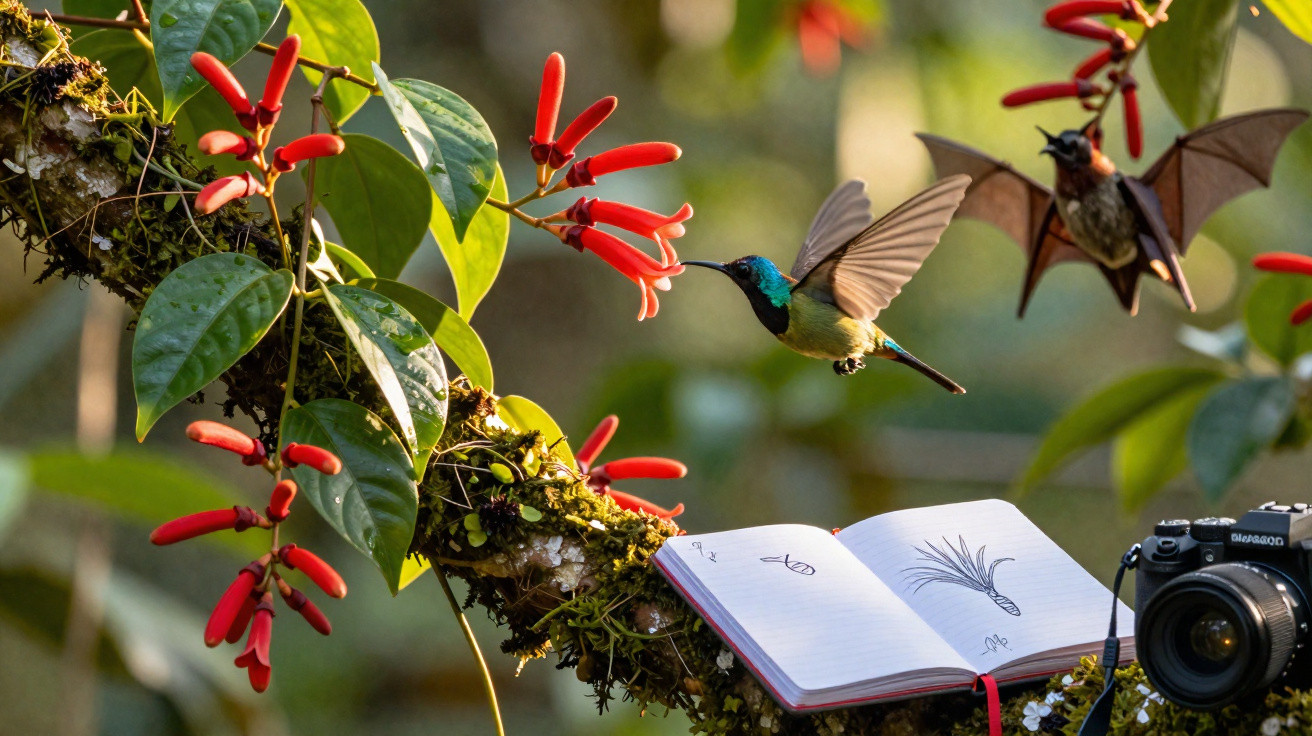
A tropical vine best known for vivid red, tube-like blooms turns out to be much less choosy than researchers previously believed.
New work finds that Aeschynanthus acuminatus is able to alter both the form and the colour of its flowers even while its usual bird pollinators remain around. This result overturns a long-standing assumption about the way floral evolution typically unfolds.
For years, many biologists argued that plants only remodel their flowers once a crucial pollinator has been lost. In this case, the vine shifted sooner than expected, widening its opportunities rather than waiting for a crisis.
That kind of adaptability helps clarify how plants adjust, expand their ranges, and even give rise to new species without first being severed from the ecological relationships they rely on.
A vine that changed its flowers
At the heart of the study is a lipstick vine distributed across mainland South-east Asia and the island of Taiwan-areas that host markedly different bird communities.
By recording the flower traits of Aeschynanthus acuminatus alongside the birds that visit them, Jing-Yi Lu and colleagues at the Field Museum demonstrated that the vine shifted away from a tightly constrained pollination approach.
Importantly, it did so while still maintaining links with the bird species it had previously depended upon.
Rather than transforming only after reaching areas without sunbirds, the vine developed a more general floral form while those long-billed birds were still part of its environment.
This timing places firm limits on conventional ideas of pollination-led evolution and opens the door to a closer look at how flexibility-rather than isolation-can influence the emergence and spread of species.
When flowers narrow too much
Many lipstick vines depend on sunbirds, whose long beaks can access nectar at the bottom of narrow floral tubes without ripping the petals.
As a sunbird feeds, its forehead and bill rub against the pollen-producing parts and the pollen-receiving tip, moving pollen efficiently from flower to flower.
Red coloration and a small opening help position this contact, often making one kind of bird far more effective than alternatives. However, this tight fit carries a downside: when flowers become too specialised, they may struggle if their favoured pollinator declines or vanishes.
Taiwan highlights that risk. The island lies beyond the natural range of sunbirds, yet A. acuminatus still persists in its mountain forests.
A 2019 study showed that passerines-perching songbirds common in Asian forests-could serve as unexpectedly effective substitutes, delivering about 60 per cent fruit set and transferring pollen in 94 per cent of visits.
Shorter, broader flowers let these birds reach nectar, while their heads still collected pollen as they fed.
Because the species is also widespread on the mainland, the researchers needed to establish whether the change in floral form and pollination strategy happened only after the vine arrived in Taiwan, or whether it had already started earlier.
Tracking shy pollinators
Watching pollination directly often came up short, and one January 2026 report noted just how rarely the birds came close.
“Most of the time, you don’t really see the birds, because they don’t come too often, and they are shy,” said Lu.
To compensate, Lu placed motion-triggered cameras by the flowers and recorded visits across hundreds of plants, capturing both beaks and tell-tale pollen marks.
On the mainland, visits came from both sunbirds and shorter-billed songbirds, whereas in Taiwan the flowers attracted only the generalists.
Genetics upended a classic pollination rule
To work out where the green-flowered form first appeared, the team compared DNA from plants gathered across South-east Asia.
They collected samples from 172 individuals across 44 populations and used the results to construct a phylogenetic tree-a DNA-based map indicating how closely related different populations are.
Their analysis showed Taiwan’s plants were most closely linked to populations in south-eastern China, not to a separate island lineage. Even after considering that genes might have mixed following dispersal, the same fundamental relationships remained.
This sequence of events matters beyond this one species. For over half a century, botanists have frequently relied on the Grant–Stebbins model, which proposes that shifts in pollinators occur after plants colonise new regions and lose access to their customary pollinators, ultimately encouraging speciation-the splitting of one species into two.
In A. acuminatus, the genetic evidence indicates the reverse: the pollinator shift seems to have occurred before geographical separation.
That reversal undermines the model’s straightforward cause-and-effect storyline and implies that pollination strategies can change earlier-and with more flexibility-than long-standing theory suggested.
More birds, same flowers
Rather than cutting off sunbirds entirely, the vine appears to have widened its list of pollinators, with sunbird visits continuing in some areas.
The pollinator niche-the collection of animals that successfully transport pollen-grew to include generalist songbirds with thicker bills.
On the mainland, shorter flowers still enabled sunbirds to drink nectar, while also placing pollen where other birds could acquire it.
Because these two bird groups can compete with one another or fluctuate seasonally, the drivers behind this expanded niche remain an active topic of research.
An unlikely pollinator
In southern Vietnam, camera traps also picked up a third type of visitor: small rodents climbing along branches to reach the flowers.
When a rodent drank nectar through the opening, its muzzle brushed pollen-bearing structures, meaning it could function as a pollinator.
At one site, the team recorded roughly 900 hours of video and observed rodents returning night after night. As the number of rodent visits was limited, the study treated the behaviour as suggestive rather than universal.
Flowers resist fine-tuning
The researchers anticipated that flowers in each region would be nudged towards the shapes best suited to their most frequent visitors, but the pattern never fully resolved.
Measurements from 23 populations indicated that sites visited only by passerines and sites visited only by sunbirds were broadly similar, apart from modest differences in tube length.
This unexpected uniformity points to stabilising selection-a kind of natural selection that favours the average form-even as pollinator communities shift.
Put simply, if one flower design is effective enough for many birds, local variation may not create enough pressure to rapidly push populations into distinct forms.
The vine’s past suggests that the “rules” of pollination can bend well before a plant ever crosses a stretch of water, allowing new partners to enter the picture early.
Future research will require long field seasons and further genetic sampling to identify what first prompted mainland flowers to move away from strict sunbird specialisation.

Comments
No comments yet. Be the first to comment!
Leave a Comment