
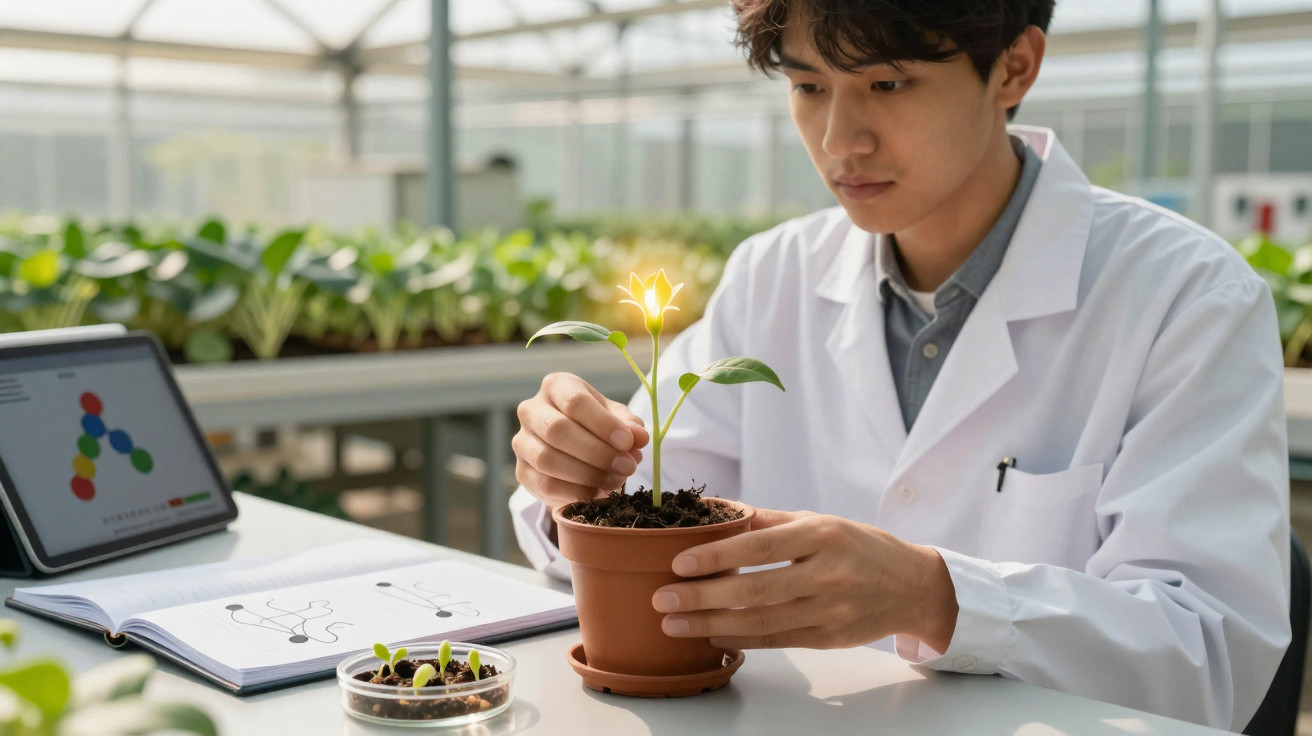
Plants cannot simply move away when conditions turn hostile. From the moment a seed germinates, a plant remains anchored to the same spot for its entire life.
Heat, cold, drought and the turn of the seasons can arrive abruptly. To persist, a plant must be able to grow, pause, or reproduce at precisely the right moment.
New research from the University of Pennsylvania reveals how certain plants strike this balance at the cellular level, using a single signal to drive different outcomes in different tissues.
The work clarifies how plants remain adaptable - and it may point the way to hardier crops as the climate becomes less predictable.
Choosing when to flower
During any growing season, a plant faces a pivotal decision. One strategy is to flower quickly, set seed, and then stop producing new growth. Many crops, including rice, follow this route.
When the main shoot converts into a flower, the plant no longer makes additional leaves or branches. This approach is effective when seasonal patterns remain reliable.
A second strategy is more gradual but offers greater insurance. Species such as Arabidopsis continue to grow while also forming flowers along the sides of the stem. The plant’s tip stays productive, extending growth for weeks or even months. This pattern is known as indeterminate growth.
“\“If the window of optimal conditions shifts during the season, continuous flowering increases the chances that at least some seeds are produced,\” noted study co-author Doris Wagner, a plant biologist.”
For many years, researchers could not explain how one plant could initiate flowering in some locations while suppressing it in others, even though all parts experience the same environmental cues.
Inside the plant’s control tip
The key sits in a minute structure known as the shoot apical meristem. Located at the plant’s very tip, it houses stem cells that sustain ongoing growth. Leaves, stems and flowers all originate from this region.
As daylight lengthens and temperatures climb, plants generate a small protein called florigen, also referred to as FT.
FT travels through the plant and instructs cells to begin flowering. In many species, FT causes the shoot tip itself to become a flower, which halts further growth.
Wagner and her colleagues examined indeterminate plants, where the shoot tip does not undergo this conversion. They found that the tip interprets FT differently from other tissues.
At the shoot tip, a second protein, TFL1, switches on. TFL1 prevents flowering and safeguards the stem cells. As FT increases, TFL1 rises too - but only at the tip - allowing the rest of the plant to flower while keeping the growth centre active.
One plant protein, two roles
The team also investigated a third protein called LEAFY, or LFY. In most parts of the plant, LFY responds to FT by activating genes that promote flowering, leading to flowers forming along the sides of the stem.
At the shoot tip, however, LFY acts unexpectedly. Its levels increase there as well, yet flowering still does not start. Instead, LFY turns on TFL1.
“\“Somewhat counterintuitively, we noticed that LFY at the shoot tip activates TFL1,\” said Wagner. \“And the two form a negative feedback loop.\””
This loop functions much like a thermostat. A strong flowering signal pushes LFY upwards, which then elevates TFL1. TFL1, in turn, drives LFY back down.
Through this repeated adjustment, the shoot tip remains just under the threshold at which flowering would be triggered. The mechanism holds steady even when the weather shifts rapidly.
Built-in protection against mistakes
To examine how robust this control system is, the researchers partnered with mathematical modellers.
Their models indicated that the LFY–TFL1 feedback loop remains stable across a wide range of scenarios. Brief spells of warm temperatures or extended daylight do not incorrectly push the shoot tip into flowering.
“\“It ensures that the shoot tip does not turn into a flower even when cues vary,\” said Tian Huang, a co-author on the study.”
Because the tip continues to grow, the plant can keep producing flowers over an extended period, increasing the likelihood of setting seed when favourable conditions return.
What this means for future crops
These results extend beyond basic plant biology. Climate change is bringing less predictable seasons, more frequent heatwaves, and altered rainfall patterns. Crops that flower only once may be particularly vulnerable under such variability.
By mapping how these proteins work together, scientists may be able to develop crops that maintain growth for longer and better adjust to changing environmental conditions.
“\“A response to climate change shouldn’t be converting more natural land into farmland,\” Wagner says. \“It should be using the land we already farm more efficiently.\””
By taking cues from plants that already balance growth with reproduction, agriculture could become more resilient without expanding the amount of land it uses.


Comments
No comments yet. Be the first to comment!
Leave a Comment