
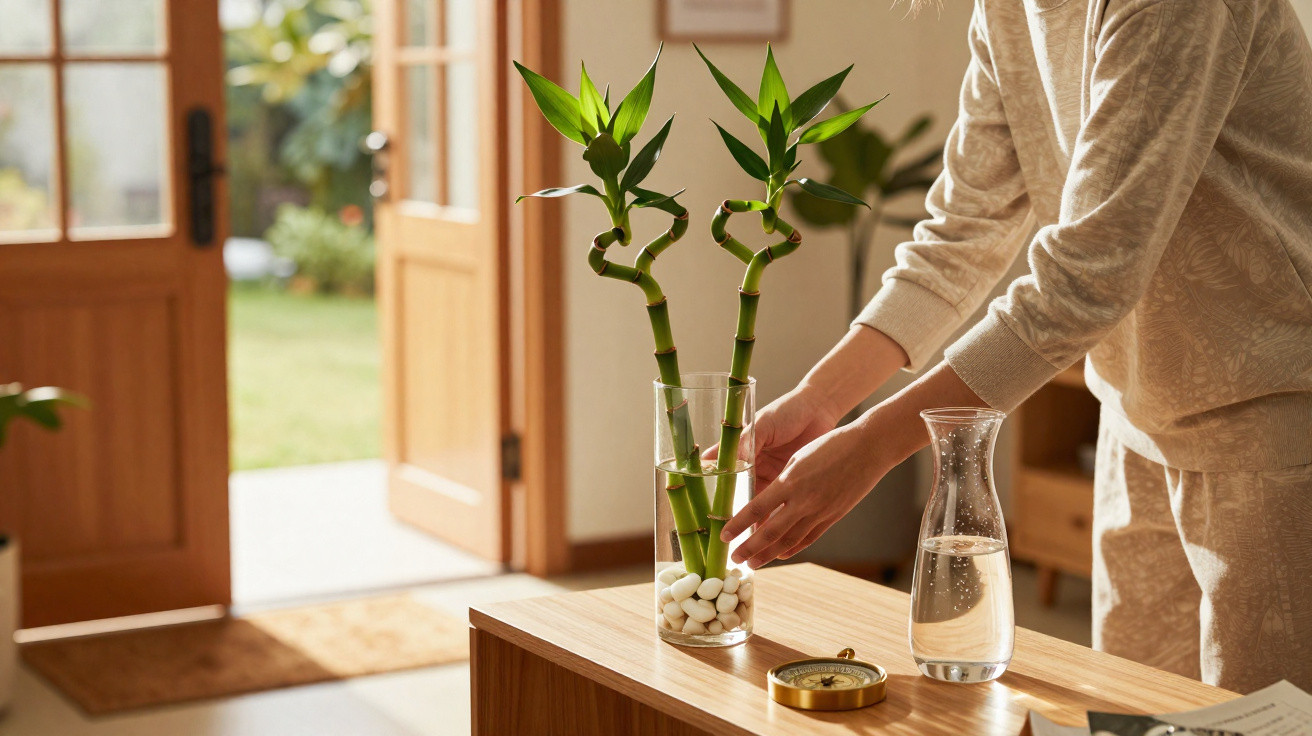
Lucky bamboo is commonly linked with prosperity, vitality and renewal in popular Feng Shui interpretations. Despite its name, it is not a true bamboo: it is Dracaena sanderiana, an ornamental species that can be grown in water and tends to do well indoors where there is bright, indirect light.
Why is lucky bamboo placed near the entrance?
In Feng Shui tradition, the front door is viewed as the main point where energy enters and moves through the home. Keeping a healthy plant close by represents an intention to welcome opportunities, growth and balance-although there is no scientific evidence that its position changes a household’s luck.
- Suggests growth and an ability to adapt;
- Represents a welcoming feel and renewal at the entrance;
- Adds greenery to compact spaces;
- Can be kept in narrow containers;
- Stays green-looking throughout the year.
Is lucky bamboo really a bamboo species?
Dracaena sanderiana belongs to the same genus as other ornamental dracaenas. Its segmented stems resemble bamboo canes, but the two plants differ in botanical classification, growth habits and care requirements.
The common name is largely due to its appearance and its symbolic association with resilience and prosperity. The stems can also be trained into curves and spirals through controlled exposure to light, producing the shaped forms often sold in florists.
What does the number of stems mean in Feng Shui?
The meanings attached to stem counts vary between traditions, retailers and practitioners, and there is no botanical or scientific rule behind them. In the most widespread interpretations, three stems are linked to happiness, five to health, and eight to material growth and prosperity.
- Three stems: happiness, longevity and good luck;
- Five stems: health and balance across areas of life;
- Six stems: opportunities and prosperity;
- Eight stems: growth, abundance and financial success;
- Nine stems: broad good fortune and fulfilment.
How can you place the plant near the door without harming it?
Put the pot in a bright spot but out of strong sun, which can scorch leaves and cause yellowing. It is also best to keep it away from draughts, air-conditioning units and places where the container could be knocked over as people pass.
It can sit beside the door, on a console table, or on a nearby shelf without blocking the entrance. In homes with pets, keep it out of reach, as dracaenas can be toxic to dogs and cats if eaten.
How do you grow lucky bamboo only in water?
Stand the stems in a clean container, using pebbles to hold them steady, and add water so only the roots are covered. Change the water regularly to prevent odours and algae, and wash the container whenever a slippery film appears. Filtered water or tap water left to stand can be helpful if the plant is sensitive to substances in mains water.
Even without soil, the plant may benefit from a very small amount of suitable fertiliser, heavily diluted and used sparingly. Like other plants considered “lucky” in Feng Shui, its most tangible effect is bringing nature indoors and adding decorative value. Keeping it healthy matters more than following a strict placement rule or a specific stem count.
Comments
No comments yet. Be the first to comment!
Leave a Comment