
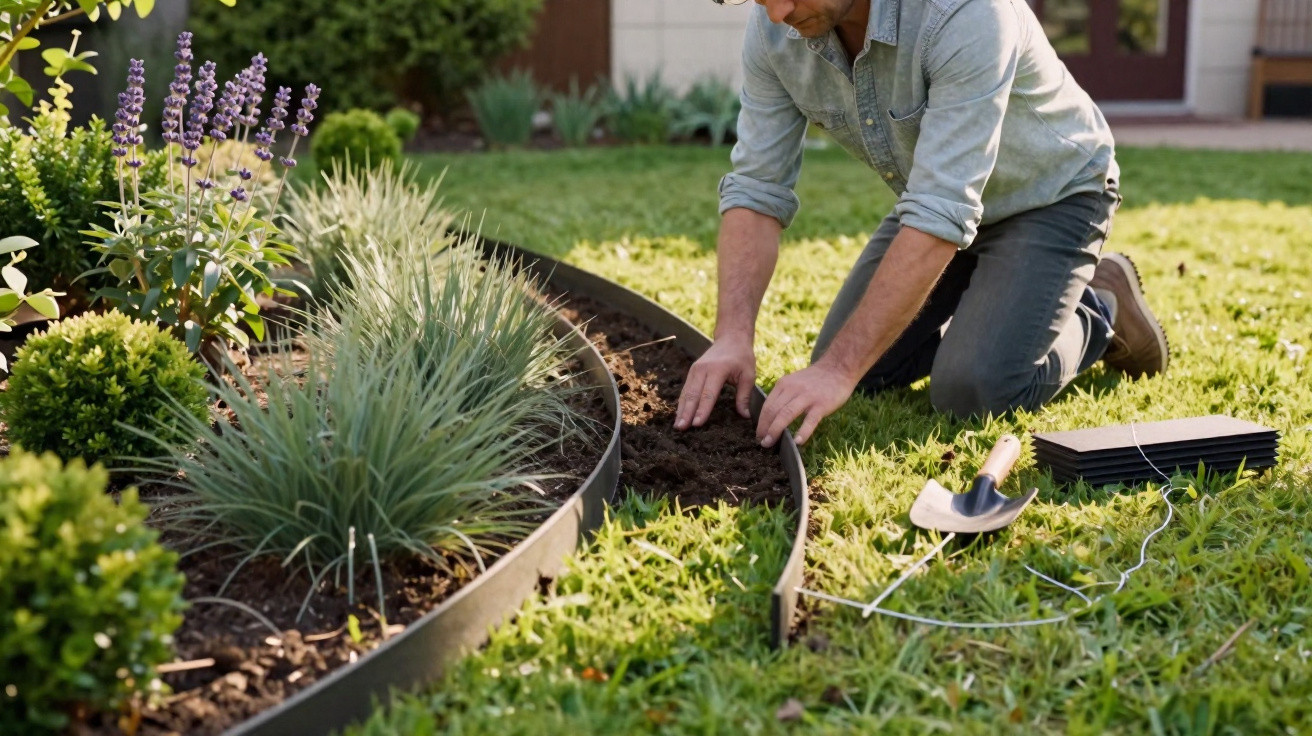
The first time I noticed it, I genuinely assumed my neighbour had brought in a landscape designer. One week, their garden was simply… fine: green, slightly flat, with the usual plastic pots standing in a row beside the fence. By the following week, the entire space seemed richer, gentler and almost cinematic, yet I could not work out what had altered. There were no new plants, costly pergola or stylish furniture. It just felt as though the whole garden had been upgraded.
Then I spotted it: a straightforward, nearly imperceptible detail tracing the edge of every border, tree and path.
It was so subtle that it was almost absent, but it transformed the entire space.
The subtle detail that makes your garden look “designed”
Look closely at any garden that appears costly, whether or not it actually is, and you will quickly notice the same feature: neat edges and defined borders. There is a quiet dividing line between lawn and border, gravel and soil. It gives the garden a frame, rather like a good pair of glasses on a tired face.
This is the garden trick that can improve the whole space immediately: deliberate edging. It is not complex landscaping or a complete redesign. It is simply the choice to ensure that no part of the garden “fades into” another without a crisp, obvious boundary.
Once you have noticed it, you will see it everywhere.
I saw how effective it could be during a viewing that an estate agent invited me to attend. It was an ordinary suburban area, with an average-sized plot and a small semi-detached house. In the photographs, the garden looked as though it belonged in a magazine. People were clicking enthusiastically and requesting viewings before they had even read the listing.
In person, the planting was nothing unusual: hostas, several lavender bushes and a hydrangea that had seen better days. The lawn was patchy, while the furniture came from a budget retailer. Yet every bed was defined with a clean metal edge, each path had a clear border, and the lawn edge was so precise that it appeared to have been drawn with a ruler.
The garden was not more luxurious. It was simply more purposeful.
There is a straightforward reason why this has such an impact. Our eyes respond well to contrast and order. When the line between lawn and soil is blurred, it can look “unfinished” or “messy”, even when the plants themselves are lovely. A crisp edge signals to your brain that someone cares for the space and that it has been planned.
Borders also influence the way you move around the garden. A defined edging line gently guides your feet, outlines a seating area and separates the “wild” elements from the “tamed” ones. This contrast makes untidy planting appear lusher, while the neat areas feel more restful.
It is visual psychology… used with a spade.
How to use garden edging as your secret upgrade
You do not need specialist equipment to begin. A spade, string, some patience and a spare morning can be enough to change the atmosphere of your whole garden. Start by walking around the space and identifying every blurred area: grass spreading into borders, gravel spilling into soil or pots scattered randomly over the lawn.
Choose one boundary and stick to it. You could mark a soft curve around your main flower bed with string or a hose, then cut along the line using a half-moon edger or a straight spade. Lift out the unwanted turf, make the trench a little deeper, and the border will suddenly look considered, as though it had always been planned that way.
Complete one edge properly and you will probably want to tackle the entire garden.
Most people make the same understandable mistakes: they hurry, make the lines too straight or attempt the whole job in one tiring afternoon. The result can look severe, or the edges may collapse after a single shower because the soil was not firmly packed or shaped. The trick isn’t speed, it’s rhythm.
Tackle small sections at a time. Frequently stand back to assess the result. Allow the lines to flow with the natural shape of the garden rather than imposing perfect geometry beside a slightly uneven fence. And yes, that smart finish will need refreshing. Honestly, nobody does this every day.
Once or twice each season? That is manageable.
For edging that will endure for years, understated materials are especially useful. Flexible metal strips, recycled plastic edging and bricks set half into the ground on their sides can all maintain a clean line without drawing attention to themselves. One gardener told me something that has stayed with me:
“People think the plants are what makes a garden look professional,” she said. “But nine times out of ten, it’s the lines. Get the lines right, and even cheap plants look expensive.”
- Begin with the most prominent spot: the border visible from your kitchen window.
- Select one edging style and use it repeatedly instead of combining five different approaches.
- Make curves broad and gentle rather than fussy or uneven.
- Tidy the edges at least twice yearly, particularly after heavy rain.
- Use edging to highlight a focal point, such as a tree, bench or small water feature.
When one small line quietly changes how you feel at home
The amusing part of garden edging is that nobody tends to praise it outright. Friends may say, “Wow, your garden looks so calm this year,” or “Did you get new plants?” even if you have not. You may only have changed the line between the lawn and the borders, but the mood of the entire garden has shifted.
That is the understated strength of this approach. It does not demand attention; it simply pulls the whole scene together, much like a good edit can improve a messy video. All at once, there is a beginning, middle and end. Your gaze moves effortlessly, your shoulders relax and you feel like remaining outdoors a little longer.
We have all experienced a space that feels wrong without being able to say why. Quite often, it is simply lacking a line.
| Key point | Detail | Value for the reader |
|---|---|---|
| Create clear borders | Mark where lawn, beds and paths start and finish | Makes the whole garden look “designed” without major expense |
| Use simple edging methods | Spade-cut edges or understated metal/plastic strips | A rapid visual improvement that lasts through the seasons |
| Work in small, visible sections | Start in the area you see most often and repeat the same style | Makes the task less overwhelming and produces quick, encouraging results |
FAQ:
- Question 1 What’s the easiest edging method for a beginner?
- Question 2 How often do I need to refresh my garden edges?
- Question 3 Do I really need to buy metal or plastic edging?
- Question 4 Can I use edging in a small or urban garden?
- Question 5 What if my lawn is in bad shape - should I still edge it?


Comments
No comments yet. Be the first to comment!
Leave a Comment