
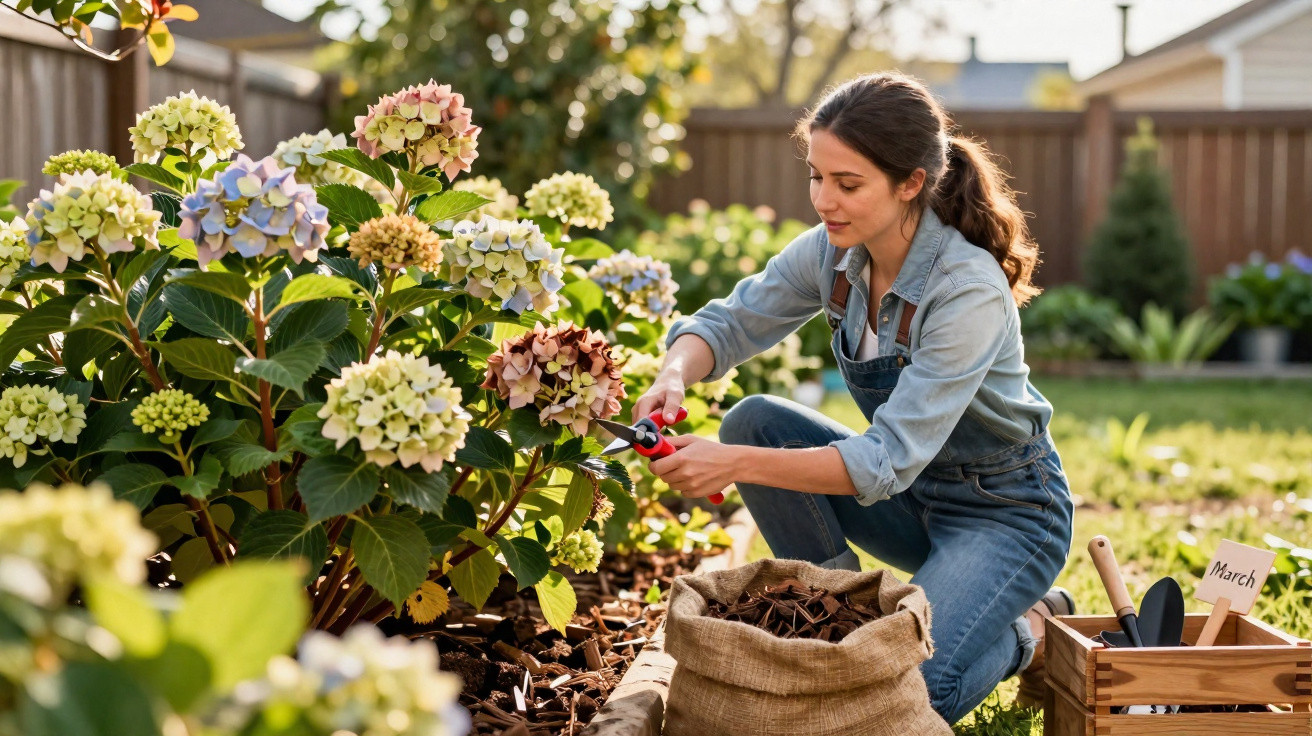
Anyone who loves hydrangeas will know the frustration: catalogues show enormous globes of flowers, while the shrubs in your own garden manage only a handful of blooms. British television gardener Monty Don says the cause is less often fertiliser than incorrect pruning – specifically, a small and frequently overlooked task in March.
Why March determines hydrangea flowers
The much-loved mophead and lacecap hydrangeas (Hydrangea macrophylla) form their flower buds during the previous year. In other words, the flowers for the following summer develop on what is known as old wood: shoots that grew in the preceding summer.
If those shoots are cut back severely in winter or early spring, the very buds intended to produce flowers in June, July and August are removed. The result is a healthy-looking shrub with plenty of foliage, but few, if any, blooms.
Monty Don has long pointed out that gardeners often confuse removing spent flowers with pruning properly. Many amateur gardeners cut off too much with the best intentions, unknowingly spoiling their flowering season.
The crucial point: for hydrangeas that flower before summer, timing matters far more than expensive fertiliser.
Gardening guides therefore describe March as a “critical window”: buds are already swelling, yet late frosts may still return. At this stage, it is decided whether the plant keeps its buds or whether they are accidentally cut away.
The one cut Monty Don always makes in March
Rather than pruning hard, Monty Don favours highly selective, almost delicate deadheading. The aim is not to reduce the plant’s size, but to tidy it gently.
How the hydrangea “March trick” works
Monty Don’s method is easy to remember and takes just a few minutes for each shrub:
- Wait until late March: Ideally, wait until the last severe frosts have passed and the hydrangea is beginning to grow.
- Find the faded flowerheads: The dry, papery flower balls from the previous year are usually at the very top of the shoots.
- Cut only just below them: Two strong, opposite buds are generally positioned directly beneath the old flower. Make the cut a few millimetres above this healthy pair of buds.
- Remove winter and frost damage: Anything that is clearly frost-damaged, blackened or completely dried out can also be cut back to living wood – but only where no plump flower buds are present.
The reasoning is straightforward: the shrub retains its fully developed shoots and every bud that can carry flowers, while dead material and unattractive remnants are removed. In spring, the strong buds beneath the cut produce new shoots – with the sought-after flower balls appearing at their tips in summer.
Cut a few centimetres too much in the wrong place, and an entire summer of flowers is lost.
One garden writer who tried the technique on her own shrubs reported that her hydrangeas flowered far more generously after a careful trim in late March than they had in earlier years, when she had cut them back heavily during winter. The key difference was not so much the surrounding care, but the precise timing and cutting height.
Common hydrangea pruning mistakes
Through lack of knowledge, many amateur gardeners repeatedly make the same errors. Here are the main pitfalls:
- A hard cut in January or February: Fearing the shrubs will become bare, gardeners cut them down to knee height. For macrophylla types, this almost always means no flowers.
- Confusing them with other hydrangea species: Panicle and smooth hydrangeas (Hydrangea paniculata, Hydrangea arborescens) flower on new wood and tolerate much harder pruning. Applying that experience to mophead hydrangeas costs them their blooms.
- Cutting too late after growth begins: Anyone who cuts back heavily in April or May is already removing actively growing, flower-bearing shoots.
To make the principle easier to remember, Monty Don has coined a simple rule: if an ornamental plant produces its flowers before summer, it should generally be approached carefully with secateurs. This is particularly true of classic mophead hydrangeas.
Monty Don’s second secret: winter mulch protection
For Monty Don, a perfect hydrangea summer depends not only on careful March pruning, but also on a midwinter routine. In January, when borders look bare, he reaches for the wheelbarrow and applies mulch generously.
He recommends well-rotted organic materials such as:
- mushroom compost
- mature garden compost
- bark mulch, such as fine pine bark
His principle is to mulch less often but apply a deep layer when doing so. He advises at least 5 cm, and preferably up to 10 cm, of mulch around established perennials and shrubs.
A deeply applied layer of mulch acts like a blanket: it protects roots, retains water and releases nutrients gradually.
This is especially useful for hydrangeas, which can react sensitively to drought and heat in hot summers. Soil moisture remains more even, temperature fluctuations are reduced, and soil life is encouraged. All of this supports vigorous new growth and larger flowerheads.
How often should you mulch?
Monty Don takes an interesting approach: rather than spreading only a thin covering everywhere each year, he recommends thoroughly mulching just part of the garden every other year. A mulch layer that is too thin quickly breaks down, lets light through and cannot deliver its full benefit.
| Mulch depth | Effect on hydrangeas |
|---|---|
| 1–2 cm | Visually pleasing, but offers hardly any protection or nutrient benefit |
| 5 cm | Noticeable protection against drying out and heat, with a small nutrient boost |
| 8–10 cm | Optimum protection, with a clear improvement in soil structure and root development |
How to tell whether your hydrangea was pruned “incorrectly”
Whether the secateurs were used too aggressively in the previous year is usually apparent by early summer. Typical warning signs include:
- Plenty of long, vigorous shoots, but few or no developing buds at the shoot tips
- The shrub appears “empty” in the middle, with its few flowers scattered mainly around the outside
- It was cut back heavily in winter or early spring the year before
If this sounds familiar, there is no need to despair. Mophead hydrangeas are resilient. With gentle March pruning in future – removing only the old blooms directly above a healthy pair of buds – the shrub will usually recover noticeably within one to two years.
Practical measures for stronger flowering
Alongside correct pruning and winter protection with mulch, a few simple adjustments can further improve results:
- Check the position: Partial shade is ideal. Leaves and flowers suffer in intense midday sun, while deep shade produces weak growth.
- Water consistently: Hydrangeas need plenty of water, but do not tolerate waterlogging. Watering deeply once is better than lightly spraying them every day.
- Fertilise moderately: A balanced hydrangea feed that is relatively low in nitrogen, applied in spring, is usually sufficient. Excess nitrogen encourages leaves rather than flowers.
Many gardeners are also puzzled by changing flower colours. For blue-flowering varieties, the shade depends greatly on the soil’s pH level and aluminium content. Slightly acidic soil, along with specialist blue hydrangea fertilisers or alum products, helps maintain blue tones, whereas neutral to lime-rich soils encourage pink shades.
Gardeners who take all these factors into account will rarely need to look for “miracle products”. Monty Don’s practical but highly effective approach is simple: mulch deeply in winter, prune carefully in March, and let the hydrangea grow undisturbed. These unremarkable routines are exactly what can turn many “problem shrubs” into the abundant clouds of flowers seen in garden catalogues.


Comments
No comments yet. Be the first to comment!
Leave a Comment