
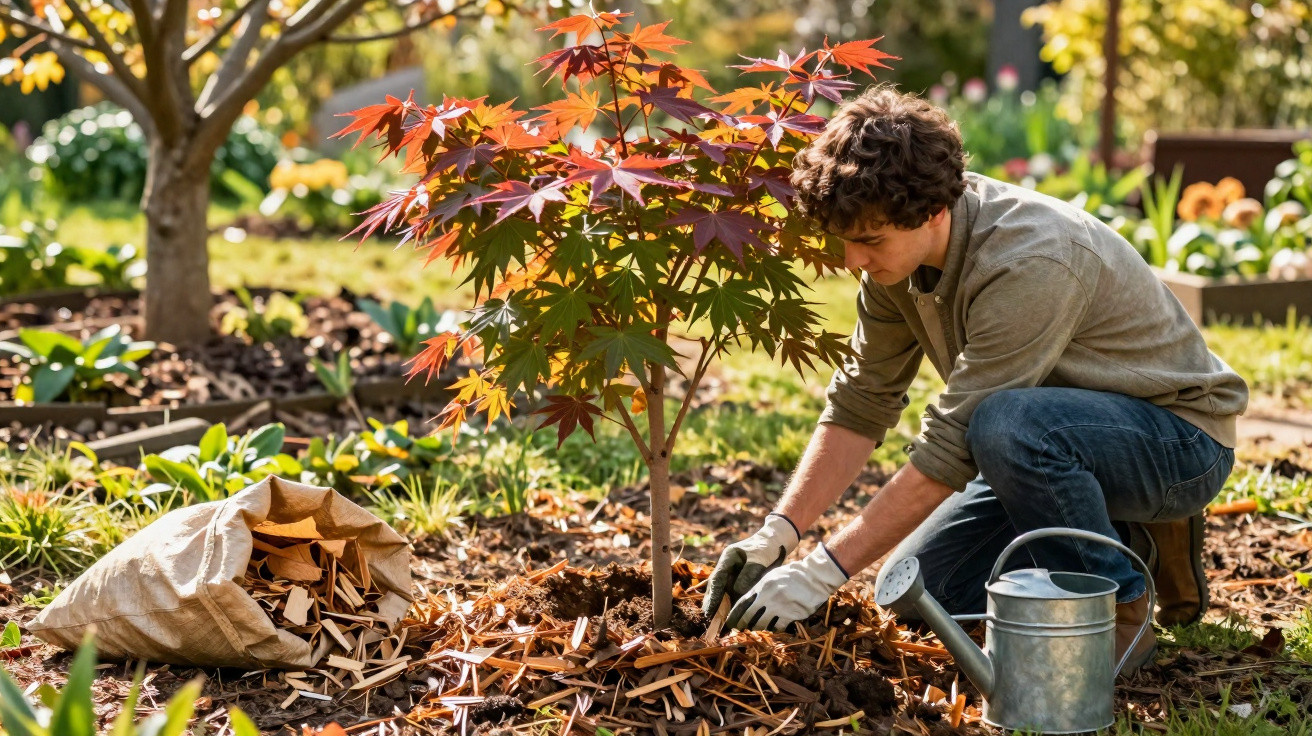
Many Japanese maples appear to struggle along – yet one simple task in March can transform the entire season.
Scorched leaf edges, dried-out shoot tips and hardly any fresh growth: this is a familiar picture for many amateur gardeners growing a beloved Japanese maple. It is especially frustrating because these trees are regarded as elegant garden focal points and are often expensive to buy. In early spring, an uncomplicated and barely noticeable measure on the soil around the trunk can make a remarkable difference to tree health.
Why Japanese maples react so sensitively in spring
Japanese maples (Acer palmatum) have a very shallow root system. Most of their fine roots sit immediately beneath the soil surface. This is precisely where spring temperatures fluctuate dramatically: overnight snow and ground frost alternate with the first mild days. Such changes put the sensitive roots under considerable stress.
There is another issue: bare soil dries out rapidly, while heavy ground can leave water sitting after rainfall. Japanese maples dislike both conditions intensely. The usual symptoms include:
- Leaf margins turn brown and look “scorched”
- Fine shoot tips dry out
- The tree produces only weak new growth
- The canopy remains sparse and looks “thin”
“Keeping the roots stable – neither freezing cold nor baking hot, neither bone-dry nor soaking wet – directly encourages denser foliage and more vigorous shoots.”
The key March task: applying a protective mulch layer
Horticultural professionals recommend one clear priority in early spring: spread a suitable layer of organic material around the base of the tree. This unobtrusive “carpet” often determines whether the tree declines or visibly thrives.
This soil protection has three effects:
- It insulates against both cold and heat
- It prevents severe drying while reducing waterlogging
- It releases nutrients gradually over many months
This gives the Japanese maple conditions resembling its natural setting in open woodland: a loose, mildly acidic, humus-rich soil that never dries out completely but is not waterlogged either.
Step by step: how to mulch your Japanese maple correctly
1. Choose the right time in March
Start as soon as the soil has thawed and is reasonably workable. Do not delay too long, as the first sunny days can dry the topsoil very quickly.
2. Prepare the area
Always work beneath the drip line of the canopy – the area where rainwater falls from the crown to the ground. This circle contains most of the fine roots.
- Carefully pull weeds out by hand; do not use a hoe
- Loosen the soil only very lightly, to a depth of no more than 2–3 centimetres
- Avoid damaging roots and do not use heavy tools
3. Keep the important area around the trunk clear
The base of the trunk, the slightly swollen point just above ground level, must remain visible. It forms the transition between root and trunk and must not be permanently enclosed in damp material.
“Leaving around ten centimetres between the mulch and the trunk prevents rot and fungal attack in this sensitive trunk area.”
4. Apply the right mulch layer
Japanese maples benefit from materials that recreate a woodland environment. Suitable options include:
- Composted pine bark
- Mature garden compost spread in a thin layer
- Well-rotted oak or beech leaves
- Finely shredded, well-seasoned woody prunings
In a border, the layer should be 5–8 centimetres deep. Too little has barely any effect, while an overly thick layer of dense, heavy material can impair soil aeration.
The following are particularly unsuitable:
- Dark stones or gravel in full sun, as they heat the soil
- Plastic sheeting or landscape fabric placed directly on the ground, as these prevent air exchange
- Thick heaps of freshly applied grass clippings, which rot easily and generate heat
Watering correctly: how mulch changes water requirements
A good mulch layer greatly reduces water evaporation from the soil. As a result, you will need to water less often, but each watering must be thorough enough to reach the roots.
Watering a Japanese maple in a garden border
Under normal weather conditions, experts advise giving the Japanese maple a deep watering about twice a week. During dry spells, this can be increased to three or four times weekly. More important than frequency is ensuring that water does not merely dampen the top few centimetres.
“It is better to water deeply and less often than to sprinkle a few watering cans across the surface each day – mulch helps retain these deeper waterings.”
Japanese maples in pots: special rules
Japanese maples in containers are even more sensitive because their root space is limited and the pot heats up more readily. A thin mulch layer is useful here too, but it should be only around 3–5 centimetres deep so that the root ball still receives sufficient air.
Important points for pots:
- Always empty saucers after watering so that no water remains standing
- The compost may dry slightly, but it must never dry out completely
- Towards the end of summer, reduce watering quantities slightly without allowing the tree to become thirsty
This slightly restrained watering in late summer helps the tree prepare for autumn colour. Leaves often develop more intense colour when the tree is neither under constant stress nor exposed to continual rain.
Common mistakes that weaken Japanese maples
Many problems stem from well-intentioned but unsuitable care practices. Three recurring mistakes are frequently seen in garden centres and online forums:
- A site that is too sunny and windy: Full midday sun combined with wind quickly dries both foliage and soil. A bright, slightly sheltered spot with morning or evening sun is preferable.
- Permanently wet roots: Heavy soil without drainage, or a pot standing in a saucer full of water, can rapidly cause root rot.
- Too much fertiliser at once: Strongly dosed mineral fertilisers scorch fine roots, and the leaves respond with brown edges.
The right soil covering in March reduces several of these risks at once by creating a more balanced climate around the roots.
Why soil beneath a Japanese maple should resemble forest soil
In the wild, Japanese maples generally grow in open mountain forests. Every year, leaves, small twigs and other plant debris fall onto the ground, forming a loose humus layer. This layer:
- Keeps the soil permanently crumbly and well aerated
- Retains water like a sponge
- Gradually supplies nutrients
- Protects roots from sudden temperature changes
Targeted mulching in the garden replicates this natural structure. Rather than removing every leaf in autumn, some can be collected, roughly shredded and later used around the root area – provided they are well rotted so that mould does not develop.
Additional care steps that support the March treatment
If you are already tending to the tree in March, there are several other points worth checking. They take only a few minutes, yet can significantly reinforce the effect of soil protection.
- Remove broken or clearly dead branches with a clean cut
- Inspect container-grown maples: if the root ball is completely filled with roots, repotting will soon be needed
- Check for bark cracks, fungal marks or pests so that you can act early
For container plants in particular, inspect the growing medium. If it is heavily compacted or made mainly from dense garden soil, even the best mulch layer will have only a limited effect. A loose mix with a high humus content, some mineral aggregate such as pumice or lava grit, and good drainage noticeably supports measures around the root area.
Conclusion without clichés: one small March task, many strong months of growth
Anyone who gives their Japanese maple targeted care in March is often rewarded in the same year: stronger shoots, a denser leaf canopy and fewer scorched leaf edges. The combination of the right mulch layer, adjusted watering and a reasonably suitable position achieves more than expensive specialist fertilisers or drastic pruning.
At its core, the aim is to protect the sensitive shallow roots and provide conditions similar to those the tree is genetically accustomed to. One morning’s work in early spring is usually enough to establish this foundation – after that, you can enjoy the delicate, colourful leaves of your Japanese maple much more calmly.

Comments
No comments yet. Be the first to comment!
Leave a Comment