
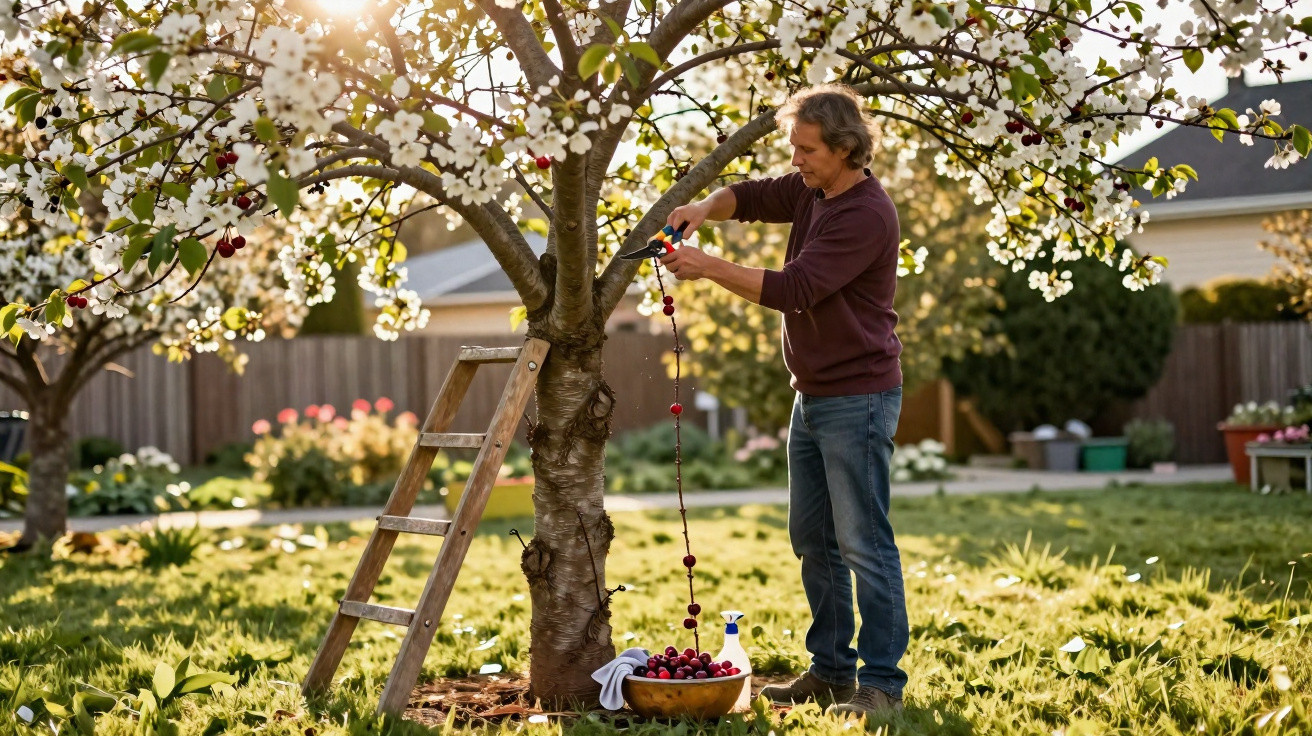
Plenty of keen gardeners know the frustration: the cherry tree looks vigorous, throws out strong new growth, yet when harvest time comes there are only a few miserable fruits dotted around the crown. That was exactly the position one garden owner found himself in-until an older neighbour stood beside the tree and showed him, on the spot, where the secateurs really needed to go. Within a single season, the “ornamental tree with no benefit” turned into a genuine fruit provider.
When a cherry tree looks healthy but barely produces fruit
A dense cherry tree covered in leaves can look impressive at first glance, and many people take that as proof it’s thriving. Often, that apparent health is the issue: the tree is spending its energy on wood and foliage rather than blossom and fruit.
Too much new wood, too few flower buds
Cherry trees need balance between shoots, leaves and fruiting wood. When a tree churns out lots of fresh branches, most of its resources go into those young, vigorous shoots. The flower buds that later become cherries don’t develop in the same way.
"A cherry tree can look absolutely top fit-and still deliver almost no harvest if it puts its energy into the wrong wood."
The neighbour in this case saw it immediately: too many strong, upright shoots, hardly any light reaching the interior of the crown, and plenty of branches rubbing against one another-classic signs of a tree that’s become “overgrown” rather than “fruitful”.
No light, no generous cherry harvest
Light is the second major key. In a mass of foliage, the centre of the crown sits in shade-yet that’s exactly where many potential fruiting shoots are located. If little sunshine reaches them, the cherry tree forms far fewer blossoms and, as a result, far fewer fruits.
This is particularly obvious in older trees that have never been pruned, or only rarely. Inside, you often find a real tangle of thin, long branches. It may look “nicely bushy”, but it blocks light, air and warmth-and it can also make the tree more prone to fungal diseases.
The crucial move: remove energy-draining water shoots
The neighbour’s most important tip centred on one specific type of growth that many non-experts don’t even recognise: the notorious water shoots (often referred to by professionals as “gourmand shoots” or “gourmands”).
How to spot these useless energy thieves
Water shoots are easy to identify once you know what to look for:
- They grow almost straight upwards.
- They usually emerge from thicker, older branches or directly from the trunk.
- Their bark often looks smoother and paler than the surrounding wood.
- They grow extremely fast and are often much longer than other shoots.
These shoots can look strong and healthy, but they produce little or no fruit. They simply consume energy that the fruiting wood needs.
"If you remove water shoots consistently, you direct the tree’s strength back into blossom and cherries."
Prune correctly: cut close to the base with sharp secateurs
The neighbour reached straight for sharp pruning shears. His advice was to cut these upright shoots as close as possible to their point of origin, without leaving stubs behind. If small “hooks” remain, the tree often responds by shooting again from the same place.
Well-sharpened, clean secateurs-or loppers for thicker growth-create smooth cuts that heal quickly. Anyone with multiple trees should wipe the blades with alcohol between trees to avoid transferring fungal spores or bacteria from one to the next.
Thin the crown: remove rubbing and crossing branches
In the next step, the neighbour pointed out that it wasn’t only the upright shoots causing trouble. Inside the crown there were numerous branches that crossed or scraped against each other.
Rubbing branches are gateways for disease
When two branches repeatedly rub together in the wind, the bark gets damaged. That opens the door for fungi and bacteria. The tree then has to spend energy sealing wounds instead of putting effort into fruit formation.
A simple rule of thumb: if two branches touch or cross, one of them has to go. Typically, you remove the weaker branch, or the one that grows inwards into the crown rather than outwards. That opens the canopy and lets light back into the middle of the tree.
A light shaft for sun and bees
After thinning, the interior of the crown develops something like a “funnel of light”. Sunbeams can reach the fruiting wood again. At the same time, bees and other pollinators can reach the inner blossoms more easily.
"A well-lit crown warms up faster, dries out better after rain, and usually produces noticeably more cherries."
With a handful of deliberate cuts, a dark, dense ball can become an airy, clearly structured fruit tree again, with distinct scaffold branches.
The right timing: when cherry trees should be pruned
Cherry trees are more sensitive to heavy pruning than apples or pears, so timing matters a great deal.
Overly harsh winter pruning can do damage
Strong cutbacks during the cold season can lead to gummosis in stone fruit: the tree exudes a sticky, amber-coloured sap that weakens it. Minor corrections in winter are possible, but major interventions are best avoided.
For that reason, many fruit growers prefer pruning immediately after harvest. The tree is still active, wounds close quickly, and by late summer it tends to put less energy into producing new wood.
Tool hygiene and wound care
In this example, the neighbour placed a strong emphasis on clean tools. Before each cut he wiped the blades with alcohol. For thicker branches, he also recommended-if needed-brushing on a thin layer of a natural, clay-based wound sealant so fungi and moisture have less chance to take hold.
| Step | Aim |
|---|---|
| Remove water shoots | Redirect energy back into fruiting wood |
| Cut out crossing branches | Prevent damage and reduce disease risk |
| Thin the crown | Bring light, air and warmth into the centre |
| Use clean tools | Avoid infections at pruning cuts |
The reward: an explosion of blossom and bowls full of fruit
The following spring made the impact obvious. The previously “quiet” tree suddenly stood thick with white blossom. Many buds that had looked unremarkable before turned into rich clusters of flowers.
With clear access for bees and sunshine warming every part of the crown, far more cherries set than in previous years. For the first time, the owner saw branches bending under the weight of the crop.
"A few well-considered cuts can turn an apparently ‘infertile’ cherry tree into the garden’s quiet star."
Anyone who repeats this approach regularly-but moderately-can keep a cherry tree vigorous and productive for the long term. Making small adjustments each year is far better than carrying out one drastic renovation every ten years.
Practical extra tips for hobby gardeners
How often should you reach for the secateurs?
A yearly check of the crown is often enough. If, in late summer or early autumn after harvest, you shorten water shoots, remove dead twigs and take out 1–2 crossing branches, the tree usually stays balanced over time.
Young trees need formative pruning first so they develop strong scaffold branches. Later, a routine maintenance prune is sufficient, focused mainly on thinning and removing water shoots.
Common mistakes when pruning a cherry tree
- Pruning too late-or not at all-so the crown becomes old, congested and tangled.
- Cutting back too hard in one go, prompting the tree to produce even more water shoots.
- Leaving stubs behind; these “pegs” often become sites for fungal infection and weak regrowth.
- Using blunt tools, which crush the wood and slow healing.
If you’re unsure, it can help to practise on a less important branch first. Looking up into the crown from below is useful: the goal is a clear structure with a few well-spaced main branches and plenty of light between them.
A well-managed cherry tree can deliver reliable harvests for decades. The mix of targeted pruning, clean tools, correct timing and a little patience can transform even apparently hopeless candidates. That was exactly the lesson in the neighbour’s demonstration: sometimes an afternoon with ladder and secateurs is all it takes for a “green show-off” to finally become the garden’s sweet attraction.


Comments
No comments yet. Be the first to comment!
Leave a Comment