
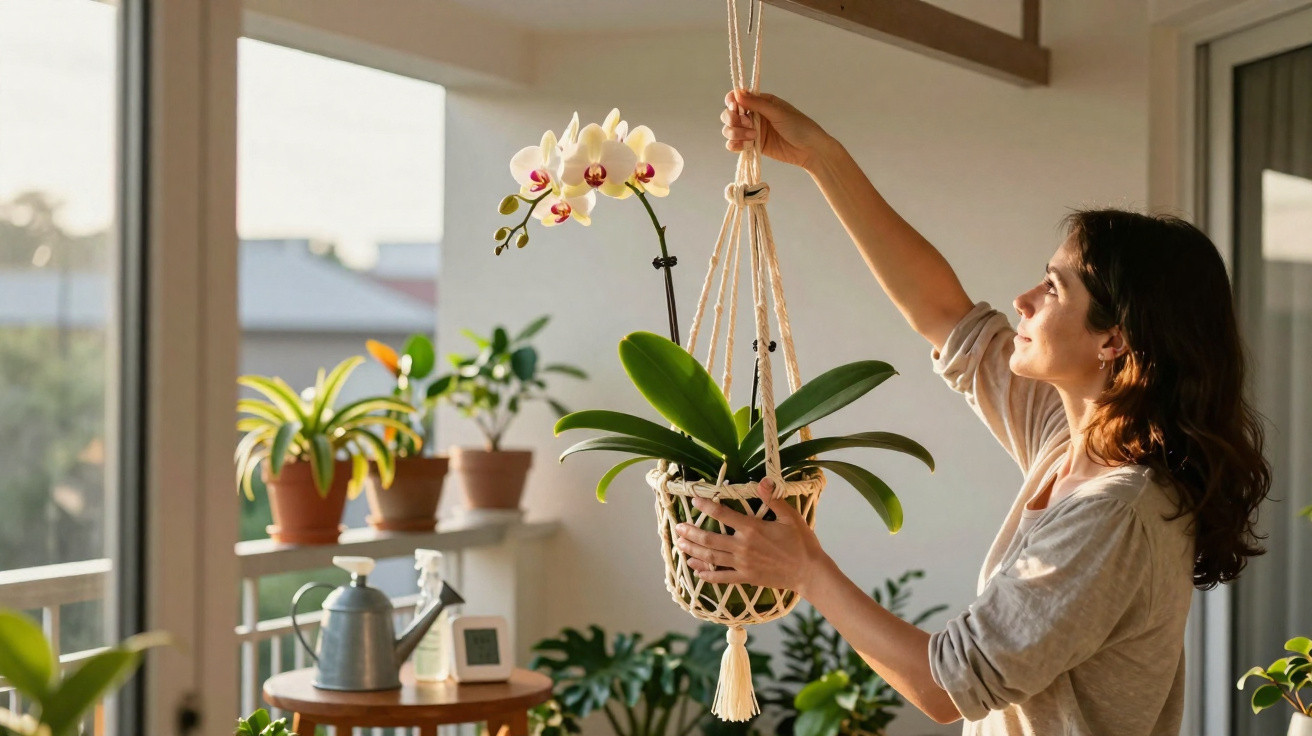
A simple change of location can transform things completely.
In countless living rooms, you’ll find magnificent orchids that never show colour again after their first flowering. Their owners water a bit more, then a bit less, buy fertiliser, read guides - and eventually blame the plant. Yet the issue is often not poor care at all, but something many people overlook: where the plant is kept indoors - and, in summer, even outdoors.
Why the windowsill quietly holds many orchids back
Germany’s most common house orchid is the Phalaenopsis. It comes from tropical forests, where it grows as an epiphyte, clinging to trees. There it experiences warm days, cooler nights, high humidity and plenty of filtered light - none of which resembles a constantly heated living room with dry air from radiators.
On a typical windowsill, this is what usually happens: the temperature stays at roughly 20 °C day and night, the air is dry above a radiator, and the light is either too weak or too harsh. The plant survives and produces green leaves, but it does not receive the cues it needs to form a new flower spike.
“Orchids need a temperature difference between day and night - otherwise you’ll get leaf growth instead of a display of flowers.”
For Phalaenopsis, a rough guideline is:
- Daytime: 18 to 22 °C
- Night-time: 12 to 15 °C
- Bright light, but no blazing midday sun
- High humidity, not dry air from heating
If these values remain almost unchanged all year, the plant never gets the “starting gun” to set buds again. This is exactly where a method comes in that a Scandinavian landscape designer has used successfully for years - by using a spot few hobby gardeners consider.
The unusual spot: put the orchid outdoors in a hanging basket in summer
In summer, the expert moves her orchids outside into a hanging basket. Not into full sun, not into driving rain, but into a bright, airy position in dappled shade. There, the plant finally experiences what it is built for: shifting temperatures, naturally moist air, and real day–night rhythms.
The approach is straightforward: the pots stay exactly as they are and are simply placed into a hanging basket. The basket is hung high enough that slugs cannot reach it and splashes from the ground do not chill the roots. An ideal location is under a tree, beneath a balcony canopy, or under a pergola, where light arrives filtered and rain does not hammer straight into the pot.
“The combination of moist outdoor air, gentle temperature fluctuations and natural daylight triggers the flowering impulse in many orchids.”
In temperate climates, a suitable period is roughly from early June to the end of August. As soon as nights become noticeably cooler, the plant goes back indoors. By then it has often already started one or more new flower spikes, which later open in the living room.
How to make the summer move work, step by step
- Wait until the weather is reliably warm: no nights below 12 °C, no risk of frost.
- Choose the right basket: a hanging basket in which the existing pots can simply be set.
- Pick the position: dappled shade, no direct midday sun, sheltered from strong winds.
- Acclimatise it to outdoors gradually: for the first few days, put it out for only a few hours, then leave it out full time.
- Watch the rain: avoid prolonged heavy rain and prevent waterlogging in the pot.
If you don’t have a garden, a covered balcony, a loggia, or a bright courtyard area can work just as well. The key is that the plant is truly outside in the open air - not behind glass, which blocks air movement and the naturally higher humidity.
Optimal conditions indoors: the right place for the rest of the year
Once back indoors, the orchid still needs a position that echoes its tropical origins without stressing it with heat. A bright east-facing windowsill is often ideal. Morning sun is usually gentle enough not to scorch the leaves, while still providing plenty of light.
What matters most is a room that cools down a little at night. Good options include:
- a bedroom that is not kept heavily heated all the time
- a bright, well-ventilated hallway
- an unheated or lightly heated conservatory/veranda that stays frost-free
- a bathroom with a window and regular ventilation, but without constant dampness
During the day, a temperature of around 20 °C is fine; at night it can be a few degrees lower. That mild difference supports the plant in forming new buds. Brief, wide-open ventilation helps prevent mould and can also raise humidity slightly.
Watering so you get blooms, not rot
Alongside location, the amount of water plays a crucial role. Phalaenopsis grow in a special bark-based medium, not standard potting compost. This medium dries out more quickly - and that is intentional.
- Water by weight: lift the pot. If it feels very light, it’s time to water; if it still feels heavy, wait.
- No standing water: pour away any water that collects in the outer pot after a few minutes.
- Use lukewarm water: cold tap water can shock the roots.
- Let it dry a little between waterings: roots need air, otherwise they rot.
Fertiliser in a low dose can help, but it is rarely the real key to flowering. Without the right location, any feeding regime achieves very little.
How to tell the new strategy is working
After a summer in a hanging basket - or another airy outdoor spot - many orchids show the first signs of change within a few weeks. Fresh, strong leaves emerge, aerial roots look vigorous, and at some point a long, narrow shoot appears from the side of the plant’s centre - that is the new flower spike.
If you spot this shoot early, you can support it with a stake and tie it in gently. That way the flowers later grow neatly upwards and the spike won’t snap. Many plants respond with clearly larger flower spikes, or even multiple spikes, compared with the previous year.
If the orchid still doesn’t flower after moving it
If flowering still fails to appear despite the outdoor summer, it’s worth checking a few other factors:
- Age of the plant: very young orchids flower less often and need time to build strength.
- Condition of the roots: brown, mushy roots in a transparent pot indicate rot - repotting is often the only solution.
- Lack of light: dark corners in the living room are not enough, especially in winter.
- Draughts: constant draughts from a tilted window can cause buds to drop.
Working through these points one by one and making adjustments significantly increases the chance that the plant switches back into flowering mode.
What’s behind the success of the “unusual place”
From a horticultural perspective, the success of spending summer outdoors makes perfect sense. In the native regions of Phalaenopsis, conditions change subtly all the time: clouds pass in front of the sun, a warm shower moves through, and nights cool down. These small fluctuations are not stressful for the plants; they are normal - and often the trigger for new flowering cycles.
Modern homes, by contrast, tend to offer an artificially stable climate. That feels comfortable for people, but for many plants it is simply “too uniform”. The unusual outdoor position brings back that natural rise and fall, without exposing the orchid to extremes.
If you feel unsure, start by hanging just one plant outside and observing how it responds. After one season, many hobby growers notice that the same principle can also work for other types with similar needs, such as certain Dendrobium orchids or bromeliads.
Over the long term, this style of growing often produces sturdier, more resilient plants. They react less sensitively to short-term care mistakes and usually develop stronger root systems. The annual shift between a bright indoor spot and a sheltered outdoor position brings structure to care - and turns the “stubborn diva” on the windowsill back into a spectacular flowering houseplant.
Comments
No comments yet. Be the first to comment!
Leave a Comment